
British film Fuze sparks debate over Istanbul’s yellow-tinted portrayal
By News Centre
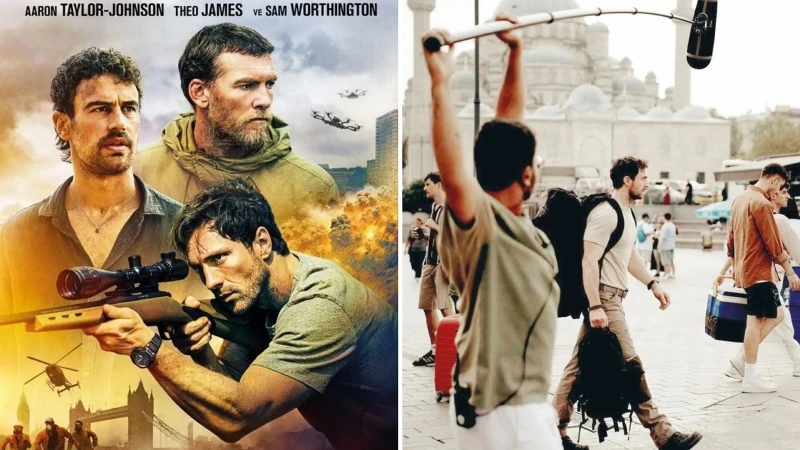
The British-made film “Fuze” has come under scrutiny due to its Istanbul scenes, where the use of a heavy “yellow filter” has sparked debate. With the film set to be released in cinemas tomorrow, many viewers have taken to social media in recent days, arguing that the production fails to present Istanbul in a realistic way. Following a press screening held yesterday, critics noted that while the action sequences are visually intense and the yellow tint is applied throughout the film, the Istanbul scenes in particular reflect an unmistakable orientalist gaze.
In cinema, color grading is often used not only for aesthetic purposes but also as a narrative tool to define geography and mood. Blue and cold tones are typically associated with Europe, symbolizing order and modernity, while warm yellow tones are frequently used to depict regions such as the Middle East as chaotic or unstable. Hollywood has long relied on this visual language, often portraying the Middle East, sometimes broadly including Türkiye, as “ancient,” “exotic,” or “dangerous.” In some productions, this convention continues to persist.
Directed by David Mackenzie and starring internationally known actors Theo James and Aaron Taylor-Johnson, Fuze opens in central London, where an unexploded World War II bomb is discovered at a busy construction site. As chaos unfolds, the effort to neutralize the threat evolves into a tense narrative filled with deception, hidden actors, and high-stakes action, maintaining a fast-paced cinematic rhythm.
In the film’s final sequences, the camera shifts to Istanbul’s Grand Bazaar. Although the heavy yellow filter remains largely unchanged, it becomes particularly conspicuous in these scenes. The characters are first shown in the streets of Eminönü, then in a dimly lit setting filled with hookah cafés. In the background, a version of the iconic Turkish song “Katibim” plays with Arabic musical elements, while the food and atmosphere deviate from authentic Turkish cultural representations. The result, critics say, is a condensed portrayal that reduces Istanbul to a stereotypical Middle Eastern cityscape.
During its Türkiye premiere at the 45th Istanbul Film Festival, the director was asked about these scenes. Mackenzie reportedly apologized, explaining that the decision to include Istanbul was made shortly before filming, leaving little time for preparation. Due to time constraints, exterior shots were filmed on location, but without sufficient control over the environment. As a result, he said, the depiction of Istanbul was shaped more by available imagery than by a deliberate aesthetic choice, and he apologized if it created a misleading impression.
Following behind-the-scenes footage released from the set, criticism on social media intensified, with comments such as “They turned blue Istanbul into the Sahara Desert” and “The old Orientalist mindset of Europeans never changes.” Many observers argue that this is not a new phenomenon.
One of the most frequently cited examples of cinematic Orientalism remains Midnight Express, which portrayed Türkiye as a brutal and inhumane place, heavily distorting its justice and prison systems. Films such as Taken 2, Skyfall, and Tirante el Blanco have also been criticized for depicting Istanbul as either mystical, dangerous, or disconnected from modern life. More recently, the Spanish Netflix series La pasión turca has drawn similar criticism for relying on orientalist tropes, despite featuring Turkish actor İlker Kaleli in a leading role.
As debate continues, Fuze has become the latest entry in a long-standing conversation about how Western cinema represents Türkiye and the broader region — often through a visual language that many viewers argue reinforces outdated stereotypes rather than reflecting contemporary reality.
Here we are to serve you with news right now. It does not cost much, but worth your attention.
Choose to support open, independent, quality journalism and subscribe on a monthly basis.
By subscribing to our online newspaper, you can have full digital access to all news, analysis, and much more.
You can also follow AzerNEWS on Twitter @AzerNewsAz or Facebook @AzerNewsNewspaper
Thank you!