
Ankara-Yerevan bridge deal marks strategic pivot in South Caucasus

Qabil Ashirov
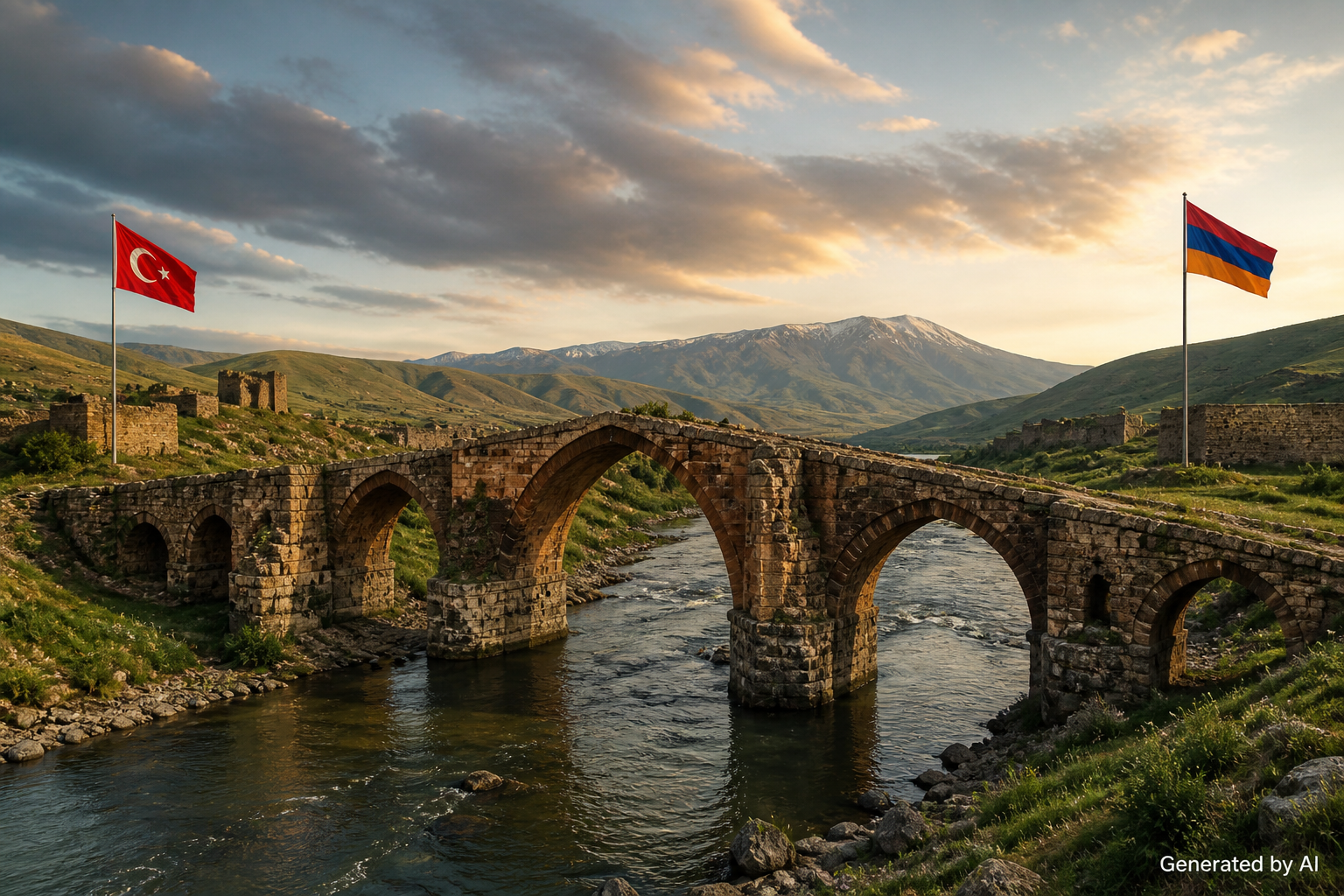
Read moreThe memorandum of understanding signed between Türkiye and Armenia for the joint restoration of the Ani Bridge is not merely a project to revive an architectural monument; it signifies the opening of a new chapter in the geopolitical and economic destiny of the South Caucasus. Formalized through high-level contacts between Turkish Vice President Cevdet Yılmaz and Armenian Prime Minister Nikol Pashinyan, this step symbolizes the region’s transition toward a more rational plane, moving away from decades of isolation and hostile rhetoric. Those ruined arches rising over the Arpaçay River, which have separated the two shores for centuries, are now being rebuilt as restored bonds of peace and regional integration. Believed to have been constructed during the 10th or 11th centuries, the peak of the Great Silk Road, the Ani Bridge once stood as one of the most vital trade arteries not only for the region but for the world. It was more than a crossing for merchants; it was a meeting point for cultures, ideas, and civilizations. However, the Mongol invasions, followed by the shift of trade routes toward the seas, condemned this magnificent city and its strategic bridge to oblivion. The destruction wrought by the Ottoman-Russian wars of the 19th century eventually plunged the remaining ruins into silence. Today, the breaking of that silence through a diplomatic agreement is the clearest manifestation of the South Caucasus’s determination to break free from its transport blockade.
Since achieving independence, Armenia’s pursuit of an irredentist foreign policy had not only poisoned its relations with neighbors but also dragged the country into an economic dead end. The occupation of Azerbaijani territories and unfounded claims against neighboring states resulted in closed borders that left Armenia excluded from regional projects. The 44-day war in 2020 and the local anti-terror measures of September 2023 forced Yerevan to realize a bitter yet inevitable truth: in the globalized world of the 21st century, a statehood model built upon territorial claims is unsustainable and brings harm to no one more than the state itself. This realization accelerated Armenia’s attempts to normalize relations with Türkiye. Throughout this process, Ankara has consistently prioritized Azerbaijan’s interests, conditioning the opening of borders on Yerevan’s total abandonment of its expansionist and irredentist policies. The document, now signed regarding the restoration of the Ani Bridge, raises positive expectations that Armenia is finally shedding the stereotypes of the past and pivoting toward a future of cooperation. The thawing of relations between Azerbaijan and Armenia—marked by the use of Armenian airspace by Azerbaijani aircraft, discussions on logistical transit, and prolonged stability on the front lines—plays a decisive role in this Turkish-Armenian rapprochement.
While many might view the bridge's restoration as having only symbolic or touristic value, the project contains much deeper economic and strategic layers. Naturally, it would be naive to expect heavy-duty trucks to traverse a crossing originally designed for camel caravans a thousand years ago. Nevertheless, this project serves as a springboard for dismantling psychological barriers. The opening of borders will facilitate direct trade between Türkiye and Armenia, bypassing third-party routes such as Georgia. This will lead to a sharp reduction in transportation costs, lower the cost of goods, and ultimately benefit the wallets of ordinary citizens in both countries. It represents an unparalleled opportunity for the revitalization of Türkiye’s eastern provinces and Armenia’s economically underdeveloped regions. Furthermore, the tourism potential of the project is immense. The ruins of Ani are a UNESCO World Heritage site, and transforming this historical city into a tourism hub through free movement between the two countries could secure a significant influx of foreign currency for the region.
On the other hand, the Ani Bridge project must be evaluated as a vital component of a much larger plan: the "Middle Corridor" strategy. The coordinated participation of South Caucasian countries in this transport line stretching from China to Europe transforms the region into a global logistical hub. Armenia’s integration into this system will help it build a multi-vector economy, reducing its dependence on Russia and Iran. Additionally, this rapprochement serves to strengthen the regional security architecture. The likelihood of conflict diminishes sharply between nations that trade with one another and jointly restore shared historical monuments. Thus, the Ani Bridge is not just a structure of stone; it is a small but essential element of the region’s "security umbrella." In conclusion, while restoring history is an act of respect for the past, restoring the future requires courage. This memorandum is a demonstration of that courage for both Ankara and Yerevan. Should this process reach a successful conclusion, the waters of the Arpaçay will no longer be perceived as a line of separation, but as a flow of unity and shared prosperity. The restoration of this bridge is the brightest and most promising beginning for the transformation of the South Caucasus from a conflict zone into an island of cooperation.
Here we are to serve you with news right now. It does not cost much, but worth your attention.
Choose to support open, independent, quality journalism and subscribe on a monthly basis.
By subscribing to our online newspaper, you can have full digital access to all news, analysis, and much more.
You can also follow AzerNEWS on Twitter @AzerNewsAz or Facebook @AzerNewsNewspaper
Thank you!