
Italy, Azerbaijan upgrade partnership built on mutual need
Akbar Novruz
Read moreAfter a month full of visits, the leaders of four of Europe's strategically essential countries realized that the strategic importance of Azerbaijan's geographical and energy position has reached new heights amidst war in Ukraine on the one hand and Middle Eastern upheavals on the other hand. As we described it, Baku became the capital of the 'Old Continent's new pragmatism. Meloni's visit, on the other hand, was anticipated very closely.
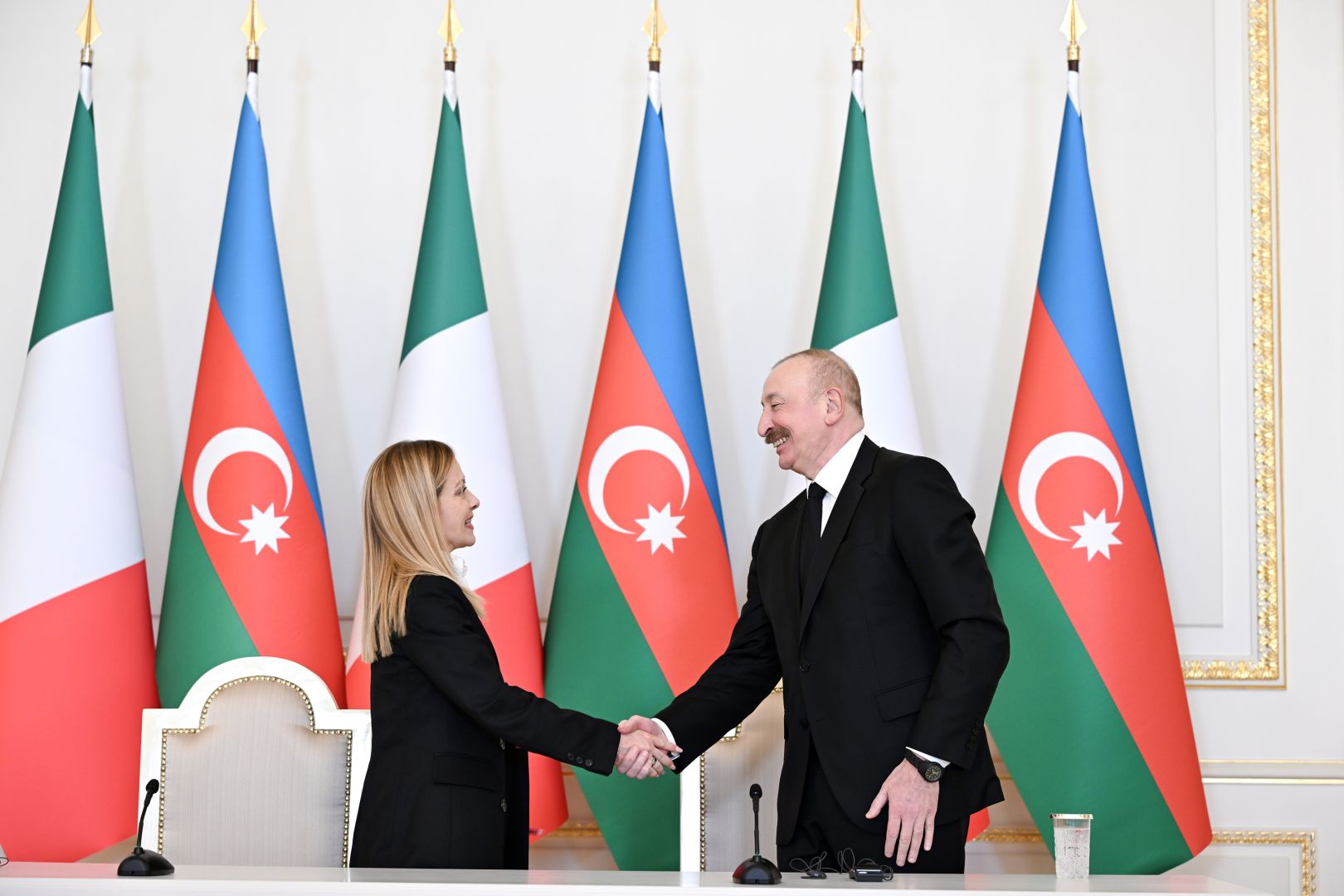
Perhaps thirteen years is a long time to leave a strategic partner without a prime ministerial visit. As Giorgia Meloni herself pointed out during her meeting with President Aliyev in Baku on Tuesday afternoon, "I believe we had to fill this long-standing gap." The gap existed in theory only, of course, since various aspects of bilateral cooperation between the two countries have been developed in different areas, Italian companies continued working in the country, energy flows increased, a sovereign wealth fund invested its money, and a university was built. The gap in prime ministers' visits, however, lasted for 13 years. This situation became particularly noticeable considering the current state of affairs, with bilateral trade amounting to 12 billion dollars annually and 16 percent of Italian gas coming from Azerbaijan.
In fact, Tuesday's visit was meant to rectify just that. Yerevan-Baku, the multilateral European format on one day, followed by bilateral talks between Italy and Azerbaijan on the next, encapsulated the two-track approach to Italian Caucasus policy in back-to-back diary entries. Two separate trips, with two separate motives behind each one. And the fact that she completed both in 24 hours was, as President Ilham Aliyev noted at their joint press conference, "a clear manifestation of the respect and goodwill shown toward Azerbaijan."
In 2025, Italy and Azerbaijan's bilateral trade was valued at $12 billion, with Italy positioned as Azerbaijan's number one trading partner. That year, Azerbaijan exported 9.5 bcm of gas to Italy, which covered approximately 16% of Italy's total gas demand. Additionally, there are currently 130 Italian companies operating in Azerbaijan, with 23 projects located in the liberated territories. Over the past few years, the State Oil Fund of Azerbaijan (SOFAZ) has invested $3 billion in the Italian economy.
The figures associated with the energy partnership are noteworthy on their own merit. According to Meloni, the gas and oil imported by Azerbaijan represent 16% and 17%, respectively, of Italy's total imports and have been crucial for its energy security ever since Russia's large-scale invasion of Ukraine in 2022. This dependence on Azerbaijan's energy has taken on a new character as of January 2026, with Azerbaijani gas flowing north from Italy to Austria and Germany for the first time, turning Italy into an intermediary for Caspian gas consumption in Central Europe. While the TAP pipeline had already delivered Caspian gas to Italy's southern shores of San Foca after crossing Greece and Albania, it is now acting as a southern gateway to the Caspian gas grid of the continent.
But TAP is currently running at full capacity, as it was noted last week. The first expansion, finished by January 2026, increased capacity by 1.2 billion cubic meters annually, out of which 1 billion goes to Italy. Pipeline design capacity of 20 billion cubic meters annually, which is twice more than the initial operational capacity of the pipeline, demands another expansion in the form of construction of new compressor stations in Greece and Albania, new investments in the upstream sector of production at Shah Deniz, as well as potentially in other oilfields in Azerbaijan, and the commitments of shippers that would make such investments justified. Aliyev was direct about what Tuesday's meeting addressed: "We held discussions to increase this volume. For this, it is necessary to expand the TAP project. It has already been expanded to a certain extent, but this process must continue." Meloni's response was equally unambiguous: "We must work not only on supply volumes but on the quality of industrial partnership across all sectors."
The mathematics of the TAP expansion: Currently, TAP can handle 11.2 bcm per year. The annual gas consumption of Italy is about 70 bcm/year. In case of full expansion of TAP to 20 bcm capacity, Azerbaijan’s share in Italy’s natural gas supplies will increase from roughly 16% to around 28%, thereby becoming its biggest supplier of natural gas ahead of Algeria, which currently supplies about 25%. This scenario will depend on several factors, including the decision-making by SOCAR and bp upstream.
Baku-Rome partnership has a new frontier
Energy has been the cornerstone of the Italian-Azerbaijani relationship for the past decade. What was communicated via the messages coming out of Tuesday's visit, through the wording of those communiques, the composition of the companies accompanying Meloni, and indeed the tone adopted by both parties, is that a more diverse approach to the partnership is now being pursued. The defence and aerospace component of the relationship has come front and center in recent years. In 2023, Leonardo secured a deal for C-27J transport planes, and subsequently moved onto defence and aerospace cooperation, with parallel moves made by the Czechoslovak Group in light of Azerbaijan’s military rearmament after the conflict.
Meloni was specific about what Italy is offering. "In the aerospace industry, maritime security, the protection of critical infrastructure, and advanced technologies, we wish to deepen our cooperation," she said, adding that the model she envisioned was one of "joint development" and "knowledge exchange" rather than simple procurement. The frame of “Italian technology and Azerbaijani capital collaborating to produce goods for other markets” is a more daring venture than merely supplying goods under a contract. It involves integrating Italian companies within the Azerbaijani manufacturing system rather than supplying machinery to it. Aliyev's language matched: "We have concrete ideas regarding the implementation of joint projects, the organisation of joint production, and the combination of Italian technologies with Azerbaijani financial resources."
Soft power exchange
The Italy-Azerbaijan University, which opened its doors in Baku in 2025, attended by President Sergio Mattarella himself, is one of those ventures that do not belong to the lexicon of energy diplomacy, and deserves to be discussed. This institution functions as a collaboration between five Italian universities under the Azerbaijan Diplomatic Academy umbrella, presently hosting over 500 students. Azerbaijani President described its graduates as future "ambassadors of Azerbaijan in Italy and Italy in Azerbaijan."
The Vatican element, rarely ever discussed in energy policy analysis, yet clearly significant for both sides, adds weight to this theory of soft power dynamics. In addition to financing the reconstruction of St. Peter’s Basilica, the Vatican museums, the Vatican Apostolic Library, and the Roman catacombs, the Heydar Aliyev Foundation is now building another Catholic church named after Pope John Paul II, which will be completed in Baku by 2027. This is symbolic diplomacy for a country with a majority Muslim population in its dealings with predominantly Christian European countries: Azerbaijan’s dedication to freedom of worship, shown through its concrete support for one of the most symbolically charged organizations in the world, is an open letter from Azerbaijan to Europe, delivered through Italy’s diplomatic channels.
The farthest-reaching long-term consequence of Meloni's trip on Tuesday might actually be one she expressed in simple terms: "Italy stands ever-ready to act as a privileged gateway to the European market." The word "gateway" defines a new role for Italy in the Azerbaijani equation, from consumer to middleman. By calling something a gateway, it means that what passes through Italy passes beyond Rome to become European. From January 2026 onwards, natural gas has begun to flow in an entirely new direction: from Azerbaijan through Italy up to Austria and Germany for the first time, creating a new Caspian pipeline into the heart of the European market.
Both leaders were careful to frame the deepening bilateral relationship within the EU-Azerbaijan context rather than separate from it. Aliyev noted that today "Azerbaijan exports natural gas to countries neighboring the Czech Republic" — a remark aimed at the broader European audience as much as at his guest. Meloni stated that "energy and transportation are two areas where Europe can and should play a more vital role" and that Italy was ready to support Azerbaijan's greater integration into European energy networks and international transport routes. The terminology of European integration for a country that does not belong to the European Union or NATO and has explicitly decided not to join either institution is very specific; it refers to functional, institutional connections – pipeline capacity, digital infrastructure, and transportation routes – rather than membership. And it was precisely such a relationship that Baku has been building for the last twenty years.
Here we are to serve you with news right now. It does not cost much, but worth your attention.
Choose to support open, independent, quality journalism and subscribe on a monthly basis.
By subscribing to our online newspaper, you can have full digital access to all news, analysis, and much more.
You can also follow AzerNEWS on Twitter @AzerNewsAz or Facebook @AzerNewsNewspaper
Thank you!