
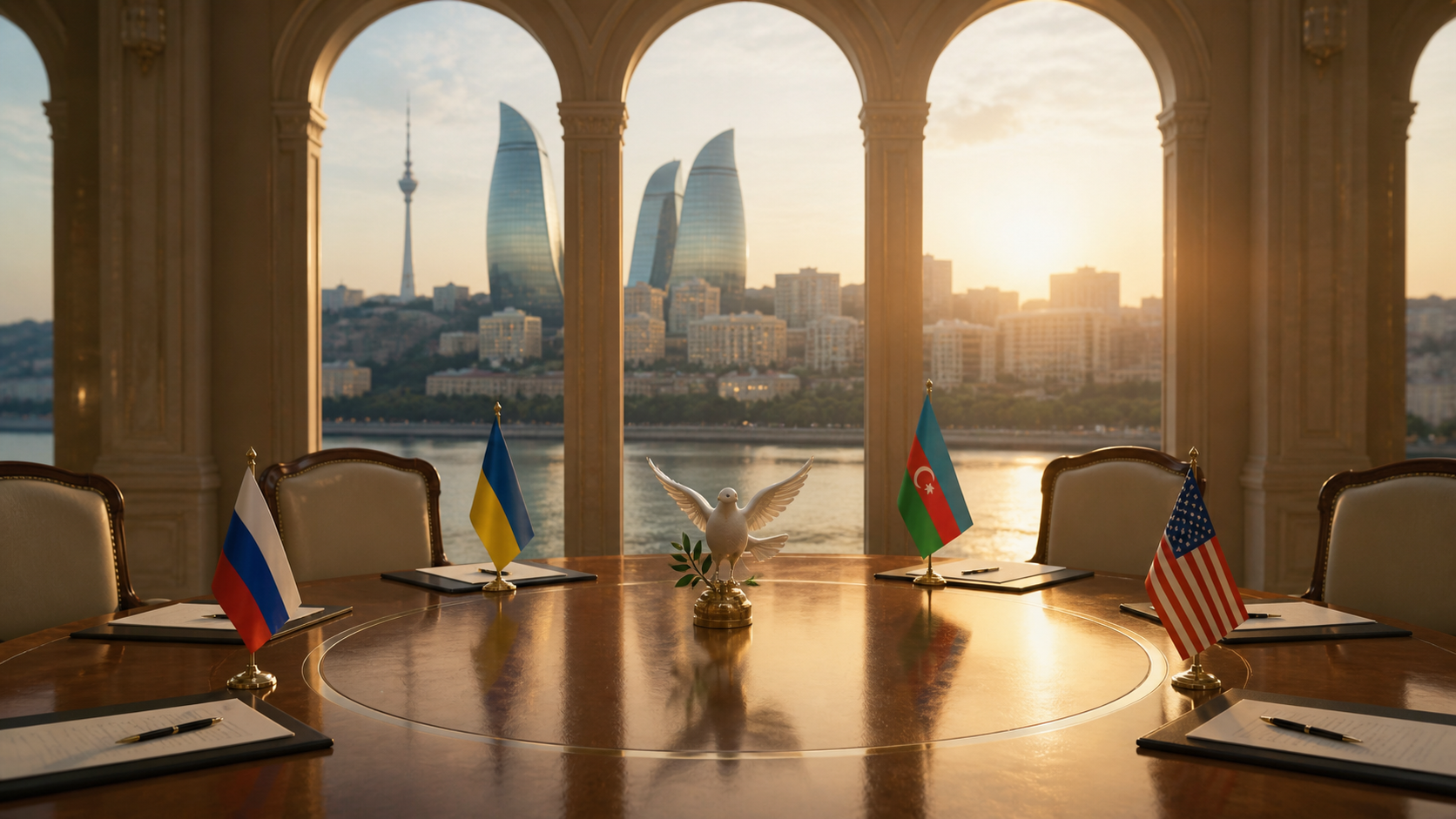
Could Baku really become the table where Russia's war ends?
Akbar Novruz
Read moreOn April 25, standing alongside President Ilham Aliyev in Gabala during his first state visit to the South Caucasus region following the start of Russia’s war against Ukraine, President Volodymyr Zelenskyy said something that rewrote the diplomatic script for a four-year war in one breath. “We are ready for trilateral talks,” he said. “We already held talks like that in Türkiye and Switzerland, and I am confident that we can hold them in Azerbaijan, as long as Russia is ready for diplomacy.” Without delay, President Aliyev took up the implicit responsibility. Soon after, the pair signed six bilateral accords concerning defense, energy, security, and investment, a trip so substantive that the proposal for a place of peace talks, the most significant aspect of the day’s activities, would have been overlooked in any press release.
A political gesture, carried out after four years of fighting, from a politician who has taken those four years to craft carefully which nations will be honored with the privilege of playing mediator in Ukraine’s affairs. Türkiye was selected to host the Istanbul talks in 2022. Switzerland was selected to host the Global Peace Summit in 2024. Each one was selected because it was an independent enough nation to serve as a neutral venue for such talks. Azerbaijan can now be added to that list.
But how possible is it for Baku to be that "Peace Venue"?
Acting as a peace venue is not just the physical space but a declaration of whose political capital is on the table, whose reputation is behind the process, and what both sides are willing to concede without compromising their negotiating positions before any discussion takes place. Russia does not negotiate in Kyiv or Warsaw or London. Ukraine does not negotiate in Moscow or Minsk or anywhere that suggests Russian legitimacy for the process. The list of countries who meet the criteria shrinks rapidly to Türkiye, which conducted Istanbul and is a NATO member with deep connections to Russia; Switzerland, whose neutrality is under threat because of its position vis-a-vis EU sanctions; and now Azerbaijan.
This meeting also highlights the meaning of the symbolic act of Azerbaijan’s behavior. Russia’s dealings with the South Caucasus have always been about more than just proximity; they have involved an expectation that Russian mediation, influence, and hierarchy be accepted in this region. The meeting between Zelenskyy and Azerbaijan contradicts this expectation. Azerbaijan did not seek the approval of Moscow before inviting Ukraine’s leader for a visit. Azerbaijan did not make it clear that it was expressing its position through subordination to the wishes of Russia. Instead, it behaved like any other sovereign nation that had the freedom to pursue its own foreign relations independently.
As a matter of fact, there have been three attacks on Azerbaijan’s energy infrastructure in Ukraine. There have been two attacks on the Azerbaijani Embassy in Kyiv, once the coordinates of the embassies were provided to Russia. In December 2024, Russia shot down a civilian airliner of Azerbaijan with 38 people on board, all of whom were Azerbaijani citizens, and did not take responsibility for weeks. Trade between Azerbaijan and Russia decreased by almost half during the first quarter of 2026. These are not gestures but actions that have put Azerbaijan into a position similar to a West-leaning neutral state.
However, Azerbaijan continues to interact economically, militarily and diplomatically with Russia. Currently, Azerbaijan is forging connections with Ukraine, Türkiye, Israel, EU and the US without entering into any direct clash with Russia. It is this delicate balancing act that lends importance to the visit to Gabala.
The reaction to the Gabala offer from Moscow has so far been silence. In itself, this is kind of telling. If the response had been rejection outright, the doors would have been shut. Silence leaves those doors open but allows the Russians to consider whether Baku has sufficient political heft to make the discussion worthwhile. This is, however, not an easy calculation to make. Azerbaijan is not a Western nation, has not imposed sanctions on Russia, and is not part of NATO, all reasons making it a more acceptable option compared to others on the table.
Most likely, the answer lies somewhere between the two options. Azerbaijan is an impartial mediator because it occupies a neutral position regarding the conflict, not because it lacks any opinions about the dispute, but because it has shown that it can exploit ties with either side for its own benefit without following any other party’s agenda. This independence of opinion is exactly why Azerbaijan can be considered a trustworthy mediator. It is hard to find countries that would be closely allied with just one of the parties to the dispute, and it is even harder to find countries that can maintain friendly relations with both disputants, especially when both sides are aware that the mediator has pursued its own self-interests.
So what could be expected?
Facilitating the peace talks among Ukraine, Russia, and the US would not be a neutral task for Azerbaijan to undertake. First of all, it means using political leverage to convince the Kremlin that participation in such talks would not be seen as a compromise for it, but rather as a chance to gain something. Second, it involves managing the Ukrainian party's expectations, since it would come to the talks showing its goodwill by offering such an attractive venue. Third, Azerbaijan should consider the implications of the precedent it is setting, both from its experience and that of the others participating in the discussion. Finally, most importantly, Azerbaijan must prepare itself for the risk of failure of the process.
President Ilham Aliyev has not publicly said yes. He has not said no either. Instead, he did not refute the narrative presented by Zelensky but acknowledged that the next meeting between Azerbaijan and Ukraine will take place in Ukraine and kept his offer open for the time being. This is a clear indication that there is still room left for further negotiation rather than an indication of the acceptance of a proposal. Accepting a proposal would mean a response from Russia, which has yet to happen. It depends on how successful the upcoming negotiations mediated by the United States about the future of Ukraine, as well as the Iran ceasefire, will be, and whether Washington concludes that a Baku channel is beneficial for its own purposes.
Perhaps, peace, as the South Caucasus region has shown more than once in the last five years, is not always delivered by the front door; sometimes, it is delivered by a door no one thought would be open.
Here we are to serve you with news right now. It does not cost much, but worth your attention.
Choose to support open, independent, quality journalism and subscribe on a monthly basis.
By subscribing to our online newspaper, you can have full digital access to all news, analysis, and much more.
You can also follow AzerNEWS on Twitter @AzerNewsAz or Facebook @AzerNewsNewspaper
Thank you!