
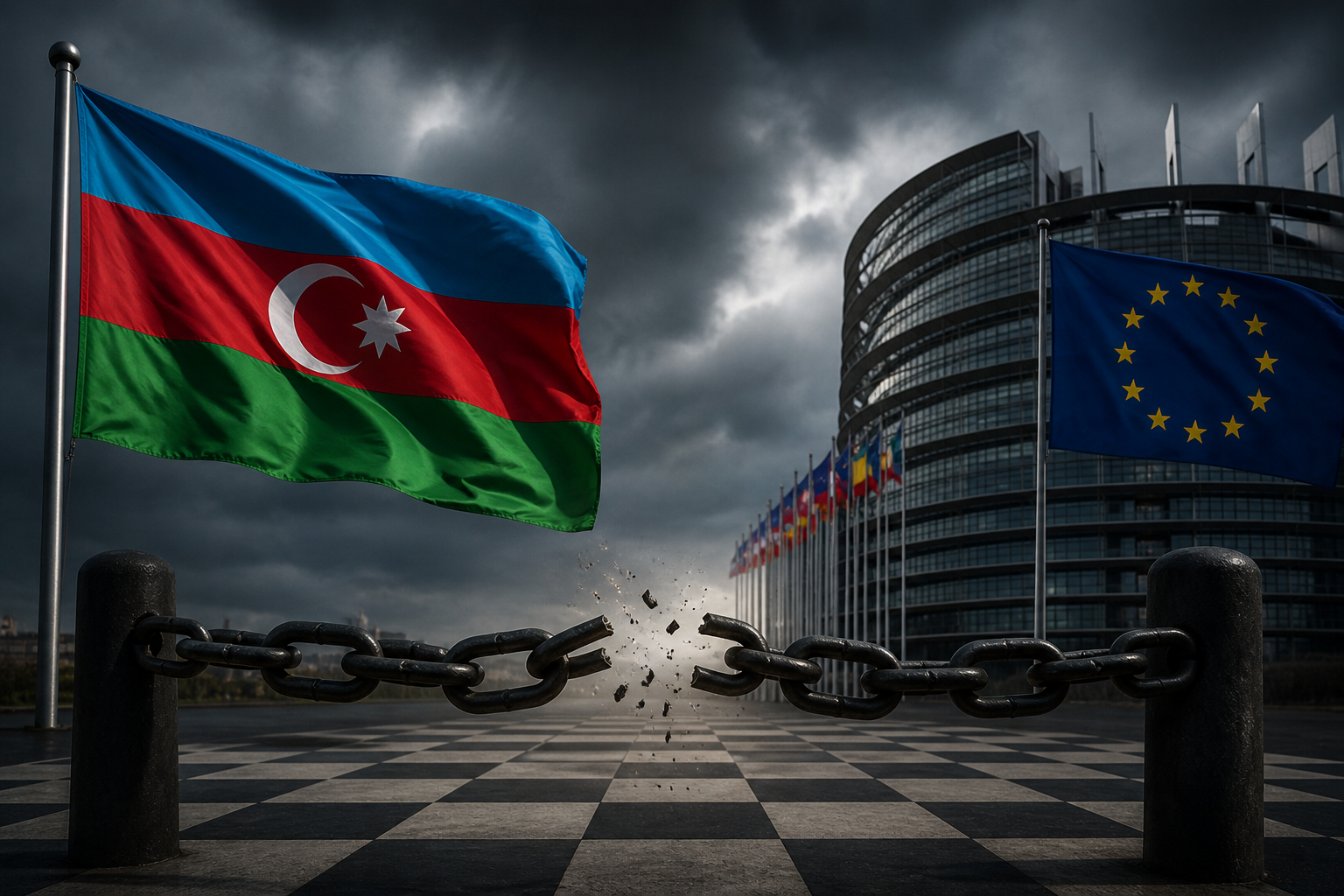
Azerbaijan’s rupture with Brussels lays bare politics behind EU institutions

AzerNEWS Staff
Read moreThe decision for Azerbaijan to officially sever ties with the European Parliament, a relationship already strained to the breaking point, is a stark manifestation of the deep fractures and institutional crises within the modern system of international relations. Baku’s decisive move is not merely an emotional reaction; it is the logical culmination of a process that has accumulated over years, characterized by systemic bias that has utterly exhausted the potential for constructive dialogue. Azerbaijan’s foreign policy toward Europe has always been built on a foundation of balanced and pragmatic partnership, but the European Parliament’s persistent actions, which run counter to the spirit of this partnership, have compelled official Baku to take the most radical step: a complete suspension of all relations.
Analyzing this situation reveals that the issue extends far beyond one or two specific resolutions. What we are witnessing is a fundamental clash of political philosophies. On one side stands a sovereign state that has restored its territorial integrity and is dictating new geopolitical realities in the region; on the other is an international parliamentary institution that frequently falls hostage to domestic lobby groups, particularly the Armenian lobby and Islamophobic tendencies. The fact that the European Parliament has passed more than ten biased resolutions since the end of the Second Karabakh War demonstrates that the body is more interested in keeping old conflict narratives alive than in supporting peace and stability in the South Caucasus. Since 2021, the weaponization of issues ranging from cultural heritage and human rights to even global events like COP29 as tools for political pressure has signaled to Baku that there is no longer any room for compromise.
The official suspension of relations—including the Milli Majlis’s termination of its membership in the Euronest Parliamentary Assembly and the recall of all delegations—is a demonstration that Azerbaijan prioritizes its national dignity and political course over any foreign dictates. The fact that the European Parliament has lost its objectivity as an institution is now being discussed more loudly on the international stage. It is absurd for a body rocked by the "Qatargate" scandal and proven to be under the influence of various corporate and political lobbies to attempt to lecture sovereign states from a position of moral authority. The lack of financial oversight and the prioritization of MEPs' personal interests over the collective interests of the European Union have transformed it from a legislative body into a platform for executing the orders of specific interest groups.
It must be emphasized that Azerbaijan’s decision will resonate deeply within Europe itself. This is because there is a sharp divergence in foreign policy perspectives between the European Parliament and the EU's executive branches, such as the European Commission and the European Council. While the Commission views Azerbaijan as a strategic partner in energy security and a crucial hub in the Middle Corridor project, the Parliament’s destructive actions undermine the broader foreign policy interests of the EU. Baku’s firm warning and diplomatic note also serve as a message to Brussels: the irresponsible and populist rhetoric of parliamentarians is destroying real intergovernmental relations. The presence of Islamophobia and a neo-colonial mindset within the halls of the European Parliament, coupled with the efforts of forces unable to stomach Azerbaijan’s independent foreign policy, is no longer a secret. As President Ilham Aliyev has noted, this is a coordinated attack by forces directly opposed to independent sovereignty.
The consequences of this decision will be long-lasting. Azerbaijan has clearly drawn its "red lines," demonstrating that it is prepared to sacrifice cooperation with even the most seemingly influential organizations when the principles of mutual respect and non-interference are violated. By maintaining a one-sided and pro-Armenian stance that harms the peace agenda, the European Parliament has effectively isolated itself from the peace process in the South Caucasus. Azerbaijan’s move also sets a precedent for other international actors: sovereignty is not a subject for negotiation. When an international institution ceases to serve intergovernmental dialogue and instead becomes an ideological weapon and a mechanism for pressure, its legitimacy is called into question. Baku’s "no" is, in essence, a step taken in defense of international law and state sovereignty. It is not just the end of a partnership, but a triumph of national will against injustice and political corruption. The ball is now in Europe’s court; they must either resolve their internal corruption and lobbying issues to return to healthy dialogue or continue to lose their strategic partners one by one.
Photo created by Artificial Intelligence
Here we are to serve you with news right now. It does not cost much, but worth your attention.
Choose to support open, independent, quality journalism and subscribe on a monthly basis.
By subscribing to our online newspaper, you can have full digital access to all news, analysis, and much more.
You can also follow AzerNEWS on Twitter @AzerNewsAz or Facebook @AzerNewsNewspaper
Thank you!