
Azerbaijan's 'second pipeline' and how it is wiring itself for post-oil future
Akbar Novruz
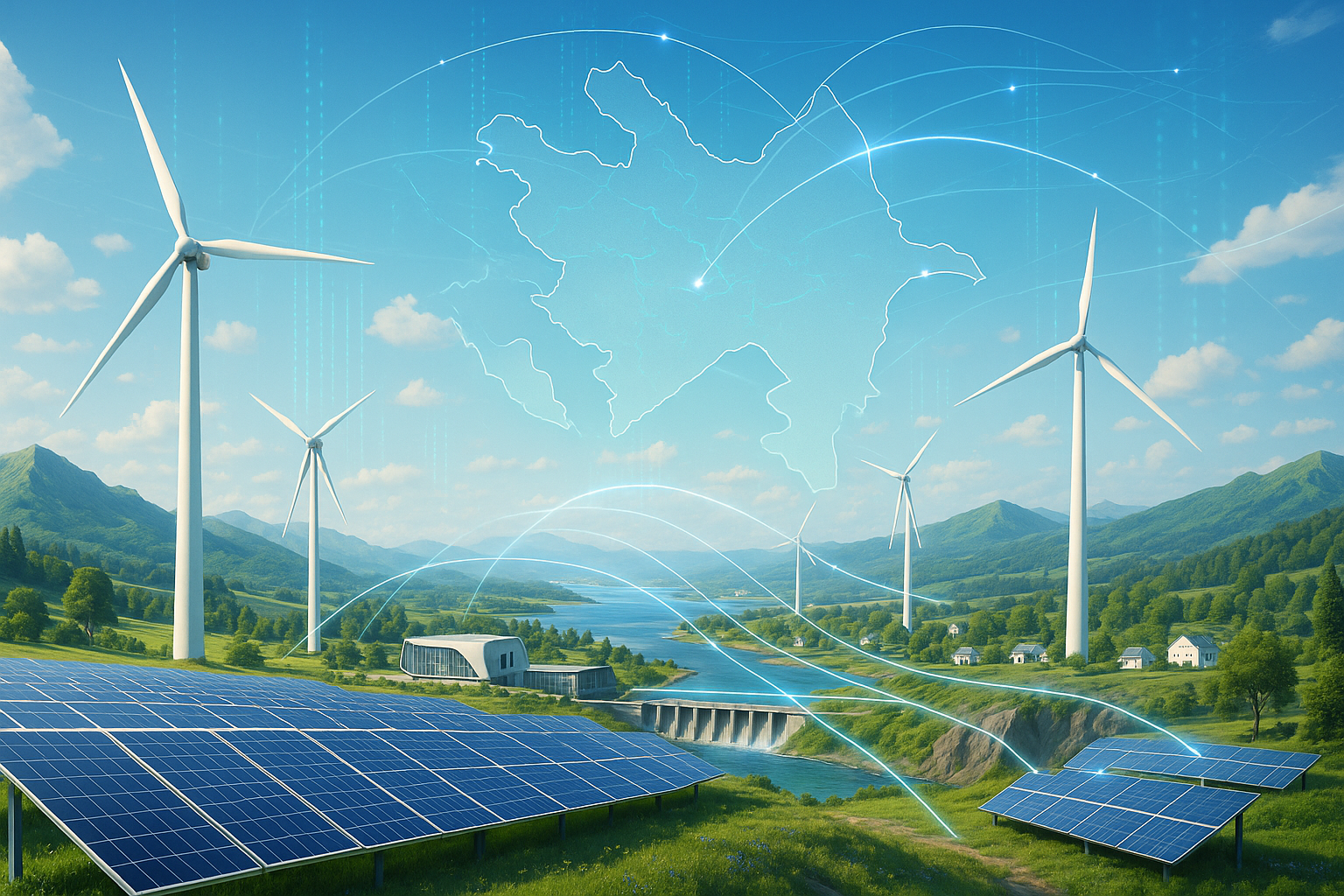
Read moreThe biggest infrastructure project Azerbaijan will undertake within the next two years will not be a pipeline but rather a power line. Construction of this project starts in Q2 2026 on an overhead transmission line of 235 kilometres in length and 500 kilovolts in voltage from the substation of the Azerbaijan Thermal Power Plant to the Navoi (Navai) substation, which is a World Bank-funded grid infrastructure project that will cut through eight districts, 64 settlements, and 44 pastures. This project does not transport oil or gas. What this project will deliver once it is completed in Q4 2027 is the ability to distribute electricity produced by wind and solar farms to the national grid system, which must be entirely reconstructed for Azerbaijan to become an exporter of green energy.
The transmission line will form part of the Azerbaijan Renewable Energy Expansion project, otherwise known as AZURE, being financed by the World Bank, along with grid expansion in both the 330kV and 500kV grids and connection of the Absheron-Garadagh wind power station. Unlike solar parks or wind turbines, which can be photogenic, the transmission line is 'inherently unglamorous'. However, the AZURE project is much more crucial in the view of any energy expert analyzing the transition in the Caspian. Azerbaijan's renewable energy capacity, estimated at 135 gigawatts onshore and 157 gigawatts offshore in the Caspian Sea according to the Ministry of Energy, has never been the limiting factor. The limiting factor has always been the grid infrastructure needed to transport this electricity from the windy Absheron peninsula and sunny Bilasuvar plains to the domestic market and eventually the European market, 3,000 kilometers away.
AZURE Project's activities
To understand the significance of such a line in a 500kV capacity, it is necessary to examine the present power grid in Azerbaijan. As the existing infrastructure is the product of the Soviet era, it was specifically designed to serve a hydrocarbons-based energy industry; this meant that electricity generation was concentrated at centralised coal and gas plants, transmission lines were built around these plants, and the distribution lines were designed to carry power in only one direction from the generation facilities to end-users. However, renewable energy is an altogether different type of resource. Not only is it diffuse, weather-dependent, and scattered all over the Absheron peninsula, the Caspian Sea shallows, and southern lowlands, but it also necessitates the construction of new grid structures altogether.
AZURE will hopefully tackle the most pressing challenge first: linking the new wind energy plant Absheron-Garadagh, which has a capacity of 240 megawatts and was developed by Saudi Arabia’s ACWA Power, having been launched in early 2026, to the 500kV main backbone. The AZURE line will link the substation of the Absheron thermal plant to the new Navoi substation, which is currently under construction as part of the far end of the corridor and represents a new segment of the backbone network, as it will become absolutely necessary for the aggregated generation capacities resulting from existing contracts up to 2030.
Other contracted projects
Masdar from the UAE is promoting the development of the Bilasuvar Solar power plant of 445 MW, set to see its initial panels deployed in October 2025; it is part of a total 1,000 MW initiative that consists of the Neftchala solar plant and the Absheron-Garadagh wind project. In addition to the above, the company ACWA Power from Saudi Arabia has already commissioned the construction of the Khizi-Absheron Wind Farm, a massive 240 MW plant which marks the first major wind park built in the country, producing nearly a billion kilowatts per hour while greatly minimizing gas consumption and emissions. Nobel Energy, part of NEQSOL Holding, initiated the development of solar power plants in Nakhchivan and Jabrayil. In October 2025, the groundbreaking ceremonies for the “Ufug” and “Shams” solar power plants, each with a capacity of 50 megawatts, took place in Jabrayil. The “Ufug” Solar Power Plant project is being implemented by Enerso Jabrayil, a subsidiary of Nobel Energy (part of NEQSOL Holding), while the “Shams” Solar Power Plant project is being carried out by Clean Energy Jabrayil.
There are existing contracts and memoranda of understanding that have been signed that represent more than 10 gigawatts worth of renewables, a figure that, if achieved, will increase the renewable energy capacity in Azerbaijan from the present 1.9 gigawatts to a point where Azerbaijan will actually have a surplus that could be used for exportation. While the government targets 6 gigawatts of renewable energy production by 2030 and 8 gigawatts by 2032, the president calls it an achievable number based on existing contractual agreements.
Strategic focus correlated with the present export corridors
Currently, the internal electricity production in Azerbaijan uses around 9–10 billion cubic meters of natural gas per year. However, if this gas were not used for the domestic electricity production in Azerbaijan, then it could be exported to Europe through the Southern Gas Corridor, but this time at much higher prices due to the current situation in which Iranian gas supplies to Europe have been disrupted because of the wars in Russia and Iran. Every one gigawatt of renewable energy produced in Azerbaijan translates into 1.5-2 billion cubic meters of natural gas that could be exported to Europe.
These considerations bear significant consequences for timing and transition politics. As opposed to a nation in Europe moving away from fossil fuels due to climate change, Azerbaijan actually stands to profit economically from speeding up its shift towards renewables, and doing so at a rate that yields the highest income from gas exports. The AZURE grid link, the Masdar photovoltaic plants, and the ACWA wind farm are not gestures of environmental goodwill; they are, using the terms familiar to finance ministers, capital investments that directly raise the income stream from the biggest entry on the nation’s balance sheet.
Development of regional energy interconnectivity is currently being realized through a series of integrated projects aimed at bringing Caspian and Central Asia renewables into Europe’s grid network. One such project central to achieving this goal is the Black Sea Submarine Cable (BSSC) HVDC transmission line running 1,195 km from Anaklia in Georgia to Constanţa in Romania. The project had its feasibility study completed and was included on the EU Projects of Mutual Interest list in December 2025. With the target of 1.3 GW by 2029 and a cost estimated between €3.1 and 3.7 billion, this project will be supplemented by the Azerbaijan-Georgia-Türkiye-Bulgaria corridor, another independent HVDC overland transmission line through an MoU in April 2025.
In order to make these export routes scalable, the Green Corridor Union, made up of Kazakhstan, Uzbekistan, and Azerbaijan, will seek to incorporate the Central Asian wind and solar energy into the Caspian-Black Sea corridor; such an effort received approval at the EU-Central Asia Summit that took place in April 2025 and is expected to increase exports beyond 2030. Underpinning all these efforts internationally is the upgrade of the Domestic Grid in the form of the AZURE project and other 330/500kV lines. The Domestic Grid infrastructure, totaling 235 km and funded by the World Bank, is scheduled to be completed by late 2027 and is crucial for the functioning of all proposed export corridors.
The most formidable one
Among the four corridors mentioned above, the Black Sea Submarine Cable is definitely the most significant and difficult. The project was included in the EU's Priority Projects of Common Interest in December 2025, a label that provides accelerated financial access and prioritization within regulatory processes. In February 2026, Romania's Transelectrica and Georgia's State Electrosystem signed an MoU to facilitate the HVDC connection. A feasibility study undertaken by Italian consulting firm CESI established that the project can be implemented at a cost of €3.1-3.7 billion for Phase I.
Better yet, the engineering feat here is no small task. For instance, there are only two firms globally, namely Prysmian from Milan and Nexans from Paris, that can lay such an offshore cable system. The project involves traversing the waters off the southern coast of Crimea in the Black Sea at depths of up to 2,200 metres, where free-floating mines from the war between Ukraine and Russia pose a threat to merchant shipping. The laying of this cable system will mean that the installation will be an important asset for Europe’s energy security, but also vulnerable to sabotage like the Nord Stream pipeline systems.
The difference between Azerbaijan’s signed contracts and its delivery history must be taken into account. The current installed capacity of renewables in Azerbaijan totals 1.9 GW. This capacity has increased since then; however, not as quickly as expected from the contracts signed in 2020. Reasons for the delay include the delayed improvements of the grid network (which is currently being started by the AZURE project), complex permitting processes for large-scale solar power in agricultural regions, and difficulties related to Caspian logistics for the installation of the foundations of offshore wind turbines. Solar power is expected to grow by 65.7% per year until 2030, provided that these changes are made promptly.
This implies that the green transition strategy relies on demand from Europe in terms of structural dependency, and therefore, in the case of any delay, the economics of the green transition become unfavorable. But as it stands, Azerbaijan is capable of keeping pace with the current trends.
Here we are to serve you with news right now. It does not cost much, but worth your attention.
Choose to support open, independent, quality journalism and subscribe on a monthly basis.
By subscribing to our online newspaper, you can have full digital access to all news, analysis, and much more.
You can also follow AzerNEWS on Twitter @AzerNewsAz or Facebook @AzerNewsNewspaper
Thank you!