
Europe turns to Azerbaijan as energy security drives new alliances

Ulviyya Poladova
Read moreAmid ongoing conflicts in various regions worldwide, Azerbaijan has emerged as one of the safest countries, a status that significantly influences its geopolitical and economic relationships. This relative stability in the South Caucasus has not only enhanced Azerbaijan’s regional importance but also attracted considerable attention from European nations seeking reliable partnerships.
Italy, as a leading European economy, exemplifies this trend through its deepening economic ties with Azerbaijan. The country’s strategic location and abundant energy resources position it as a critical player in Europe’s quest for diversified and secure energy supplies, particularly amid growing concerns over energy security caused by geopolitical tensions in the Middle East. Both Italian Prime Minister Giorgia Meloni and Kaja Kallas, High Representative for Foreign Affairs and Security Policy and Vice-President of the European Commission, have highlighted Azerbaijan’s role in fostering regional stability and emphasized Italy’s and the EU's commitment to strengthening bilateral cooperation during their official visits to Baku. In a meeting with President Aliyev, Italy's PM noted that the goal is to further strengthen the existing cooperation in energy, security, connectivity, investment, and political dialogue, turning these collaborative efforts into tangible opportunities for the people of both countries.
Such endorsements underscore the broader European recognition of Azerbaijan as a dependable partner, particularly in the energy sector. Beyond Italy, multiple European states are actively pursuing closer contact with Azerbaijan to capitalize on its stable environment and strategic advantages. Furthermore, efforts by Azerbaijani authorities to maintain peace and security contribute significantly to positioning the South Caucasus as a safe region conducive to investment and collaboration. This dynamic interplay between safety, economic opportunity, and international diplomacy forms the basis for understanding how Azerbaijan navigates complex global challenges while fostering mutually beneficial relations with Europe.
Moreover, High Representative of the European Union for Foreign Affairs and Security Policy and Vice-President of the European Commission, Kaja Kallas, underscored Azerbaijan’s strategic importance as a reliable energy partner for the EU.
"Azerbaijan is a valued and reliable energy partner for the European Union. There is clear scope to deepen our cooperation, particularly in trade, transport, and digital areas," she noted.
Following the 2022 energy crisis, the European energy market has entered a phase of structural transformation. The sharp reduction of Russian supplies, volatile LNG prices, and intensified competition for tanker shipments have prompted EU and non-EU countries alike to accelerate revisions of their energy strategies.
Azerbaijan has emerged as a key player in this evolving landscape. In the first quarter of 2026, the country exported 6.5 billion cubic meters of gas, half of which went to Europe. In 2025, Azerbaijan exported 25.2 billion cubic meters via pipelines, with European markets accounting for 50% of that volume. Specifically, Azerbaijan delivered 12.5 billion cubic meters to EU countries in 2025, a 53.8% increase compared to 2021, representing more than half of the total growth in just four years.
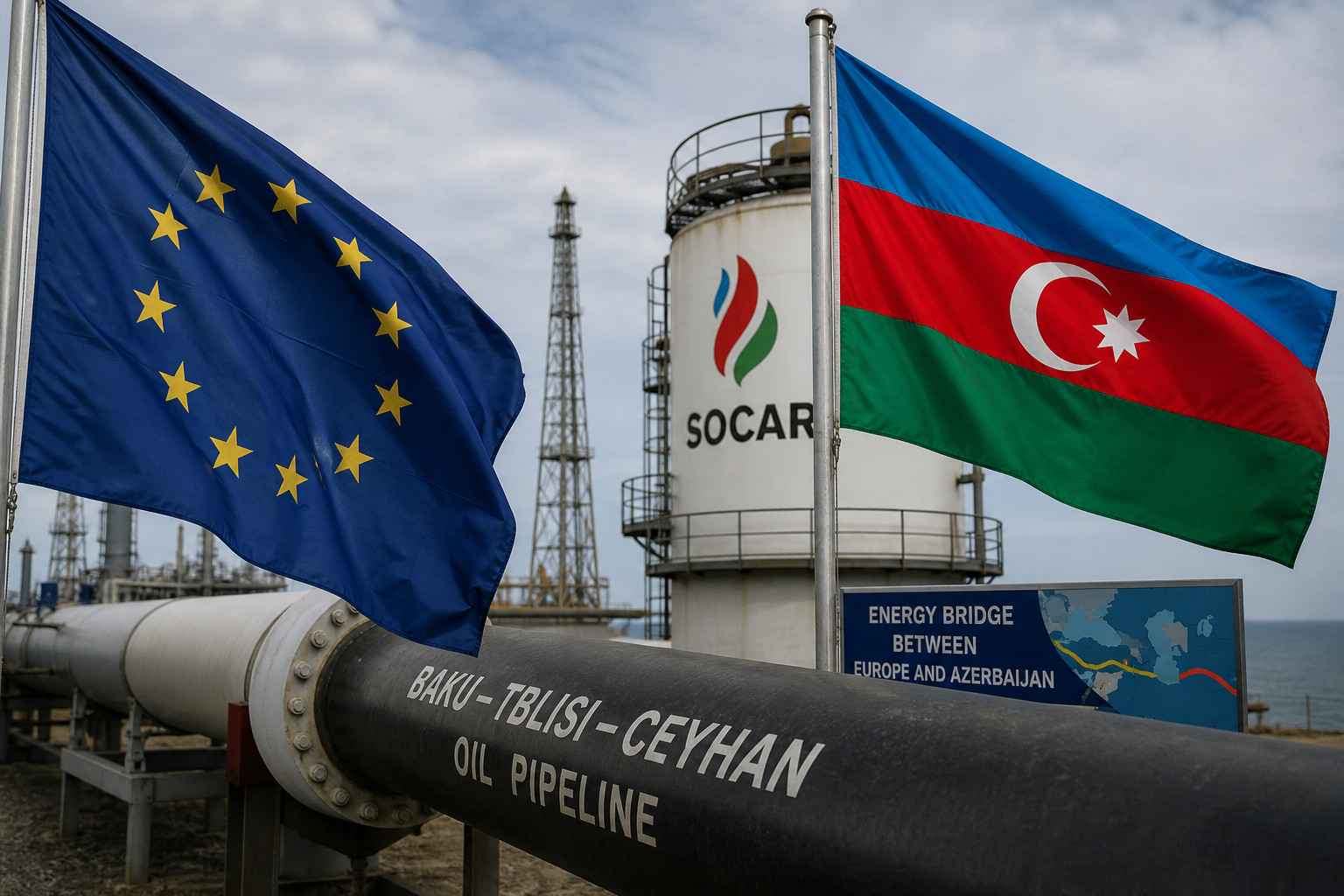
In January 2026, SOCAR began deliveries to Germany and Austria through the Trans Adriatic Pipeline (TAP), which runs from the Greek-Turkish border through Greece and Albania to southern Italy, and from there further north. In June 2025, SOCAR signed a ten-year contract with German energy holding Sefe, supplying 1.5 billion cubic meters annually. With the expansion to Western European markets, Azerbaijan now exports gas to 16 countries, ten of which are in Europe.
This extensive reach highlights Azerbaijan’s strategic focus on diversification, deliberately supplying resources to as many partners as possible. Several European countries are actively developing or have already established energy ties with Baku.
Slovenia is exploring the possibility of diversifying its gas supply through Azerbaijani supplies. Hungary signed a two-year agreement with SOCAR in December 2025, allowing it to purchase up to 0.8 billion cubic meters in 2026-2027, as needed.
Serbia is discussing with Azerbaijan the possibility of flexible gas supplies of up to 0.9 billion cubic meters per year, with the prospect of increasing to 1.4 billion cubic meters annually after the completion of the gas power plant in Nis in 2030.
Italy, the continent’s largest consumer of Azerbaijani gas, imported 9.5 billion cubic meters in 2025 — 38% of the country’s total exports. Italy also serves as a key entry point for pipeline gas into Europe via TAP.
The TAP currently has a capacity of 10 billion cubic meters per year, with plans to double this volume in the future. As of January 1, 2026, the pipeline added long-term capacity, preparing the infrastructure for further growth.
Beyond hydrocarbons, Azerbaijan is actively developing renewable energy. Following COP29 in Baku, cooperation on the green transition has accelerated. Azerbaijan aims to raise the share of renewable energy in its domestic energy mix to 38% by 2030, with ongoing projects totaling 8 GW. Pilot hydrogen projects are underway, and work continues on an undersea electricity cable from Georgia to Romania, as well as other energy corridors linking Azerbaijan to Europe.
The strategy behind this green push is clear: the more domestic energy consumption is covered by renewables, the more gas becomes available for export. This approach is economically beneficial while enhancing Azerbaijan’s reputation as a reliable long-term supplier.
The South Caucasus is increasingly emerging as a stable energy corridor between East and West - a feat largely credited to Azerbaijan. Even amid significant geopolitical turbulence, Baku has ensured continuity and predictability in energy flows.
What sets Azerbaijan apart is its strategic vision. President Ilham Aliyev has pursued a consistent energy policy emphasizing diversified buyers, long-term contracts, infrastructure and production investments, alongside parallel development of renewables.
In today’s world, the search for security is a priority for countries across Europe. The South Caucasus, a region that experienced instability just a few years ago, is now rapidly developing into a prosperous and stable area, with Azerbaijan playing a central role in this transformation.
Azerbaijan has invested significant efforts to create a safe environment, understanding that only a secure country can attract investment and foster economic growth. The nation consistently ranks among the world’s safest countries. According to the 2026 Global Terrorism Index, Azerbaijan holds 93rd place (with lower rankings indicating higher safety) and has an index score of 0.123, reflecting low terrorism risk.
The country boasts a high level of personal and public safety and maintains effective counter-terrorism measures. Global travel safety rankings also recognize Azerbaijan’s secure environment. For example, the World Travel Index places Azerbaijan 41st out of 193 countries, underscoring its reputation as a safe destination for travelers.
Azerbaijan’s stability, combined with its growing economy and strategic regional position, makes it an increasingly attractive partner for Europe and the wider international community.
Here we are to serve you with news right now. It does not cost much, but worth your attention.
Choose to support open, independent, quality journalism and subscribe on a monthly basis.
By subscribing to our online newspaper, you can have full digital access to all news, analysis, and much more.
You can also follow AzerNEWS on Twitter @AzerNewsAz or Facebook @AzerNewsNewspaper
Thank you!