
How disinformation campaigns target Azerbaijan to undermine peace with Armenia

Ulviyya Poladova
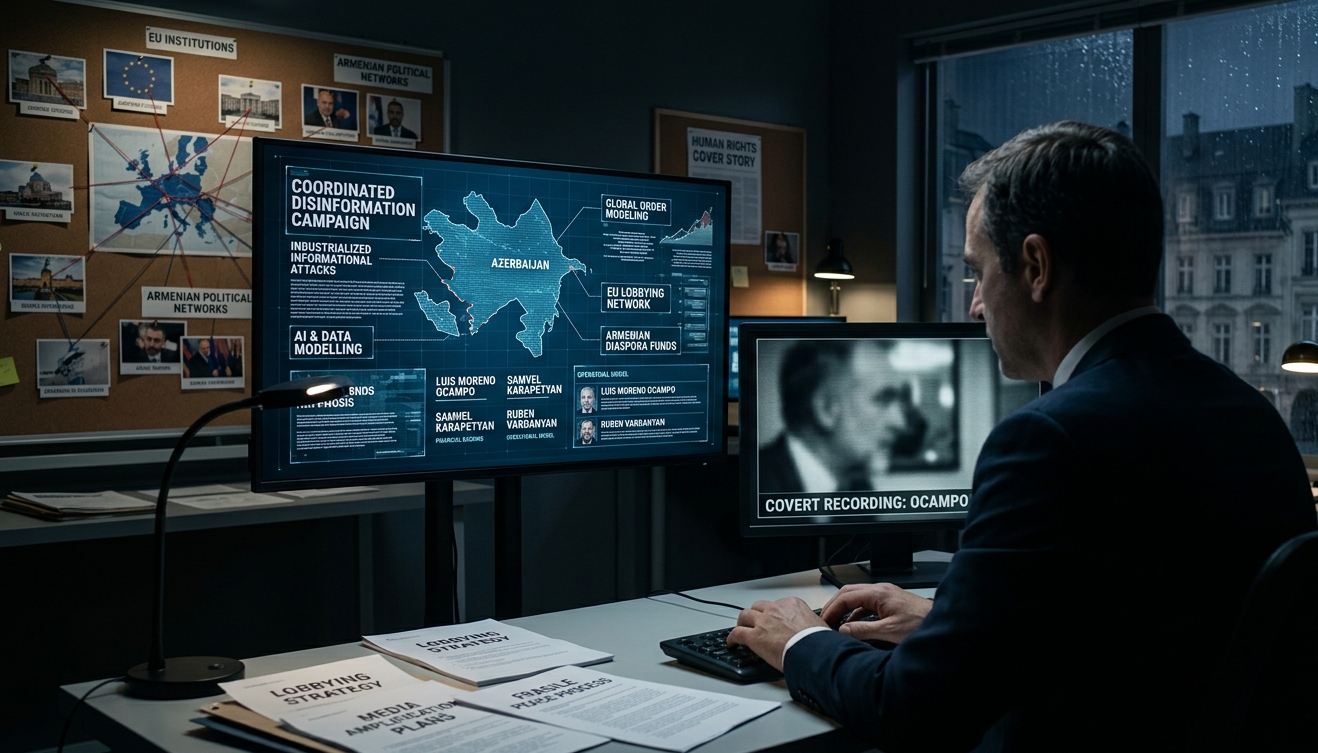
Read moreIn recent months, the Azerbaijani media has been shaken by the release of covertly recorded videos featuring former International Criminal Court (ICC) Prosecutor Luis Moreno Ocampo and his associates. These recordings expose a coordinated campaign of disinformation and political manipulation directed against Azerbaijan under the guise of "defending human rights" and "pursuing justice."
The revelations have ignited debate throughout the region,
exposing connections between lobbying structures in Europe,
Armenian political networks, and influential diaspora financiers.
When viewed collectively, these elements portray not a moral
crusade but a strategic effort to undermine Azerbaijan’s
international standing, complicate the peace process with Armenia,
and shape perceptions within key Western institutions.
The videos depict Ocampo speaking candidly about his contacts
within the European Parliament and his ability to influence
officials, including those close to Josep Borrell, the EU’s top
diplomat. He outlines how narratives critical of Azerbaijan could
be amplified within European institutions to sway policymaking and
public opinion.
Far from being an impartial expert offering humanitarian counsel,
Ocampo appears as a political operator leveraging his credibility
as a former ICC prosecutor. His language in the recordings shows an
awareness of lobbying dynamics - where influence becomes a tool in
an information war.
Ocampo speaks of collaboration with the University of São Paulo, the use of supercomputers, and attempts to model "global order" via artificial intelligence. However, more importantly, he directly points to Karabakh as one of the main directions, evaluating it as a "product from which maximum benefit must be obtained."
He then discusses creating a transnational company aimed at turning "produced information" into a tool for influencing decision-makers—pushing necessary narratives through media, social networks, and expert circles.
This suggests an attempt to use AI as a tool for advocacy, where the data produced by AI models could influence public discourse and, ultimately, political outcomes.
In the context of geopolitical conflicts, AI’s ability to analyze trends, predict developments, and craft targeted narratives could make it a powerful instrument for external advocacy groups, lobbyists, or political actors seeking to influence foreign policy.
In many cases, propaganda institutions operate through highly sophisticated communication mechanisms. These networks often include politically affiliated media groups, advocacy organizations, coordinated social media campaigns, bot systems, algorithmic amplification, and emotionally charged narratives aimed at influencing global audiences. Artificial intelligence technologies now allow actors to generate convincing visual materials, manipulated statistics, fabricated reports, and emotionally persuasive content at unprecedented speed. As a result, distinguishing factual reporting from strategically designed disinformation becomes increasingly difficult even for experienced audiences.
Azerbaijan became one of the clear targets of such informational pressure during and after the Second Karabakh War. Throughout the conflict and its aftermath, various narratives circulated internationally portraying events in a selective or distorted manner. In many instances, Azerbaijani positions were either underrepresented or framed through politically motivated interpretations. Coordinated disinformation campaigns attempted to shape perceptions of military operations, humanitarian issues, cultural heritage, and regional diplomacy. Social media platforms accelerated the spread of emotionally manipulative content, while certain foreign outlets repeated unverified claims without sufficient fact-checking.
One of the key factors contributing to victory in war is effectively harnessing the power of information. During the Second Karabakh War, Azerbaijan's success can largely be attributed to its skillful counteraction against Armenia’s disinformation efforts. Unlike previous conflicts, the Azerbaijani leadership, recognizing the significance of modern weaponry, military technology, and combat readiness, was better prepared to counter the influence of the strong Armenian lobby, which aimed to sway international opinion in Armenia’s favor, secure military and political backing from countries seeking to prolong the conflict, isolate Azerbaijan, and exert political-diplomatic pressure on its leadership to prevent a possible defeat. Consequently, Armenia’s disinformation campaign, which had been used for years, did not have the desired effect this time.
Azerbaijan had managed to expose such false claims during and after the war, saying that one example was a fake report published at the time under the headline 'Azerbaijani soldiers entering Karabakh mock an elderly Armenian woman.' In the footage, one soldier is seen offering a glass of water to an elderly woman, and as she was about to drink it, another soldier poured the water onto the ground. However, in the complete version of the video, it is clearly seen that the Azerbaijani soldier personally gives the water to the Armenian woman.
Disinformation has become a threat spreading on an international scale. The magnitude of the risk and danger posed by disinformation must now be clearly perceived.
Azerbaijan must approach the fight against disinformation not only politically, but also academically and technologically. The country needs institutional frameworks dedicated to strategic communication studies, digital propaganda analysis, cyber psychology, AI-driven information security, and media forensics. Universities and research centers should establish specialized programs on hybrid warfare and digital manipulation.
Azerbaijan also needs highly trained analysts capable of identifying coordinated influence operations, detecting fake narratives, and responding with evidence-based counteranalysis.
Artificial intelligence itself must become part of Azerbaijan’s defensive strategy. A few years ago, Assistant to the President of Azerbaijan and Head of the Foreign Policy Affairs Department of the Presidential Administration, Hikmet Hajiyev, said that Azerbaijan uses artificial intelligence in the fight against disinformation.
Since hostile actors increasingly use AI to manipulate information ecosystems, Azerbaijani institutions need to develop technological capacities to monitor disinformation trends, analyze social media behavior, detect deepfakes, and track coordinated propaganda networks in real time. Cooperation between state institutions, academic researchers, cybersecurity experts, and independent media organizations is essential in building such resilience.
The Azerbaijani media carries exceptional responsibility in this struggle. Rapid exposure of fabricated reports, immediate fact-checking, multilingual communication, and professional investigative journalism are critical tools against manipulation campaigns. Media organizations must strengthen analytical reporting rather than emotional reactions. Credibility, transparency, and speed are decisive factors in modern information warfare. A delayed response often allows false narratives to become globally entrenched before corrections are introduced.
Ultimately, the information dimension of geopolitical conflict has become as important as military or diplomatic power. The Ocampo episode demonstrated how rapidly narratives can be internationalized and politically instrumentalized in the digital era.
In fact, we are talking about an attempt to industrialize informational and political attacks, dressing them in "scientific" garb and scaling them through technology.
This demonstrates that propaganda and disinformation, once disseminated through traditional means, can now be produced in far more sophisticated forms against the backdrop of rapidly advancing technologies. This, in turn, reflects a new mode of confrontation, namely, the transformation of conventional warfare into hybrid warfare. Whereas in the past shots were fired with weapons, today they are replaced by information circulated through deepfakes and falsehoods. Cyberattacks carried out via electronic platforms have become instruments potentially more destructive than lethal weaponry. Technological progress now poses serious challenges to all countries, including Azerbaijan. It makes the development of more advanced protection mechanisms against these new, ruthless tools not only necessary but urgent.
Here we are to serve you with news right now. It does not cost much, but worth your attention.
Choose to support open, independent, quality journalism and subscribe on a monthly basis.
By subscribing to our online newspaper, you can have full digital access to all news, analysis, and much more.
You can also follow AzerNEWS on Twitter @AzerNewsAz or Facebook @AzerNewsNewspaper
Thank you!