
Armenia’s revanchists rise as peace begins to change Caucasus
Akbar Novruz
Read moreKeeping old wounds open has always been easier than building new bridges. Yet as cities are rebuilt, supply chains are reconnected, and pragmatic diplomacy begins to quiet the noise of inherited grievance, those who built careers on perpetual conflict find themselves losing their audience. The smear campaigns that we witness nowadays are not evidence of strength but rather proof of irrelevance as the region is forging its own path towards peace. The same region, finally charting its own peace, leaving little room for those whose influence depended entirely on its destruction.
This month it was a diplomatic tour - 150 representatives from 58 countries and nine international organisations, walking through Shusha, Gandzasar (Ganjasar), Dadivank (Khudavang), Aghdara, Kalbajar, territories that spent thirty years as a closed military zone rather than a place anyone could actually visit. The response from parts of the Armenian diaspora was not measured disagreement. It was fury, in language too crude to reprint, directed at ambassadors for the offence of showing up and looking around. One widely shared post called them "political prostitutes." Another demanded formal diplomatic notes be sent in protest, not against any documented harm, but against the fact that foreign officials had been permitted to see the region with their own eyes rather than take a single community's word for what stood there.
But there is something worth sitting with in that reaction. A society genuinely confident in its account of events does not need to keep outsiders from looking. It invites them, and trusts the evidence to speak. The energy on display here, the insults, the demands for censure, the fury that anyone dared laugh at a political jibe, reads less like the defence of a historical truth than the defence of a narrative that cannot survive contact with the ground it describes.
The industry that needs the wound to stay open
However, in all senses, none of this is to dismiss what either side has lost. Displacement is real on both ends of this conflict: the hundreds of thousands of Azerbaijanis driven from Karabakh and its surrounding districts in the 1990s, and the Armenians who left the same land in reverse thirty years later. Grief is real for both peoples, and both trace their national memory through centuries of hardship that entitle them to mourn what these decades cost. Azerbaijan has its own dead, its own destroyed towns, its own generation raised on stories of a home they had never seen and might never return to. But there is a difference between two nations mourning and processing loss in parallel, however unevenly, and a diaspora lobby that has, consciously or not, built an entire political identity around never being allowed to move past it. To some of the organizations based in Paris, Los Angeles and Beirut, this conflict is not just something to remember. This is their raison d'être – the very reason why people donate money to them, why politicians respond to their calls, why a newsletter has an audience. To such organizations, peace is a layoff notice.
That is a harsh thing to say about people who would insist, sincerely, that they act from love of homeland rather than institutional self-interest. Perhaps some do. But intention and effect are different things, and the effect of demanding "zero weakness," of treating every diplomatic visit as treason and every restored monument as erasure, is to keep an entire region hostage to a grievance that people actually living there are trying, however imperfectly, to move past. Geography does not change to suit anyone's preferred narrative. The Armenians and Azerbaijanis who share this stretch of the Caucasus will still be neighbours in fifty years, whichever slogans are shouted from abroad today. Peace is not a betrayal of memory, and it is what allows memory to stop being a prison for the generations who inherit it without having chosen it.
Now, as it seems, the ones crying in high notes do not understand the mere fact that the stakes at play are much higher than any tour around monasteries. Even the solution to Yerevan-Baku is much more than a legal game where you draw borders on a map. It is the opening of corridors that have been closed for three decades and that connect Central Asia with Europe and the Black Sea with the Persian Gulf. When borders become barriers and not just a simple line, they isolate people from opportunities, from markets, from one another. Opened transit routes do not simply carry goods, as all those headlines write, but also the reward of peace itself in the form of employment and trade, the simple activity of commerce that war had denied to everyone for thirty years. And cultural argument follows the same logic. Placing Gandzasar and Dadivank into the broader context of Caucasian Albania’s complex and multiconfessional history is not an exercise in denial, despite how many times the accusation is made. The South Caucasus was never the sole legacy of one narrative, but one formed by generations of people, including but not limited to Albanians, Armenians, Georgians, Persians, Turks, and others. To demand that there is only one story is not faithfulness to history but a monopoly on history, and monopolies do not generally last long under scrutiny.
Whose future, if not theirs?
What the current campaign against the peace agenda ultimately targets is not really Baku. It is Armenia's own right to exist as a sovereign country charting its own course, rather than a permanent client of a diaspora that experiences the conflict from a safe distance and pays none of its daily costs. The true peace requires much more from people than simply reminiscence of good old times, it requires that a region breaks away from those maps where nobody recognizes its reality anymore and forgets about rhetoric of grievance that was acquired from somewhere else and not from personal experience. Every renovated road and every restored monument or signed protocol is going to be much stronger than this campaign trying to ruin it – since treaties and roads belong to the people living there, not to the people who are already safe.
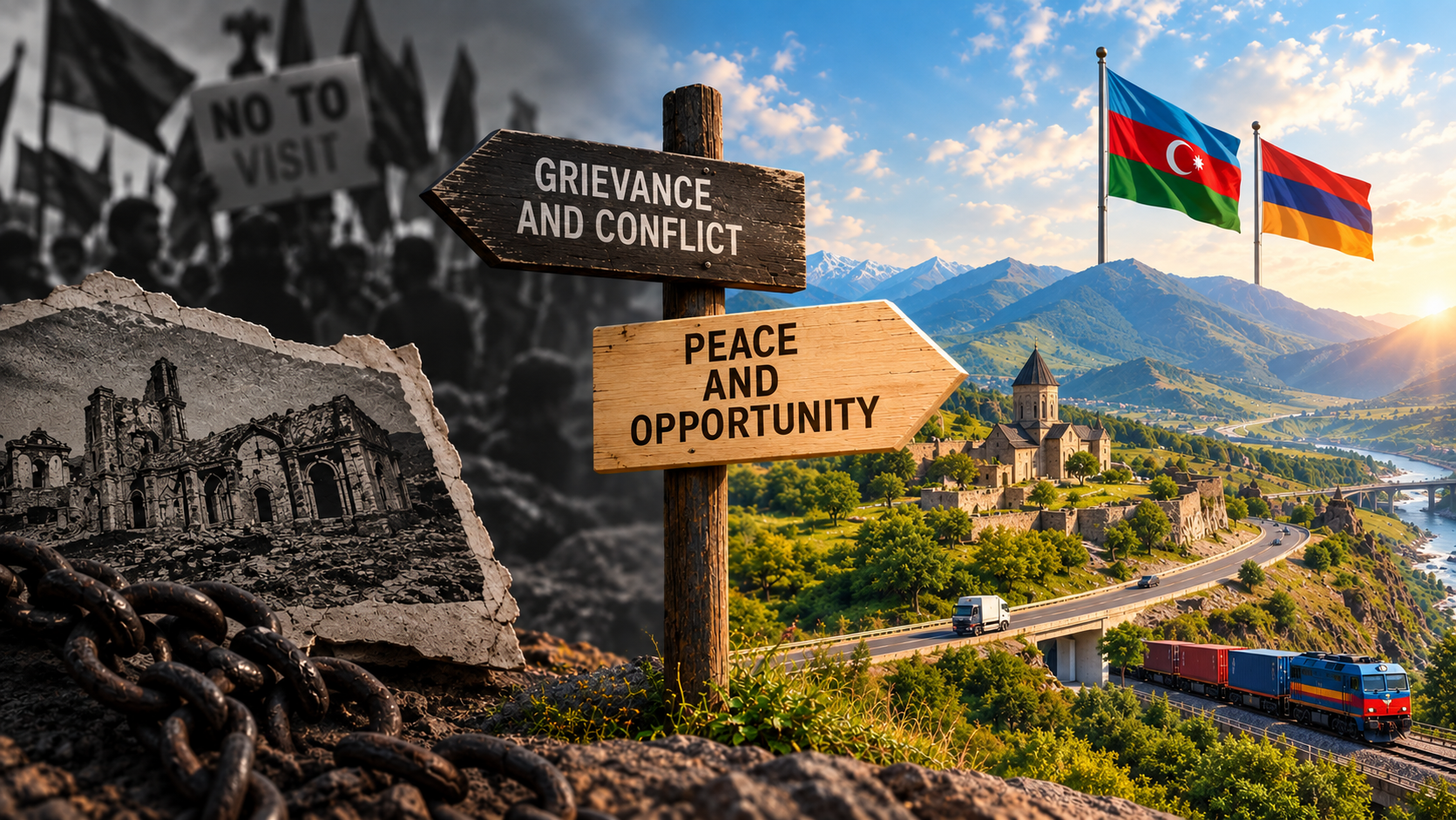
*the cover image has been generated by artificial intelligence.
Here we are to serve you with news right now. It does not cost much, but worth your attention.
Choose to support open, independent, quality journalism and subscribe on a monthly basis.
By subscribing to our online newspaper, you can have full digital access to all news, analysis, and much more.
You can also follow AzerNEWS on Twitter @AzerNewsAz or Facebook @AzerNewsNewspaper
Thank you!