
Azerbaijan and Türkiye eye an “Electric TANAP” for green power

Akbar Novruz
Read moreFor thirty years, the Azerbaijan-Türkiye energy relationship has meant one thing above all: gas, moving in one direction, through pipe. That relationship has been prodigiously profitable. At the 5th Azerbaijan-Türkiye Energy Forum, held in Baku this month and co-chaired by energy ministers Parviz Shahbazov and Alparslan Bayraktar, officials put a number on three decades of cooperation: 561m tonnes of oil and 196bn cubic metres of gas delivered from Azerbaijan to Türkiye and onward markets through existing infrastructure. Of the 130bn cubic metres of that gas that reached Türkiye specifically, 40bn cubic metres travelled via the Trans-Anatolian Natural Gas Pipeline (TANAP) alone, the backbone of the Southern Gas Corridor and, at 1,850km, more than half its total length. In the first eight months of this year, Türkiye took 6.2bn cubic metres, European buyers received 7.5bn cubic metres via Turkish territory, and Syria, a market that barely registered a decade ago, took 1bn cubic metres.
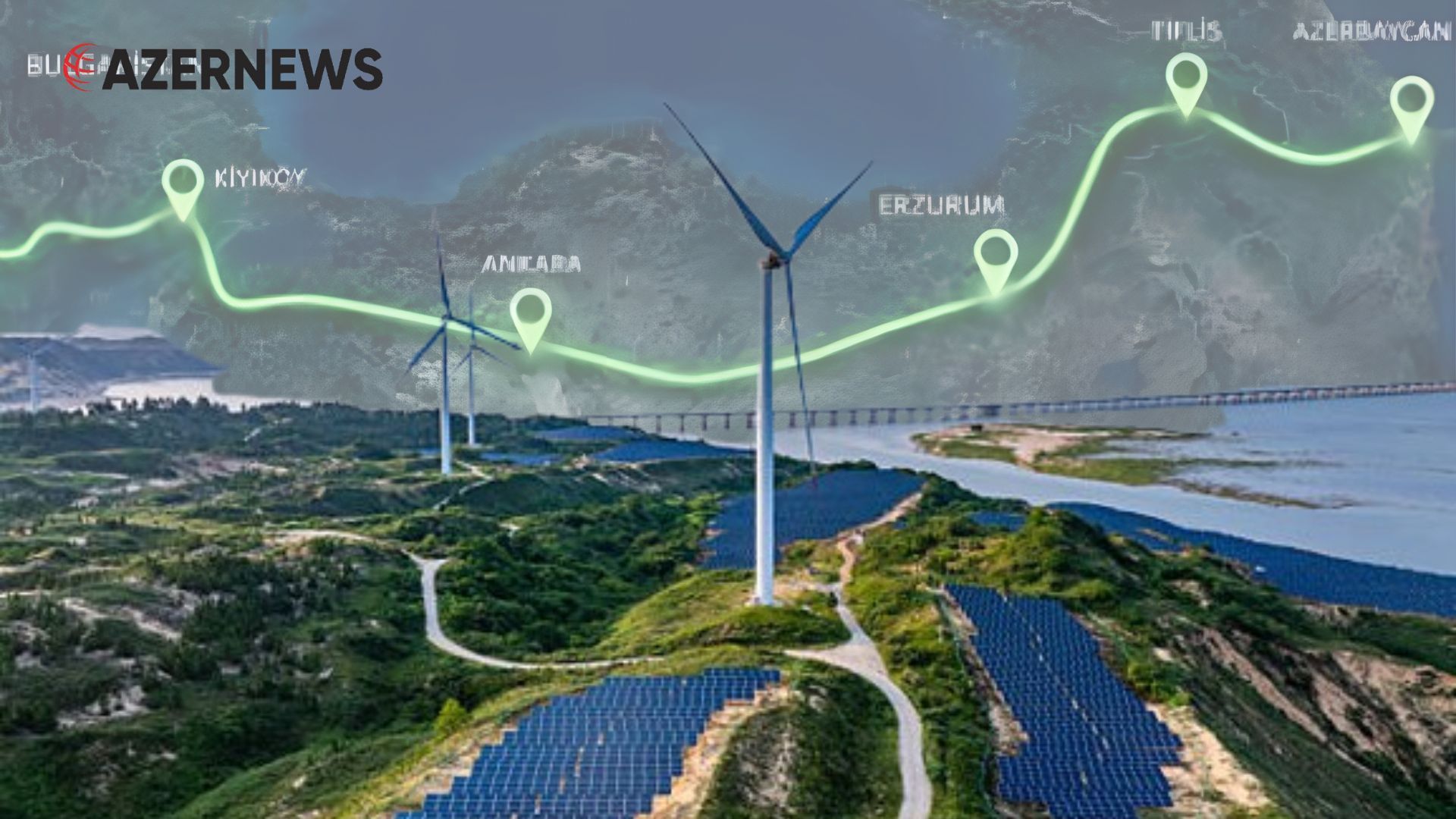
This is the paragraph that officials enjoy reciting. The far more intriguing one is the one that is hidden further down in the text of the forum’s declaration, and it speaks of what happens next – not a new pipeline, but a wire. The officials are now starting to speak of “Electric TANAP,” a deliberately stolen metaphor and a pretty good one, as it speaks of an interconnected high voltage grid that will tie Azerbaijani, and ultimately Central Asian, energy production to Türkiye and Europe.
According to Parviz Shahbazov, speaking at the forum, digitalization, artificial intelligence and growth of data centers are making electricity "one of the key strategic resources for economic development" – an idea which does not seem exaggerated when considering the upward revision of power-needs projections in Europe and Central Asia due to AI infrastructure. Gas pipelines took many years to reach the necessary political consensus, while the logic in Baku and Ankara now is that the necessary institutions of cooperation and trust have been built already and only need to be shifted from compressor stations and valves to electric grids and storage.
Geography plays into it nicely as well, which is known to everybody. Azerbaijan already has signed a Strategic Partnership Agreement in Bucharest in December 2022 with Georgia, Romania, and Hungary to construct a submarine cable capable of transmitting up to 4 gigawatts of green energy from the coastline of Georgia on the Black Sea to Romania – the so-called Black Sea Green Energy Corridor, whose feasibility study was revealed at COP29 in Baku. Currently, Azerbaijan's generating capacity amounts to 8.4 gigawatts, of which more than 20% is renewable sources of energy despite the fact that the government has made an ambition to increase the share of renewables in the power sector to 30% by 2030. According to the World Bank, the potential of offshore wind energy in the Caspian Sea alone can reach 157 gigawatts.
Nakhchivan's new relevance
The place where the narrative of electricity has a very direct connection to politics today is Nakhchivan. The fact that the Iğdır-Nakhchivan gas pipeline opened this year has already provided a second route for this isolated enclave to receive energy from Türkiye, and the next stage – that of high-voltage electricity through the Zangezur corridor and turning Jabrayil-Aghband and similar routes into electricity corridors as well – was presented at the forum as the solution that will finally allow Nakhchivan's renewable energy potential to reach the grid of Türkiye and not remain stranded in the corridor, which even now lacks its section on the territory of Armenia. As analysts tracking the project say, the export potential could be in the region of 1-2 gigawatts from the region, although like many parts of the corridor's infrastructure, this figure will become clear only after construction of the disputed Armenian part begins.
Capital movements paint their own picture of reciprocity. SOCAR, Azerbaijan’s state-owned oil and gas company, is buying up power production facilities in Türkiye, including an 870 megawatt plant, effectively taking decades of upstream profits and turning them into downstream Turkish power generation infrastructure. TPAO, Türkiye’s state oil company, is buying stakes in offshore exploration in Azerbaijan, including the Shafag-Asiman block and the premier Azeri-Chirag-Guneshli blocks, adding to a trend of both countries having physical investments, as opposed to contractually bound obligations, in the energy economies of the other country. This mutual investment, rather than “language of unshakable brotherhood” (Bayraktar’s phrase, spoken without apparent irony), gives the electricity shift a reality beyond aspirations. Both sides have interests in each other’s power grid already; making this connection between gas and oil and power becomes a natural progression.
None of the above should distract from the amount of work yet to be done. Feasibility studies are all that have been completed on the Black Sea cable. The Zangezur Corridor’s Armenian link – the only connection Nakhchivan could make to the network – has not been given any date of beginning construction by mid-2026, despite the signing of an agreement with a contractor. Even Azerbaijan’s own renewable power capabilities, whatever its theoretical maximum of 157 gigawatts of renewable electricity generation in the Caspian, are a small fraction of that, constructed piecemeal through such projects as the $173.5m AZURE loan from the World Bank, which will unlock another $384m in onshore wind power. “Electric TANAP” is a framing concept and a strategic objective more than it is a construction timetable for now. But to be fair, so too was cooperation on gas between Baku and Ankara in the early 1990s, and today that collaboration moves 200bn cubic metres of product and is a cornerstone of southeastern Europe’s energy security. Should the electrons take the same 30-year path as the molecules did, then the 5th Energy Forum might, in retrospect, appear to have been more than a diplomatic nicety.
Here we are to serve you with news right now. It does not cost much, but worth your attention.
Choose to support open, independent, quality journalism and subscribe on a monthly basis.
By subscribing to our online newspaper, you can have full digital access to all news, analysis, and much more.
You can also follow AzerNEWS on Twitter @AzerNewsAz or Facebook @AzerNewsNewspaper
Thank you!