
Why does heritage of Caucasian Albania bother Armenia?
Qabil Ashirov
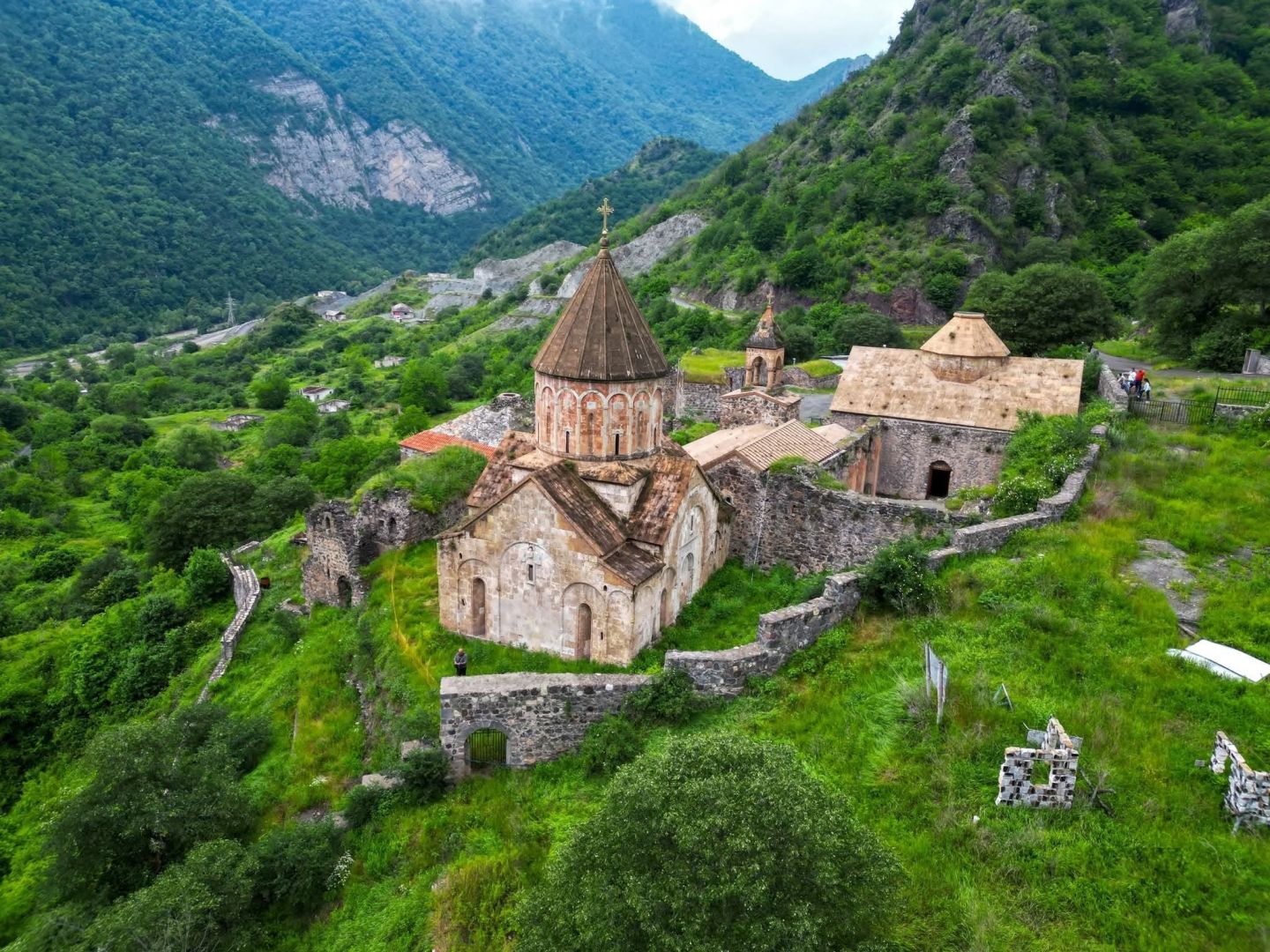
Read moreThe recent visit of diplomats to Karabakh and their visit to places related to the Christian heritage of Caucasian Albania as part of the visit have caused some concern in Armenia. The statements made by the Deputy Speaker of the Armenian Parliament, Ruben Rubinyan, on this subject also show that the issue has reached a political level. He said that such steps do not serve peace between Azerbaijan and Armenia.
It would not be wrong to say that the statements of the Speaker of the Armenian Parliament regarding Caucasian Albania call into question the peace process on the horizon between the two countries. Because, unfortunately, denying Caucasian Albania and its cultural heritage forms the basis of the irredentist policy pursued by the Armenian state against Azerbaijan.
The fact that a state that existed centuries ago and has long disappeared from the historical stage is still a subject of controversy in the 21st century may seem strange to many people. But what can one say? This lies at the heart of some of Armenia’s peculiar ideas. I was also surprised by this when I first encountered it.
Let me put it this way: when I had just graduated from university, I regularly followed the Armenian media. Azerbaijan’s economy was developing rapidly, and naturally, this was also contributing to the strengthening of the Azerbaijani military. Contrary to what one might have expected, however, what seemed to concern Armenian media and intellectuals more was Azerbaijani national identity and Azerbaijan’s efforts to embrace its Caucasian Albanian heritage, rather than the rapid growth of the Azerbaijani economy.
I only understood the reason for this much later. For years, Armenian media and intellectuals have been trying to argue that Azerbaijanis are not indigenous to this region and that they arrived here much later as a nomadic people. In their own view, they seem to believe that if they can convince the world that Azerbaijanis are a nomadic people who only arrived in the region in the Middle Ages, the entire world will ultimately support their position.
What I have described may seem contradictory to many people. Yet anyone who regularly follows the Armenian media can easily get the impression that Armenians live in a parallel world.
For example, according to their claims, Armenians were the first people in the world to adopt Christianity as a state religion. Yet it is widely known that the Kingdom of Edessa was the first state to declare Christianity its official religion.
They also claim that Armenian genius lay behind Napoleon’s successes, supposedly because his closest servant was an Armenian from Karabakh. Apparently, Armenian genius was also behind Russia’s defeat of Napoleon. They even claim that it was Armenian marshals who led Russia to victory in World War II.
Apparently, they invented apricots, invented television, and so on. In fact, just two or three years ago, the Armenian media held an extensive discussion inspired by Donald Trump’s MAGA program and had supposedly “proved” that Armenians were the ones who made America “great.”
This is a state that managed to hold out against Azerbaijan for 44 days with the help of this or that outside power, is one of the poorest nations in the Caucasus, and sees thousands of its people leave the country every year. Yet somehow, everything seems to benefit everyone except itself. Neither they nor we seem able to understand this contradiction.
Armenians seem to believe that the more often they repeat something, the more people around them will eventually believe it. For example, they have been trying to present the Govhar Agha Mosque in Karabakh and the Blue Mosque in Yerevan to the world as Iranian mosques. Yet they fail to understand that, unlike Christianity, Islam does not traditionally identify places of worship — mosques — by the nationality of their congregation or community. In Christianity, for example, there are Russian Orthodox churches, Armenian Catholic churches and so on, whereas Islam does not have an equivalent system. There are mosques and jami mosques. They seem to assume that nobody knows the facts and that, if they repeat this narrative often enough, the rest of the world will simply accept it as truth.
Unfortunately, because we are the ones being targeted, we are also compelled to respond in order to expose what we see as these false claims.
Caucasian Albania holds a very important place in the history and statehood of modern Azerbaijan. There is considerable historical information about Caucasian Albania. According to historical records, this state, which was home to 26 different peoples, maintained its existence in the region until the Arab conquest. The Arab conquest brought an end to the state’s political existence, and although it was later succeeded by the Muslim Shirvanshah state, the Albanian Church managed to preserve its existence until the period of Russian rule in Azerbaijan, that is, until the 19th century.
As mentioned above, what makes Caucasian Albania unique is the fact that it was a Christian state. In The History of Albania by Movses Kaghankatvatsi, which provides some of the most detailed historical information about Caucasian Albania, it is stated that the head of the Armenian Church wrote to the Albanian Church demanding that the Albanians dissolve their own church and join the Armenian Church. In response, the Albanian Church reportedly stated that the Albanians had adopted Christianity earlier than the Armenians and that, in fact, it was the Armenian Church that should dissolve itself and join the Albanian Church. After Russia occupied Azerbaijan, a similar letter was reportedly sent to the Russian tsar. The tsar then fulfilled the Armenian Church’s request, abolishing the Albanian Church in the 1830s and transferring its entire heritage to the Armenian Church.
In fact, the situation described above suggests that the roots of Armenian claims, particularly those of the Armenian Church, concerning Karabakh go back not merely 30 or 40 years, but hundreds of years. Movses Kaghankatvatsi’s History of Albania explicitly describes Karabakh as having played a kind of natural fortress role in the history of Caucasian Albania because of its geographical position. Albanian kings are said to have taken refuge in Karabakh during enemy attacks. Kaghankatvatsi also describes numerous churches and religious complexes, including Aghoghlan and Amaras. He provides detailed accounts of the relics kept in these churches and how they were displayed to the local population. In addition, the historical record identifies Partav, located in what is now the lowland Karabakh region and known today as the city of Barda, as one of the capitals of Caucasian Albania. The Aghuen Church Council, which held an important place in Albanian ecclesiastical law, is also said to have been held in what is now Karabakh.
There are dozens of examples demonstrating the important place Caucasian Albania occupies in the history and statehood of Azerbaijan. Yet, for some reason, this seems to irritate Armenians living in their parallel world. As noted above, Armenians seem to believe that they can erase from history this unique state, which was initially Christian and later embraced Islam. They appear to assume that the descendants of the Albanians who converted to Islam — that is, us Azerbaijanis — will be ashamed of the fact that our ancestors were Christians and will therefore reject that part of our history.
Apparently, Armenians think that Islam consists of nothing more than the radical Muslims they see on YouTube today. What they forget, however, is that Azerbaijan is a multicultural and secular country. We would like to remind those living in this parallel world that, before Christianity, the population of what is now Azerbaijan also practiced Zoroastrianism. Unlike them, we are neither ashamed of our ancestors nor do we intend to deny them.
Here we are to serve you with news right now. It does not cost much, but worth your attention.
Choose to support open, independent, quality journalism and subscribe on a monthly basis.
By subscribing to our online newspaper, you can have full digital access to all news, analysis, and much more.
You can also follow AzerNEWS on Twitter @AzerNewsAz or Facebook @AzerNewsNewspaper
Thank you!