
Iran says 'now best time' to solve nuclear dispute with West
By Sara Rajabova
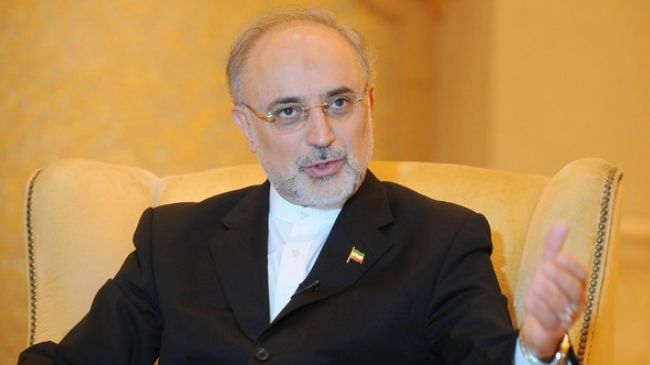
Iranian Foreign Minister Ali Akbar Salehi has said prospects for resolving the conflict over Iran's nuclear program have improved following signs of "good faith" from Western powers, Press TV reported.
Iran considers that the P5+1 powers want to solve the problem, Salehi said at a news conference in Tehran on Monday.
Commenting on the discussions last month in Almaty, Salehi said this is the best time for resolving the nuclear dispute between Iran and the West.
"I have some information that I prefer not to talk about, but it shows that the sanctions over Iran would be eased in the next solar year," he said.
Iran's solar year will start on March 19.
Salehi went on to say that Iran has attempted to bypass imposed sanctions in a creative and innovative way and most of the sanctions have been neutralized so far.
Salehi's statement over the neutralization of the sanctions came after the International Energy Agency said last month that Iran had lost $40 billion in oil revenues in 2012 due to the sanctions and the chairman of Iran's Parliamentary Economic Committee, Gholamreza Mesbahi-Moqaddam, has predicted that the administration would face 540 trillion rials (some $44 billion) budget deficit in the current calendar year.
Last time, Iranian delegates met with those from China, Germany, France, Russia, the UK and the U.S. in Kazakhstan on February 26 and 27. No diplomatic breakthrough was announced and the details of an international proposal to Iran weren't released. The sides agreed to meet in Almaty again on April 5-6 for the next round of negotiations after "expert-level" talks in the Turkish city of Istanbul on March 17-18.
Meanwhile, prominent American Middle East expert Gary Sick warned when speaking about the possibility of new US sanctions on Iran that any fresh round of US embargoes against Iran would jeopardize the prospect of comprehensive negotiations between Iran and the world powers.
"A new round of sanctions at this moment, when serious talks seem to be getting underway for the first time in eight months, risks sabotaging the limited progress that has been made," Sick said.
"Each time the United States imposes a new coercive restriction on Iran, Iran responds by upping the ante on its nuclear program," said Sick, a Columbia University professor who has served on the National Security Council under former US Presidents Ford, Carter and Reagan.
In the latest talks with Iran, the P5+1 reportedly demanded that Iran stop enriching uranium up to 20 percent, ship out its stockpile of enriched uranium and shut down the Fordow nuclear facility near the central city of Qom. In return, the Western governments offered to lift some sanctions.
The six world powers offered that they would ease gold, petrochemical and banking sanctions against Iran, if it scaled back nuclear activity the West fears could be used to build bombs.
Meanwhile, UN Secretary-General Ban Ki-moon described the Almaty talks between Iran and the P5+1 as positive, urging Iran to respond to international concerns about its nuclear energy program.
Ban Ki-moon said the negotiations between Iran and the P5+1 have been useful, stressing that the confidence building efforts by Iran would help resolve the nuclear disagreement.
Also, Japanese Deputy Foreign Minister Akitaka Saiki has welcomed Iran's talks with major world powers over its nuclear energy program as "positive" and "constructive." In a meeting with Minister Salehi in Tehran on Sunday, Saiki said the negotiations have been constructive and effective, and have created trust between the two sides.
Russia also binds hopes with the forthcoming Iran-P5+1 talks in Almaty. Russian Ambassador to the UN Vitaly Churkin has expressed hope about the success of the next round of negotiations between Iran and the six major world powers.
Churkin expressed hope that the meeting over Iran's nuclear issue would not be inconclusive, and the parties can move closer in their positions.
In early 2012, the US and the European Union imposed new sanctions on Iran's oil and financial sectors with the goal of preventing other countries from purchasing Iranian oil and conducting transactions with the Central Bank of Iran.
The sanctions were imposed based on the accusation that Iran is pursuing non-civilian objectives in its nuclear energy program. Iran rejects the allegations, arguing that as a committed signatory to the nuclear Non-Proliferation Treaty and a member of the International Atomic Energy Agency, it has the right to use nuclear technology for peaceful purposes.
Here we are to serve you with news right now. It does not cost much, but worth your attention.
Choose to support open, independent, quality journalism and subscribe on a monthly basis.
By subscribing to our online newspaper, you can have full digital access to all news, analysis, and much more.
You can also follow AzerNEWS on Twitter @AzerNewsAz or Facebook @AzerNewsNewspaper
Thank you!