
Türkiye targets central role in Europe’s strategic order through Erdoğan’s EU push

Akbar Novruz
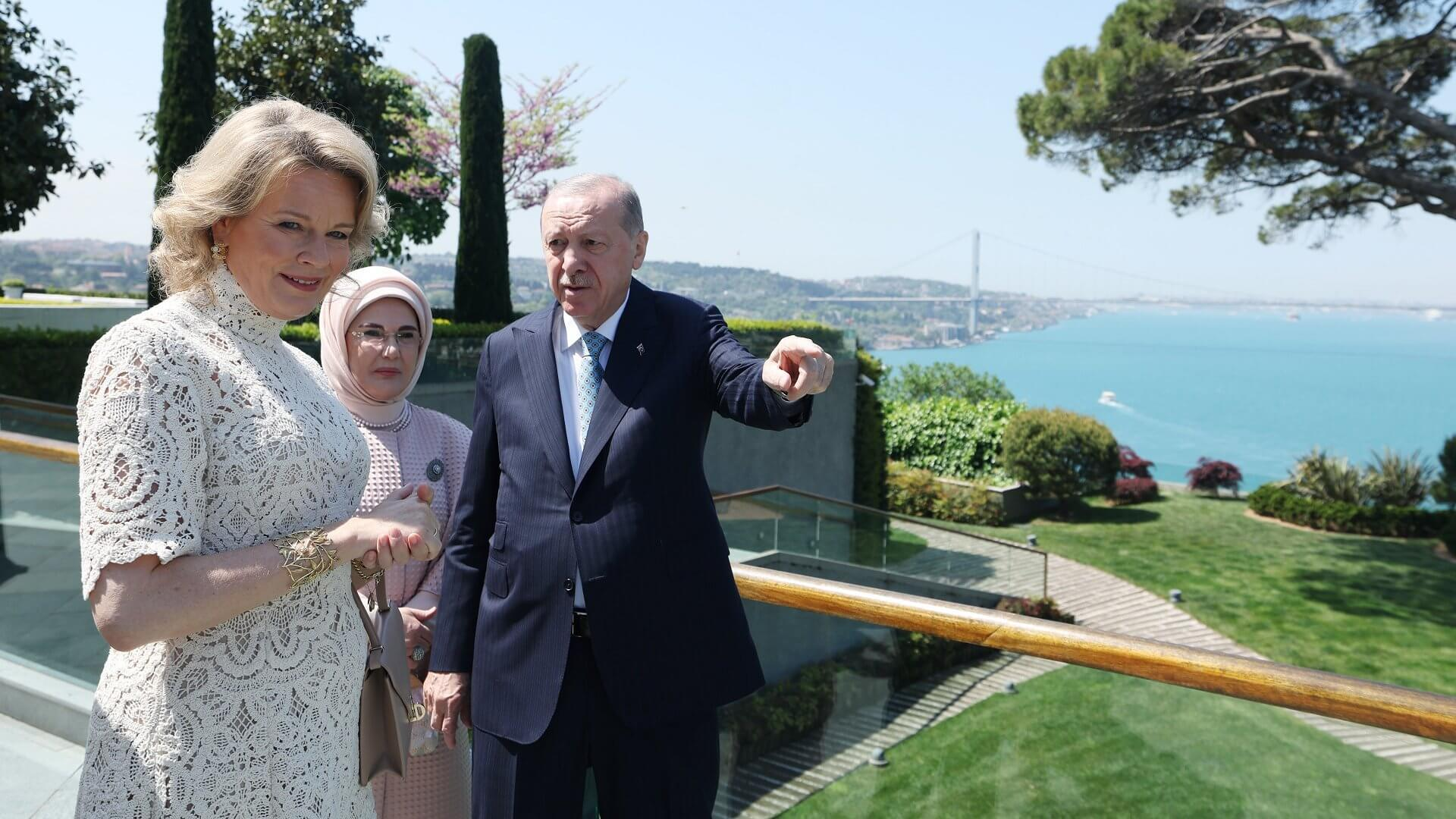
Read morePresident Erdoğan met Belgian Queen Mathilde in Istanbul on Monday. He called updating the EU-Türkiye Customs Union "a key area necessitating swift progress" and said Türkiye's participation in EU defence initiatives is "in the mutual interest of all sides."
Perhaps such an unexpected, open statement from the Turkish leader raises curiosity about why, in such a different context, he is emphasizing the enhancement of relations. In this paper, we will explore what this means and why it is happening now.
From its economic perspectives, the answer to this is quite easy to tell. The Customs Union came into effect from 1 January 1996. This agreement permits most industrial products to flow freely between Türkiye and the EU, which today is Türkiye's largest trading partner, with two-way goods trade soaring to a record €210 billion in 2024, making Türkiye the EU's fifth-largest trading partner. On paper, it appears to be a successful story, except for one flaw – the document was devised in the 1990s.
The core grievance on the Turkish side is structural asymmetry. While the Customs Union has provisions for industrial goods, it makes no provision whatsoever for services, agriculture, or public procurement, which are all fields in which there is great potential for commercial transactions, but which are all fields where Türkiye is denied preferential access that it would be entitled to under membership within the European Union or at least a state-of-the-art Free Trade Agreement. Moreover, since Türkiye uses the EU common external tariff in transactions with third parties, each time the EU signs an FTA – such as the one signed with India in January 2026 or the ones with Mercosur or Singapore – the exports of the latter get preferential access into Türkiye through the European Union.
To put it into perspective, for example, the EU-India FTA concluded in January 2026 will allow Indian goods to circulate freely into Türkiye via the EU, while Turkish exports to India continue to face India's standard tariff regime. Indian textile and apparel exports to the EU are projected to approach $100 billion annually by 2030, directly competing with Turkish textiles, one of Türkiye's largest export sectors.
Now the thing is that, this has been a core issue as well, 10 years ago. The European Commission has proposed a modernization mandate since December 2016, to be precise. However, the mandate has never been approved by the EU Council, which is largely influenced by Cyprus and Greece, who have effective veto rights over decisions regarding Türkiye in the context of the EU. As of February 2026, Bolat, the Turkish Trade Minister, stated that out of 29 technical topics, 15 have been agreed upon in the High-Level Dialogues. However, without the approval of the mandate, the negotiations cannot officially commence. There are no economic doubts, as the institute and Ifo Institute predict that modernization will increase Türkiye’s GDP by 2.5% and its EU trade by €25 billion by 2030. The core problem once again came back to politics.
Given the significance of Türkiye's rising power - even boosted since the war in the Gulf. What that means is it became the dominant power in the Middle East, undoubtedly. In short, the convergence of Türkiye's geopolitical leverage.
Ankara is hosting the NATO Leaders Summit on 7–8 July. This is the first time that the summit takes place on Turkish soil since 2004. Then follows COP31 in Istanbul and Antalya later in November, with about 196 world leaders in attendance. With the addition of OTS, 2026 is easily Türkiye’s busiest year in terms of diplomatic summits. At the same time, the Iran war, as well as the war between Russia and Ukraine, has put Türkiye in a situation whereby its strategic importance – the second-largest army within NATO, Bayraktar drones deployed on the battlefield, a gas pipeline country, and intermediary between Kyiv and Moscow- is more recognized in Brussels than ever before. This explains Erdoğan’s call to include Türkiye in EU defense projects.
Saying this, the real question is, could this be a significant step towards Türkiye's accession to the bloc?
Honesty is the Customs Union modernisation and EU membership are two different conversations, and conflating them, as Erdoğan frequently does, is partly strategic. Full EU membership for Türkiye is not a realistic near-term prospect. The process of accession talks kicked off in 2005 and was almost put on ice due to issues of the rule of law and the dispute over Cyprus.
However, the geopolitics of 2026 have introduced a new dimension into the equation that was absent at the time of the failed negotiations. Armenia, which has long been one of Türkiye’s most difficult relationships based on its century-old dispute over the genocide claim, with its closed borders never having been reopened since 1993, has become an ally of the EU in a significant way. Indeed, the elections in Yerevan on June 7th are being carefully observed by Brussels, seeing the results as an indication of whether Armenia is capable of continuing its journey towards Europe despite any political opposition from pro-Russian factions within its country.
The connection to Türkiye is direct and underappreciated. For the peace process between Armenia and Azerbaijan, which is being officially promoted by the 2025 Washington declaration signed in August and now on the verge of the potentially decisive 2026, economic implementation requires the participation of Türkiye. Indeed, the TRIPP transport corridor linking Azerbaijan to its Nakhchivan exclave through Armenia's territories, along with the currently under construction 224-km-long railway connecting Nakhchivan with the Turkish railway system through the Kars-Iğdır-Aralık-Dilucu line, form a triangular scheme of links involving Ankara, Baku, and Yerevan. A normalized relationship with Armenia, the borders between the two nations have been closed since 1993, and diplomatic ties were suspended, will be the last element in the scheme of connections in the South Caucasus area. This part could potentially be raised if things go as expected.
Customs Union modernization on the other hand, is another goal, which is attainable. It is not necessary to gain consensus from all the other EU members on account of the process being similar to an accord, and therefore, if there is the possibility of gaining a mandate from the Council, it can actually be attained rather quickly, considering the technical aspect of it (15 out of 29 issues sorted). The wise interpretation of the strategy of Erdoğan would be that he is utilizing the terminology of EU membership to put more pressure on the matter of Customs Union modernization.
Nevertheless, the structural obstacles, such as Cyprus, will not disappear just because there was an effective meeting between the Belgian royals and Türkiye in Istanbul. Rather, what the meeting on Monday shows is that Türkiye is employing every diplomatic option possible to form a coalition of pro-modernisation EU member states versus the opposing camp of the minority that stands in its way. This process is deliberate, systematic, and, given the international environment, more likely to bear fruit than ever before. Whether this success is achieved within the window of opportunity that Türkiye enjoys strategically is the issue that will shape Türkiye-EU relations for the next decade.
Here we are to serve you with news right now. It does not cost much, but worth your attention.
Choose to support open, independent, quality journalism and subscribe on a monthly basis.
By subscribing to our online newspaper, you can have full digital access to all news, analysis, and much more.
You can also follow AzerNEWS on Twitter @AzerNewsAz or Facebook @AzerNewsNewspaper
Thank you!