
Global trade chokepoints turning Baku into Eurasia’s gateway
Akbar Novruz
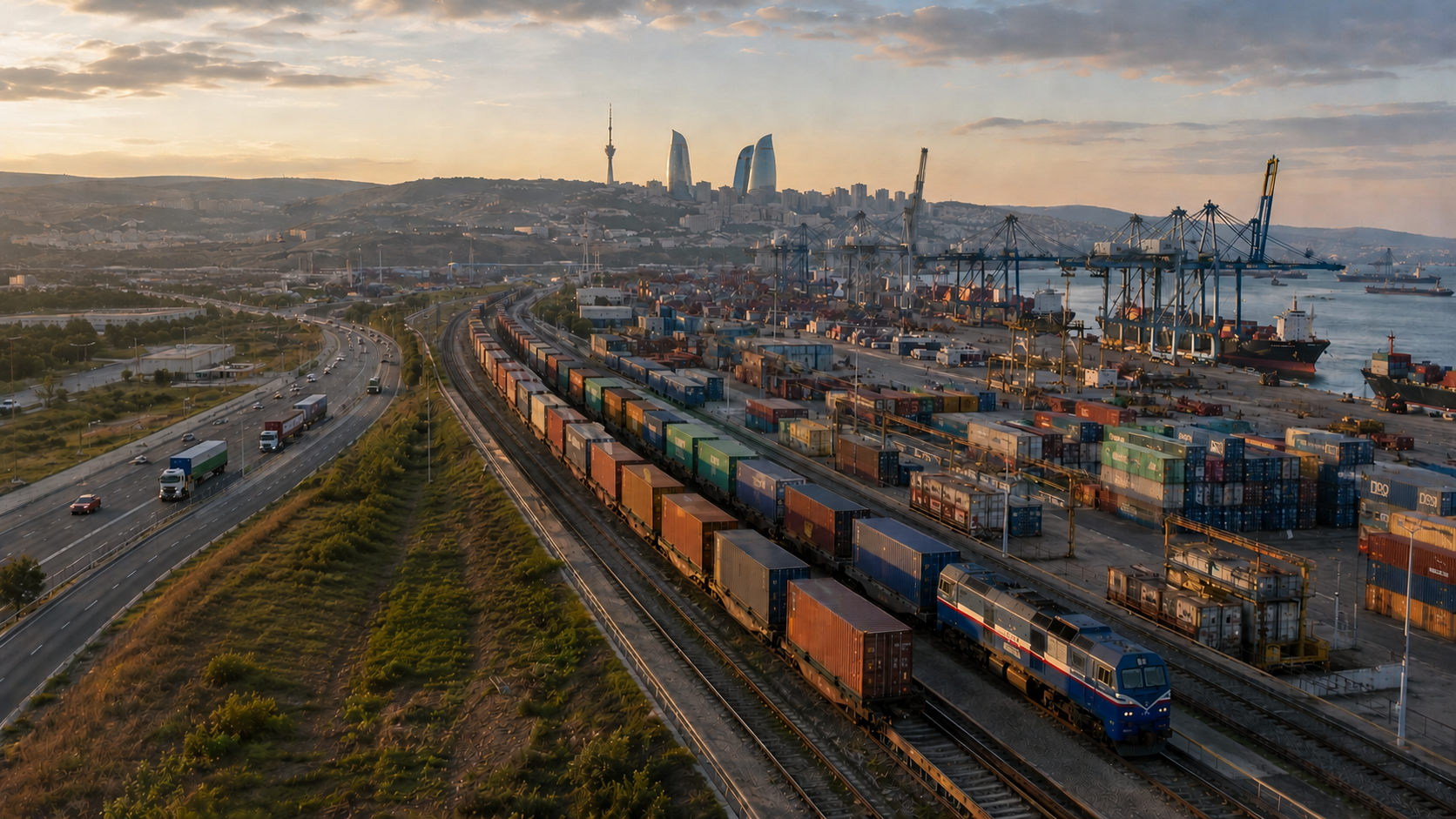
Read moreSince 2008, the International Transport Forum has been hosted in Leipzig every year in May, and there have been few exceptions when the situation was not dire in any sense. However, the 2026 ITF held under the Azerbaijani presidency and featuring an exclusive session on the Middle Corridor had an exceptional degree of concentration on it. The Strait of Hormuz has been blocked by the naval confrontation between Iran and the United States of America for three months now. The Red Sea remains unsafe due to the Houthis' missile strikes, forcing ships to take a detour along the African coast, thus adding two to three extra weeks and extra costs to sea traffic from Asia to Europe. Finally, the Northern Corridor through Russia has become inaccessible because of the sanctions imposed on Russia since 2022. No alternatives left for the Middle Corridor function are free from restrictions, either. In other words, the more than 1,200 attendees from 80 countries who arrived in Leipzig this week to discuss transport infrastructure could speak to something real.
Such a coincidence did not go unnoticed by Azerbaijani Transport Minister Rashad Nabiyev, who represented his nation as the president of the ITF for 2025–26, the first time for Baku to chair what is, uniquely in the world, the sole international governmental organization for transport policy. "Resilience is not only an engineering question, but it is a financing question," he told the opening plenary. "Building systems that can withstand, adapt, and recover takes long-term planning, smarter spending, and technology that lowers costs over time." Precise wording indeed, the Middle Corridor’s choke point is no longer political or even logistics-related. It is money.
| Route | Normal volume | Current status | Middle Corridor |
| Strait of Hormuz | 20% of the world's oil and LNG | Blockaded, US-Iran standoff, 3 months | BTC pipeline bypasses entirely |
| Red Sea / Bab el-Mandeb | 12% of global trade, 30% of container traffic | Hostile, Houthi attacks are forcing Africa to reroute | Overland Trans-Caspian bypasses entirely |
| Northern Corridor (via Russia) | Dominant China-Europe rail route pre-2022 | Effectively suspended, Western sanctions | Direct alternative; 90% traffic growth since 2022 |
| Panama Canal | 6% of world trade; 40% of US container traffic | Periodic drought closures; reduced capacity | Indirectly adds pressure on all alternative routes |
| Middle Corridor (TITR) | 76,900 TEUs in 2025; 390 block trains China-Europe | Operational and growing, the only major route bypassing Russia AND Iran | The route itself — capacity expansion is the constraint |
******
The final session of the ITF Summit held on 8 May was devoted exclusively to the Middle Corridor, with the headline "Strategic Investment in Resilient, Competitive and Future-Ready Eurasian Connectivity." Rahman Humbatov, the Deputy Minister, noted that the corridor "offers quick transit, route stability, and access to new markets," and highlighted Azerbaijan's investment in the Baku-Tbilisi-Kars railway, Baku International Seaport, and Alat Free Economic Zone as the infrastructure pillars of the project that would turn the country's "geographical position into modern and efficient transit." This is no empty talk either. The railway was upgraded and ready for the 2025 deadline. The capacity of Alat Port will reach 25 million tonnes per year and has already exceeded last year's levels by 40.8%. The Alat Free Economic Zone brings together road, rail, maritime and air freight logistics in one system, the kind of multifunctional terminal that the Middle Corridor has been lacking from the moment it started increasing volumes. The issue of funding, identified by Nabiyev as the key limiting factor, is truly difficult to address. Developing countries located along the corridor, Uzbekistan, Tajikistan, and Kyrgyzstan, do not have enough resources for investment into reserve capacity. The developed countries, faced with the challenge of geopolitical fragmentation, are usually unwilling to allocate large sums for infrastructure in far-off locations with unpredictable political futures. This problem was also acknowledged by the ITF's own assessment of the situation in stating that the corridors requiring investment are located in the countries having the least capacity to obtain the necessary investments on commercial grounds.
The plan of investment worth €1.1 billion formulated by the EU in regard to Azerbaijan in 2019 was an attempt at addressing this situation. In turn, the program of the Asian Development Bank, worth $10 billion, was launched in Samarkand recently.
For this particular article, one sentence should be quoted in its entirety, as it perfectly reflects the dynamic that Leipzig mirrored and reinforced: “Real economics and transport geography will almost invariably trump dubious political adventurism.” It refers to the resolutions passed by the European Parliament against Azerbaijan in April, specifically, the resolutions by the parliaments of Belgium and the Netherlands calling for the release of prisoners and withdrawal of troops, which prompted Baku to summon ambassadors to protest. These resolutions were passed on the very day that talks between the EU and Azerbaijan resumed bilaterally in Brussels. Within two weeks, Meloni’s visit to Baku, Babiš’s 50-strong company delegation from the Czech Republic, and the Latvian President’s visit followed. The corridor needed by the Europeans traverses the country, which, at times, the Europeans legislate about for their human rights abuses. Both exist; neither negates the other.
However, the meeting was marked by Azerbaijan giving over the role of president to the Czech Republic, where the prime minister visited Baku only a week prior, looking for deals and opportunities in terms of gas agreements and metro systems. ITF Secretary General, Young Tae Kim, thanked Azerbaijan for its "successful and productive activities during its presidency," emphasizing that the emphasis on green transport, digital logistics, and sustainable development has "accelerated the modernisation process" in these realms. Formal language of intergovernmental thanks. Underneath it all, a somewhat different story emerges: a nation with just 10 million inhabitants, with waning oil reserves, and an outdated pipeline has managed to secure its place as the absolutely necessary transit point for the world's most important alternative trade route. And what's more, it got them to do it in a hall in Germany.
Here we are to serve you with news right now. It does not cost much, but worth your attention.
Choose to support open, independent, quality journalism and subscribe on a monthly basis.
By subscribing to our online newspaper, you can have full digital access to all news, analysis, and much more.
You can also follow AzerNEWS on Twitter @AzerNewsAz or Facebook @AzerNewsNewspaper
Thank you!