
How Zangilan becomes symbol of Azerbaijan’s post-conflict order
Elnur Enveroglu
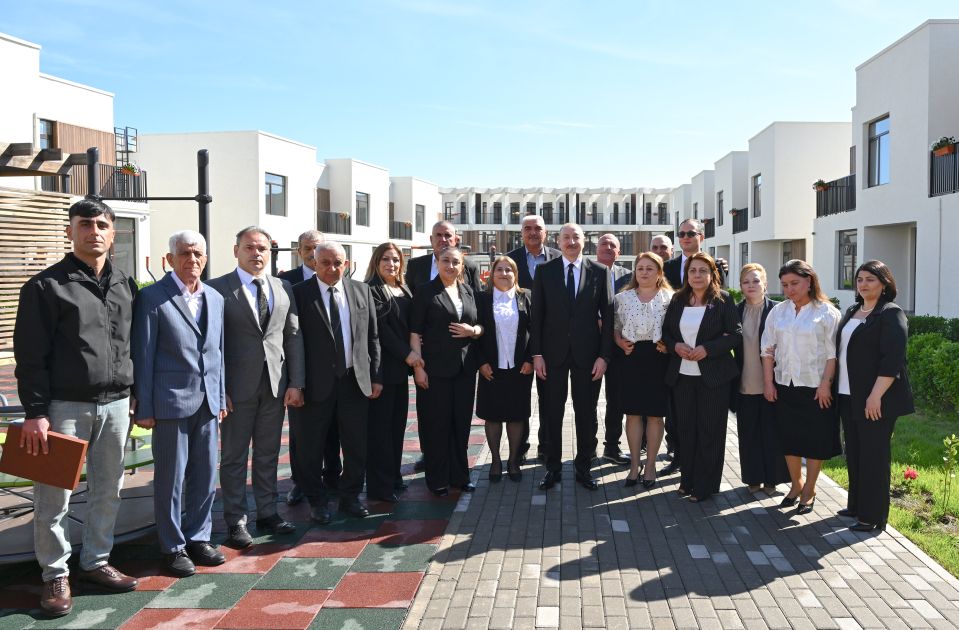
Read morePresident Ilham Aliyev’s meeting with families relocating to the first residential complex in Zangilan was far more than a ceremonial handover of apartment keys, which brought a smile of joy to many people's faces. The meeting in Zangilan was also a subtle political and historical statement about the future of Azerbaijan and, more broadly, the future geopolitical order of the South Caucasus.
Here, of course, the symbolism of Zangilan matters enormously.
For nearly three decades, Zangilan stood as one of the clearest examples of the destruction and demographic rupture caused by the Armenia-Azerbaijan conflict. Occupied in 1993, the district became part of a broader geography of displacement, devastation and frozen conflict that defined the post-Soviet South Caucasus. Today, however, Baku is attempting to transform Zangilan into the exact opposite: a symbol not of occupation, but of return; not of separatism, but of restored sovereignty; not of stagnation, but of reconstruction and connectivity.
This explains why President Aliyev chose Zangilan as the venue for one of his most politically significant speeches since the 2023 anti-terror operations in Garabagh.
The President’s remarks were notable not merely because they celebrated reconstruction, but because they framed recent events as the definitive end of separatism in the South Caucasus. His argument was clear: after the dissolution of the separatist structure in Garabagh in September 2023, the region has entered an entirely new historical phase in which the principle of territorial integrity has prevailed over the politics of ethnic fragmentation.
Whether one fully agrees with this interpretation or not, it undeniably reflects a profound transformation in regional realities.
For more than 200 years, the Caucasus has been shaped by imperial rivalries, ethnic engineering and externally backed separatist movements. From the Russian Empire to the Soviet Union and the chaotic decades that followed the collapse of the USSR, unresolved territorial conflicts became instruments of geopolitical influence. The South Caucasus effectively existed in a permanent state of strategic uncertainty.
Azerbaijan now argues that this era has ended.
The Azerbaijani President's statement that “we are the authors of this peace” was therefore not simply rhetorical triumphalism. It reflected Baku’s growing confidence that it has shifted from being a state defending its territorial integrity to one actively shaping the region’s political architecture. The message from Zangilan was that Azerbaijan no longer sees itself through the prism of victimhood or unresolved conflict, but as the principal driver of a new regional order based on sovereignty, transport connectivity and economic integration.
Yes, Zangilan itself embodies this transition.
Geographically, the district occupies a strategic position near the borders with both Iran and Armenia. Politically, it has become one of the flagships of Azerbaijan’s “Great Return” programme. Symbolically, it demonstrates the state’s attempt to convert military victory into long-term demographic and economic permanence.
The image of displaced families receiving keys to newly built homes carries enormous political weight because it reverses one of the defining traumas of the conflict: forced displacement. In Azerbaijani political discourse, the return of civilians is presented as the ultimate confirmation that the post-war reality is irreversible.
At the same time, President Aliyev’s speech also carried an external geopolitical message. His criticism of foreign actors and references to European observers on the Armenian border reflected Baku’s growing frustration with what it perceives as selective approaches by some Western institutions. The underlying implication was that Azerbaijan achieved on the battlefield and through state policy what decades of international mediation failed to accomplish.
However, the broader significance of Zangilan lies in something deeper than diplomacy alone. The city is increasingly being presented as a model for how Azerbaijan wants the post-conflict South Caucasus to function: secure borders, restored infrastructure, regional trade corridors and the reintegration of territories under central state authority.
In this sense, Zangilan is no longer merely a liberated district. It has become a political stage upon which Azerbaijan is projecting its vision of the future Caucasus, the one in which the era of frozen conflicts and separatist entities is over, and where the balance of power has decisively changed.
Here we are to serve you with news right now. It does not cost much, but worth your attention.
Choose to support open, independent, quality journalism and subscribe on a monthly basis.
By subscribing to our online newspaper, you can have full digital access to all news, analysis, and much more.
You can also follow AzerNEWS on Twitter @AzerNewsAz or Facebook @AzerNewsNewspaper
Thank you!