
bp joins SOCAR in race to unlock Ustyurt’s untapped reserves
Akbar Novruz
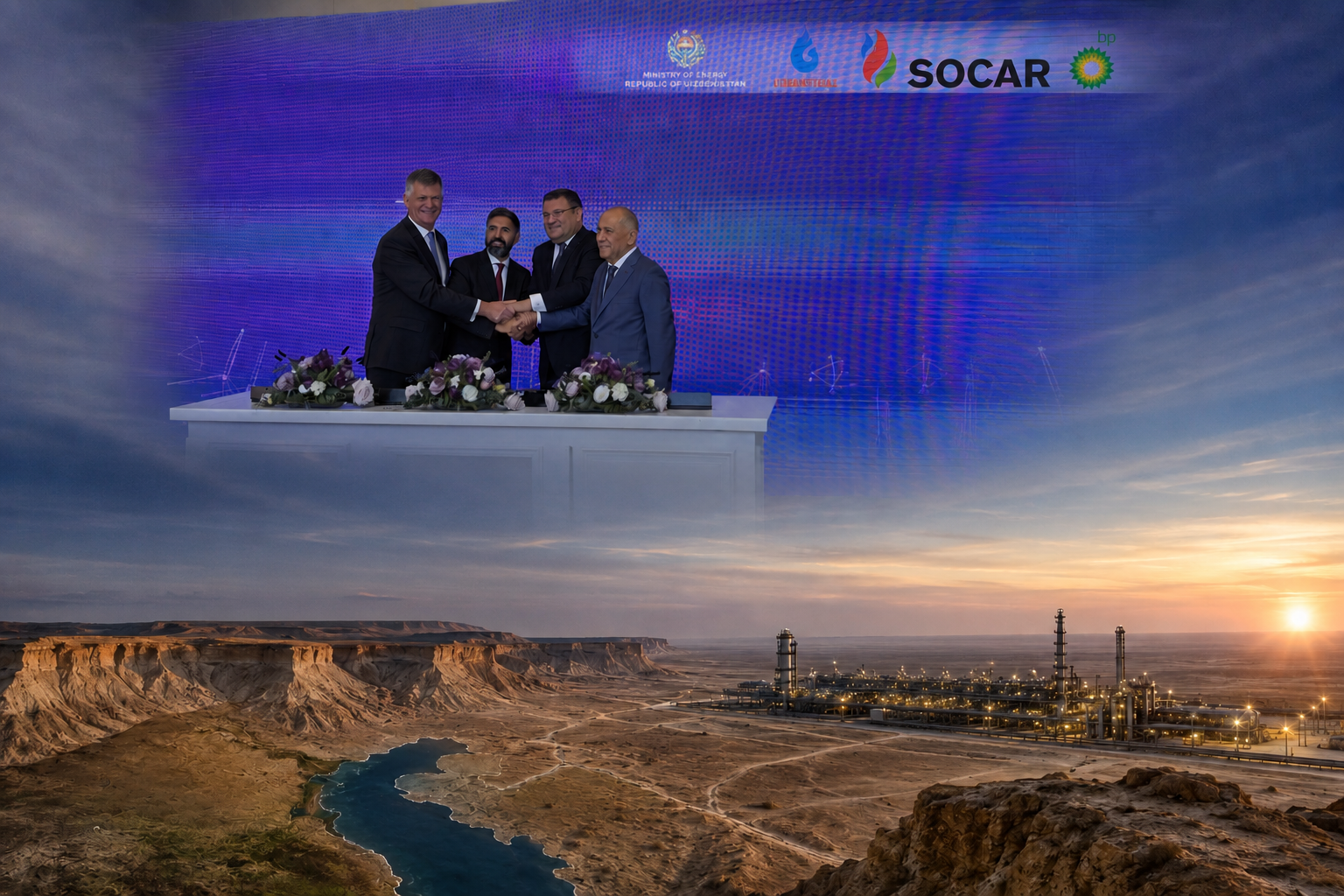
Read moreThe Ustyurt Plateau lies along the Uzbek-Kazakh border like a gigantic geological whispering, dry, barely investigated, and holding the sort of sub-surface secrets that drive upstream companies to be at once apprehensive and intrigued. Wednesday, on the sidelines of the Oil and Gas of Uzbekistan Conference 2026, in Tashkent, bp made up its mind to quell its apprehensions. The London-headquartered international major inked an agreement to develop six blocks in Uzbekistan's North Ustyurt province, securing a 40% participating interest against current partners SOCAR and Uzbekneftegaz. This deal marked bp’s first upstream venture in Central Asia, outside its traditional Caspian assets. Signing the agreement alongside the Minister for Energy of Uzbekistan, the Chairman of Uzbekneftegaz and the President of SOCAR, Rovshan Najaf, was Gio Cristofoli, bp's regional president for Azerbaijan, Georgia and Türkiye. The target date for the first exploration well, a crucial event for the project's future, is projected for 2027. The one thing common to all six blocks is that there have been very few drilling activities conducted in each of them. That, in terms of frontier exploration, is both an omen and an opportunity.
Deal structure, as it stands:
bp (40%) - As the largest single shareholder, bp acts as a technical and financial partner. They provide deep-water and frontier exploration technology, seismic interpretation capabilities, and have a strong balance sheet to fund exploration programs. Additionally, bp has global offtake relationships.
SOCAR (30%) - SOCAR is the operator, responsible for day-to-day management. They have been conducting seismic activities across the license area since the production sharing agreement (PSA) was signed in July 2025. SOCAR brings regional geological expertise, access to Caspian operational infrastructure, and a diplomatic channel between Azerbaijan and Uzbekistan.
Uzbekneftegaz (30%) - As the state partner and sovereign license holder, Uzbekneftegaz offers regulatory access and local knowledge. Their goals align with Uzbekistan's energy diversification and foreign direct investment (FDI) attraction agenda.
Though bp owns the biggest portion of shares, at 40%, it does not run the process, but SOCAR does that. This is a rather peculiar situation, which is explained both by the history of the project and by SOCAR’s particular expertise. In July 2025, the PSA was signed by SOCAR, Uzbekneftegaz, and the Uzbek Ministry of Energy; prior to bp joining the group, SOCAR had done all the necessary geophysical studies in the area. The fact that bp bought two shares, each worth 20%, shows that it trusts SOCAR’s approach and believes in its ability to do things right in terms of exploration and development. Moreover, this is another example of the way bp operates in the region – it operates Azerbaijan’s ACG PSA through owning just 28.8% of it.
North Ustyurt lies geologically in between two of the most productive hydrocarbon basins of Central Asia. Northward, in the northwest, is the North Caspian basin, which contains Kazakhstan’s Kashagan, the giant oil discovery of the past four decades, with recoverable reserves of 9 to 13 billion barrels. In the southwest is the Amu Darya basin, the major producer of Uzbekistan, whose gas basins have provided the Soviet Union and post-Soviet Central Asia with their fuel needs for decades. Ustyurt is a basin that has received some exploration studies but hardly any drilling activity because of its remote location and complicated underground structure, not to mention its being among the last unexploited basins of the region, despite the major efforts of global majors in the 1990s to map the area.
This situation is influenced by the geopolitical environment, which has altered the economic conditions for exploration along this frontier dramatically. The Hormuz Strait has been blockaded for three months already, meaning that every barrel of crude from outside the Middle East region is even more valuable and appealing to importers in Europe and Asia alike. Both Kazakhstan’s oil fields, which are currently working close to their capacity, have sent increasing supplies westwards through CPC and BTC pipelines via Azerbaijan. Uzbekistan, traditionally a gas-exporting nation to other Central Asian states, has been exploring the possibility of diversifying and attracting foreign investments, with TotalEnergies, Lukoil, and Gazprom Neft already operating in the country; however, no new commercial reserves have yet been discovered that would alter the trajectory of Uzbek production.
The contract gets more intriguing if one considers how the same deal is connected to bp's activities in Kazakhstan. There are already talks underway between bp and KazMunayGaz regarding geological structures in the Ustyurt region on the Kazakh side of the border – geological structures that are directly connected to those in the North Ustyurt blocks in Uzbekistan. This suggests that bp's contract in Uzbekistan cannot be seen as a simple project in the field of oil exploration. Rather, bp is preparing to explore an entire geological formation that crosses the international boundary between two countries, with its first drilling well in Uzbekistan scheduled for 2027. If the exploration of Uzbek blocks proves to be commercially successful, it will be natural to explore the Kazakh territory, where the same structures exist.
This basin-level thinking is familiar from bp's own history. Indeed, its entry into the Caspian in the early '90s, by securing an 8% interest in the Azerbaijan International Operating Company (AIOC) deal in 1994, and subsequently assuming the operator role at the ACG development project, was based on geological assumptions regarding the South Caspian basin that the early drilling proved beyond expectation. The ACG field, having been in production for over three decades now, has yielded some 5 billion barrels of oil and remains one of the key fields of bp. The Ustyurt play is on a much smaller scale, but has a remarkably similar strategic logic: enter an early stake into a promising geological basin, use your first well to assess resource potential, and target the bigger prize just across the border if geological data supports your view.
Exploration in the frontier area is intrinsically binary in the short term. Not only will the initial exploration well scheduled for North Ustyurt in 2027 be an important step in building the geological model, but it will also validate or invalidate the whole regional thesis. Should it be successful and discover commercial hydrocarbons within the structures identified via the seismic conducted by SOCAR, the results will flow quickly as the Uzbek blocks gain commercial interest, discussions regarding the Kazakh part of the Ustyurt gain traction through KMG, and the whole region gains status as a frontier province that can attract exploration dollars in the future. Failure in the well will not result in failure of the thesis, but the timeframe will extend significantly, and discussions about Kazakhstan will become less plausible. The key factor in the message on Wednesday is bp's readiness to come in at 40% prior to even the first well being drilled. The firm is not waiting for proof from its drilling program before making its financial commitment. Rather, bp is buying the geological interpretation made by SOCAR since the PSA was signed in July 2025, and it feels that there is enough information available for it to take frontier risk at the major shareholder level. This is a geological confidence statement that, against the backdrop of bp's current portfolio management (at the same time that the firm is reportedly looking to divest its UK North Sea business), speaks to where bp sees the future potential for value creation.
Clearly, it does not see such potential in the North Sea, which is expensive and declining. Rather, bp is seeing such potential in the Ustyurt, where no one has ever drilled, and where the geological analogy to the North Caspian Sea is sufficiently strong to make it worthwhile at this stage of the exploration life cycle.
Here we are to serve you with news right now. It does not cost much, but worth your attention.
Choose to support open, independent, quality journalism and subscribe on a monthly basis.
By subscribing to our online newspaper, you can have full digital access to all news, analysis, and much more.
You can also follow AzerNEWS on Twitter @AzerNewsAz or Facebook @AzerNewsNewspaper
Thank you!