
Baku disappointed by EU's approach on Nagorno-Karabakh: expert
By Sara Rajabova
A European expert says Baku has been disappointed by the European Union's approach to the long-standing Armenia-Azerbaijan Nagorno-Karabakh conflict.
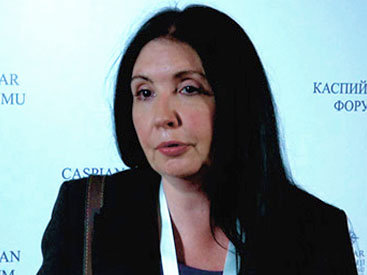
Amanda Paul, an expert at the Center for European Policy in Brussels, said in an interview with the Day.az website that Karabakh is presently simmering with risks boiling over "if we are not careful".
Paul said that unfortunately, the EU has little interest in further engaging in the Nagorno-Karabakh conflict and is happy to sit on the sidelines supporting the efforts of the OSCE Minsk Group co-chairs and financing peace-building and confidence building measures.
"This suits the EU's approach of maintaining a balanced position," the expert said.
EU High Representative for Foreign Affairs and Security Policy Catherine Ashton's spokesperson Maja Kocijancic said earlier that the EU stresses the importance of finding a peaceful settlement to conflicts in the South Caucasus and calls for strong commitment by all concerned parties in this respect.
According to Paul, the issue here should not be about making the Nagorno-Karabakh problem more known in every household around the world but rather having greater engagement with those people that have influence and leverage in terms of promoting a solution.
"The conflicts need to be given greater priority which has frequently not been the case and this seems unlikely to change. Unfortunately, Nagorno-Karabakh is little more than a 'footnote' on the foreign policy agenda of the West," Paul said.
The expert also said that Azerbaijan is located in an unstable and explosive neighborhood.
"Two of Baku's neighbors are particularly difficult, each having their own agenda, frequently accused of trying to influence internal developments in Azerbaijan, its foreign policy and the region more broadly. This already represents a challenge, which is exacerbated by the ongoing serious security situation as a consequence of Nagorno-Karabakh and the other seven occupied territories," Paul said.
Commenting on the EU-Azerbaijan relations, Paul said that Baku wants good ties with the EU, but has been disappointed by the EU's approach towards Nagorno-Karabakh and the EU's failure to clearly recognize Azerbaijan's territorial integrity in the same way it does with Moldova and Georgia.
She added that yet Azerbaijan is a westward looking country, in a difficult neighborhood, so, having engagement with the EU is important and more than likely this is a relationship that will become increasingly interdependent.
The Nagorno-Karabakh conflict emerged in 1988 when Armenia made territorial claims against Azerbaijan. Since a lengthy war in the early 1990s, Armenian armed forces have occupied over 20 percent of Azerbaijan's internationally recognized territory.
The UN Security Council has adopted four resolutions on Armenian withdrawal from the Azerbaijani territory, but they have not been enforced to this day.
Peace talks brokered by the Minsk Group co-chairs representing the United States, Russia and France have been largely fruitless so far.
Here we are to serve you with news right now. It does not cost much, but worth your attention.
Choose to support open, independent, quality journalism and subscribe on a monthly basis.
By subscribing to our online newspaper, you can have full digital access to all news, analysis, and much more.
You can also follow AzerNEWS on Twitter @AzerNewsAz or Facebook @AzerNewsNewspaper
Thank you!