
Azerbaijan becomes bridge between civilisations with its multicultural strategy

Ulviyya Poladova
Read moreThroughout the centuries, as human society has evolved, so too has the nature of relationships among its various components. The diversity of religious, ethnic, and racial characteristics has shaped distinct cultures, each with its own values, traditions, and social norms. In the process of intercultural interaction, the recognition and understanding of these differences have played a crucial role in improving communication and fostering cooperation. Such engagement has often led not only to the exchange of ideas and practices but also to the blending of cultural traits, as well as the expansion of trade, economic ties, and diplomatic relations.
As these interactions intensified, processes of integration and unification gradually gave rise to what is now understood as globalization. This phenomenon has significantly increased interconnectedness among nations, linking societies across geographical, political, and cultural boundaries. Globalization has enabled the rapid flow of information, goods, and people, creating new opportunities for collaboration and development. At the same time, however, it has also raised complex questions about the nature and limits of intercultural engagement.
Ultimately, the success of intercultural interaction in the modern world depends on the ability of societies to embrace diversity while promoting mutual respect and understanding. Rather than viewing cultural differences as sources of division, they can be seen as opportunities for enrichment and innovation. In this context, effective intercultural policies and inclusive governance become essential tools for preventing conflict and ensuring sustainable global cooperation in an increasingly interconnected world.
Azerbaijan’s foreign policy achievements cannot be fully understood without examining the decisive role of its domestic political framework - particularly the emphasis on multiculturalism. As a core component of internal governance, multiculturalism in Azerbaijan has contributed to the preservation of ethnic, religious, and cultural diversity. This internal stability and inclusiveness naturally extend into the country’s external relations. By promoting tolerance and coexistence at home, Azerbaijan creates a foundation for building constructive and cooperative relationships abroad, regardless of ethnic or religious differences. In this way, domestic multiculturalism becomes a strategic asset, fostering dialogue and strengthening intercultural and inter-civilizational connections on a global scale.
The process of building an independent Azerbaijani state, safeguarding its sovereignty, ensuring territorial integrity, and protecting economic interests has required a carefully balanced and multidimensional foreign policy. Since gaining independence, Azerbaijan has sought to gradually move beyond traditional spheres of influence while maintaining pragmatic ties with major global actors. Its foreign policy is characterized by flexibility and strategic balance: relations with Russia are counterbalanced by cooperation with the United States; engagement with the Islamic world is complemented by strong partnerships with European countries. This multi-vector approach allows Azerbaijan to position itself as a reliable partner across different geopolitical and cultural spaces.
Azerbaijan’s balanced diplomacy is also evident in its active participation in leading international organizations, including the United Nations, the Organization for Security and Co-operation in Europe, the Council of Europe, the Organization of Islamic Cooperation, NATO, the Commonwealth of Independent States, and the Organization of Turkic States. Through these platforms, the country contributes to international security, economic cooperation, and cultural dialogue, further reinforcing its role as a bridge between regions.
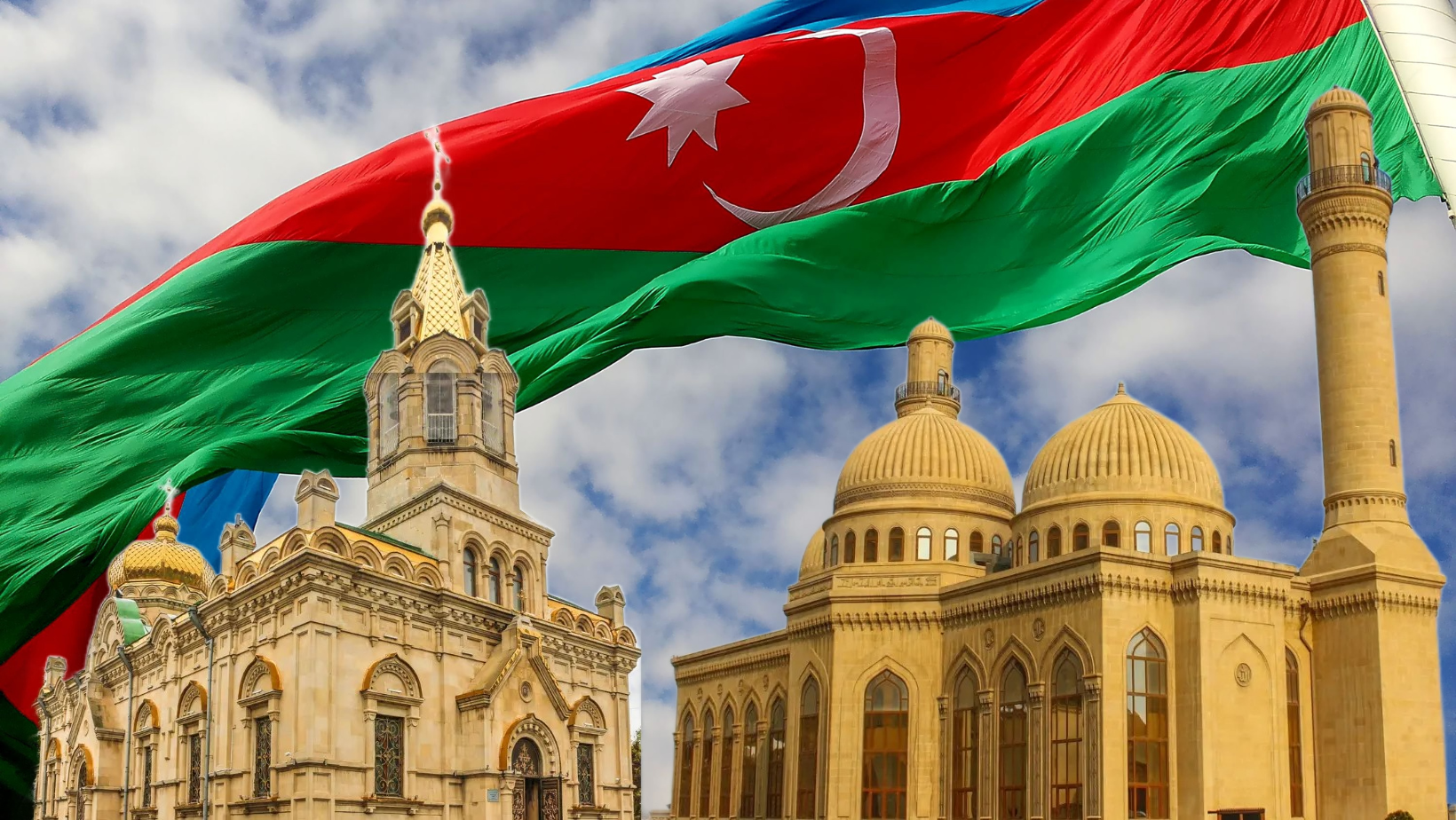
An important aspect of Azerbaijani diplomacy is its self-identification as a bridge between the Muslim and Christian worlds. This idea has been repeatedly emphasized by Ilham Aliyev, who highlights Azerbaijan’s unique position as a member of both the Council of Europe and the Organization of Islamic Cooperation. Such dual engagement reflects the country’s commitment to fostering mutual understanding between different civilizations and underscores its reputation as a tolerant and inclusive state.
In pursuit of protecting the rights of national minorities and religious communities Azerbaijan has acceded to more than 50 international legal instruments within the frameworks of organizations such as the United Nations, the Council of Europe, and the OSCE. The country has made notable progress in fulfilling its international obligations, further strengthening its image as a responsible member of the global community. Altogether, Azerbaijan’s experience demonstrates how a strong and inclusive domestic policy can serve as the foundation for a successful, balanced, and forward-looking foreign policy.
A key question in contemporary political and cultural discourse is: where and why have multicultural values failed? In a number of cases, difficulties have emerged in societies where the process of cultural and spiritual formation had already reached a certain level of consolidation, and only afterward new waves of migration introduced unfamiliar norms, values, and social practices. In such contexts, multiculturalism was often perceived not as an organic development, but as an externally introduced or artificially promoted model. As a result, established social and political systems sometimes struggled to absorb these new elements, leading to tensions, fragmentation, and debates over identity and cohesion.
This distinction brings forward an important methodological approach - the differentiation between "original diversity" and "late diversity." Late diversity is typically associated with migration-driven changes, where new cultural layers are added to an already formed societal structure. In contrast, original diversity refers to a historical coexistence of different ethnic, religious, and cultural groups that have evolved together over centuries within the same geographical and social space. In such cases, diversity is not perceived as foreign or imposed, but as an inherent and natural characteristic of society itself.
Azerbaijan represents a notable example of what can be described as original diversity. The multicultural environment of the country has deep historical roots and has developed organically rather than through external imposition. Various communities have coexisted for centuries, forming a shared social fabric grounded in mutual respect and interaction.
This historical continuity helps explain why Azerbaijan has been more resilient in the face of challenges that multicultural policies have encountered in parts of Europe. While some European societies have faced difficulties integrating newly arrived cultural groups, Azerbaijan’s model is rooted in a longstanding tradition of coexistence rather than adaptation to sudden change. This has allowed the country to maintain social cohesion while preserving cultural plurality.
Today, Azerbaijan can be seen as a unique environment where representatives of different cultures, religions, and value systems live together in relative harmony. Its experience suggests that the success of multiculturalism depends not only on political frameworks, but also on historical context and development of diversity within society.
Here we are to serve you with news right now. It does not cost much, but worth your attention.
Choose to support open, independent, quality journalism and subscribe on a monthly basis.
By subscribing to our online newspaper, you can have full digital access to all news, analysis, and much more.
You can also follow AzerNEWS on Twitter @AzerNewsAz or Facebook @AzerNewsNewspaper
Thank you!