
Legendary singer who conquers millions of hearts [PHOTOS]
![Legendary singer who conquers millions of hearts [PHOTOS]](https://www.azernews.az/media/2026/08/17/1786947198384731148_1200x630.jpg)

Laman Ismayilova
Read moreAugust 17 marks the 84th anniversary of Muslim Magomayev, one of Azerbaijan's most beloved and celebrated singers.
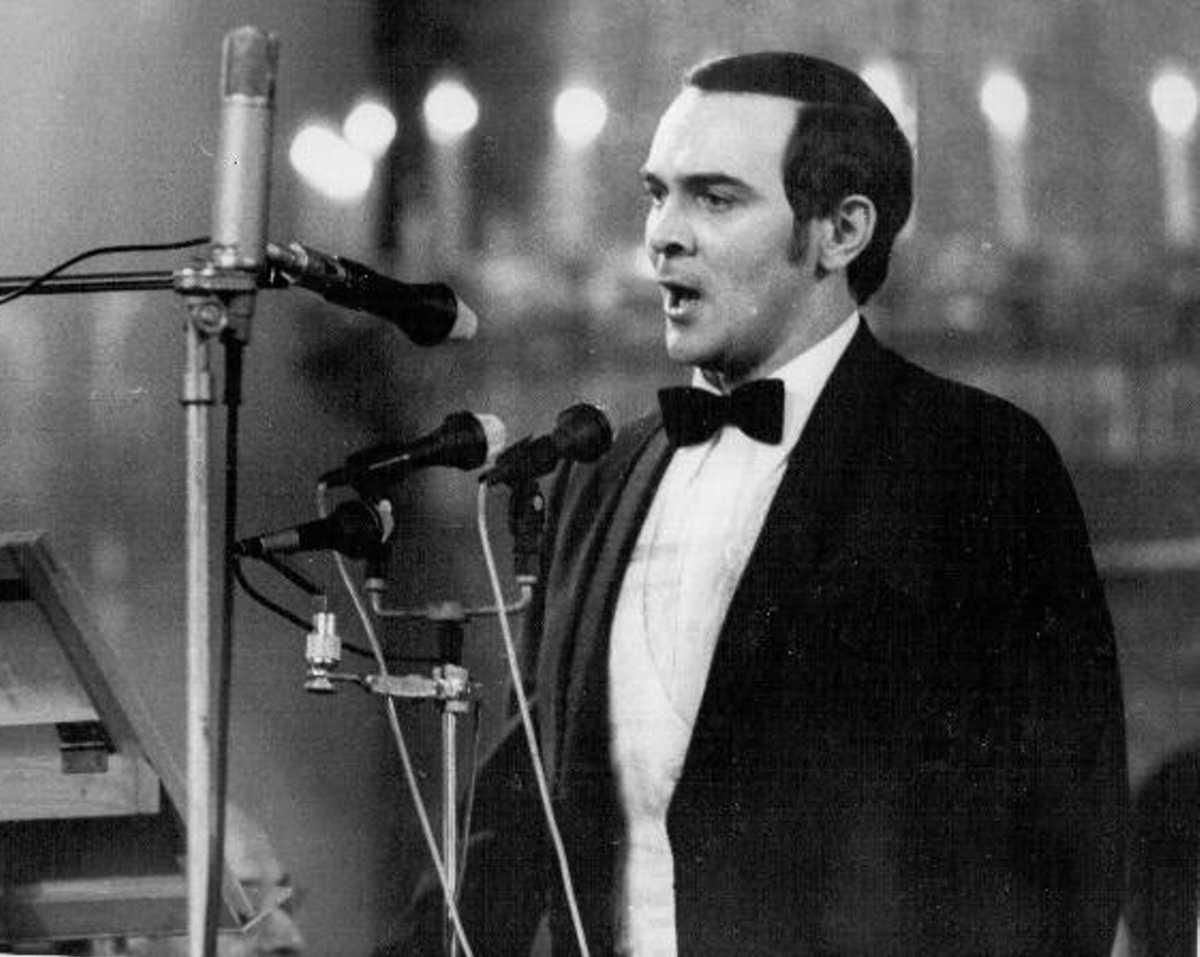
His voice filled the greatest concert halls of his time, his songs became part of everyday life, and his name became known far beyond his homeland. Years after his death, his music still carries the same warmth and power, keeping the memory of the great singer alive.
Born in Baku on August 17, 1942, Muslim Magomayev grew up in an artistic family. His grandfather, composer Muslim Magomayev Sr., was one of the important figures in the development of Azerbaijani classical music. The young Muslim inherited both the family's musical tradition and an extraordinary natural gift. He began performing publicly as a teenager, appearing on stage at the age of 14 at Baku's Sailors' Club.
His first great international breakthrough came in the early 1960s. At the recommendation of the celebrated Azerbaijani conductor Niyazi, the young singer took part in the World Festival of Youth and Students in Helsinki and returned with an award. His performance attracted attention well beyond Finland. The Soviet magazine "Ogonyok" subsequently published his portrait under the striking headline, "A Young Man from Baku Conquers the World."The headline proved remarkably prophetic.
By the middle of the 1960s, Magomayev had become one of the most recognizable voices of the Soviet Union. He was a soloist of the Azerbaijan State Academic Opera and Ballet Theatre, where his performances in works such as Rossini's The Barber of Seville, Puccini's Tosca, and Azerbaijani operas demonstrated the power and range of his baritone. He also spent time at Milan's legendary La Scala, an experience that deepened his connection with the Italian vocal tradition.
But Magomayev was never destined to remain solely within the opera house.
He possessed the rare ability to move effortlessly between opera, romance, popular song and patriotic music. In an era when millions listened to the same radio stations and bought the same records, his voice became one of the defining sounds of Soviet popular culture. He performed to enormous audiences, often in venues far larger than conventional concert halls, while his records circulated in extraordinary numbers.
His success was not limited to the Soviet Union. He performed in Paris at the Olympia in 1966 and again in 1969, and in 1969 he won first prize at the International Song Competition in Sopot, Poland. That same year, he received a Golden Disc in Cannes.
At just 31, he was named a People's Artist of the USSR, an exceptionally early recognition for a popular singer.
His repertoire eventually approached 600 works, encompassing opera arias, romances, popular songs, classical pieces and Neapolitan melodies. He was also a composer, writing more than 20 songs as well as music for films.
Among his most cherished performances are the romances "Sənsiz" and "Sevgili canan," composed by Uzeyir Hajibayli to poems by Nizami Ganjavi. In Magomayev's interpretation, the work of three towering figures—poet, composer and singer seems to converge. He did not merely sing these pieces; he gave them a deeply personal emotional character.
His relationship with Azerbaijani music was equally profound. Perhaps no song illustrates it better than "Azərbaycan," written by Magomayev to words by People's Poet Nabi Khazri. Over the years, it has become one of the most beloved musical tributes to the country. Official Azerbaijani sources continue to describe the song as one of the finest works dedicated to Azerbaijan.
Magomayev's connection with his homeland remained strong throughout his life. Although much of his career unfolded in Moscow and on stages across the Soviet Union, he returned to Baku regularly and remained closely attached to the city where his story had begun.
Magomayev's artistry extended beyond the microphone. He appeared in films including "Muslim Magomayev Sings" and "Nizami", and he played an important role in the development of Azerbaijan's estrada tradition. As artistic director of the Azerbaijan State Estrada-Symphonic Orchestra, he helped bring together the traditions of Azerbaijani musical culture and contemporary popular performance.
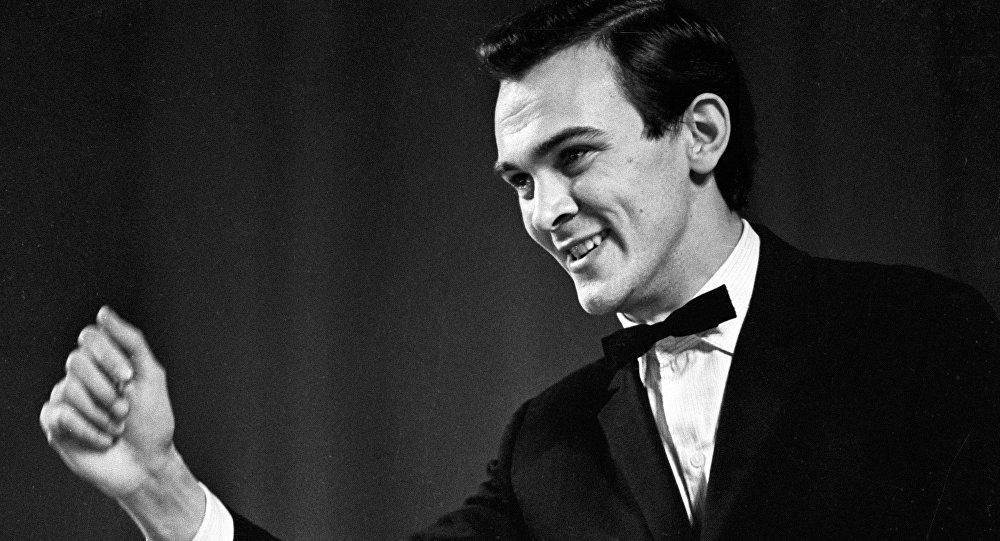
On stage, he had the presence of an actor as much as a singer. His performances carried drama, elegance and physical confidence. A song could become a small theatrical world in his hands.
This quality helps explain why recordings of Magomayev remain so compelling. His voice could be tender one moment and overwhelming the next. He could sing a romantic melody with intimacy and then turn to a patriotic song with almost orchestral force. There was refinement in his technique, but never coldness.
When Muslim Magomayev passed away in Moscow on October 25, 2008, at the age of 66, tributes came from Azerbaijan, Russia and the wider musical world. He was buried in Baku, the city of his birth.
For an artist of Magomayev's stature, death did not bring an end to his public presence. In some respects, it made his place in cultural memory even clearer.
In 2017, President Ilham Aliyev issued a decree marking the singer’s 75th anniversary, recognizing his contribution to Azerbaijani culture and his important place in the history of Soviet estrada.
Five years later, on what would have been his 80th birthday, a memorial evening was held in Baku. The occasion brought together Azerbaijani and international performers, who sang works from Magomayev's repertoire alongside pieces by Azerbaijani and foreign composers.
That same day, a bronze monument to Magomayev was unveiled in Baku's Seaside National Park. Created by People's Artist and sculptor Omar Eldarov, the two-metre statue stands on the city's boulevard, a place Magomayev loved.
There is something fitting about that location. The boulevard opens onto the Caspian, the sea that shaped Baku and so often appeared in the cultural imagination of the city. Magomayev's music, too, seems inseparable from Baku: its broad horizons, its mixture of cultures, its melancholy and its confidence.
Muslim Magomayev left the stage in 2008. But he never really left the music. And every August 17, when Azerbaijan remembers the day he was born, the country is reminded once more that some voices do not belong to a single generation. They belong to memory itself.
Here we are to serve you with news right now. It does not cost much, but worth your attention.
Choose to support open, independent, quality journalism and subscribe on a monthly basis.
By subscribing to our online newspaper, you can have full digital access to all news, analysis, and much more.
You can also follow AzerNEWS on Twitter @AzerNewsAz or Facebook @AzerNewsNewspaper
Thank you!