
Europe’s responsible solidarity
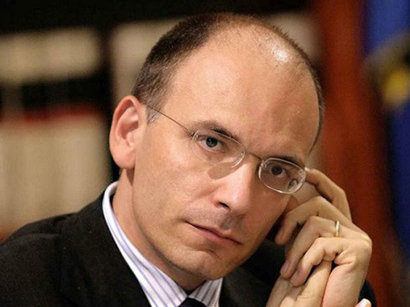
By Enrico Letta
Prime Minister of Italy
Next year will be crucial for the European Union. EU citizens
will elect a new European Parliament, which will vote for a new
president of the EU Commission. There will be a new president of
the European Council and a new high representative for foreign and
security policy as well.
This change of top EU personnel represents an ideal opportunity to
debate what Europe stands for, and how to create a more stable,
integrated, and prosperous union - one based on solidarity,
interdependence, and enlightened self-interest.
Over the past few years, Europe has made extraordinary progress in
responding to the financial crisis. But the future of Europe's
Economic and Monetary Union (EMU) depends on three crucial
components: greater economic convergence, greater openness within
the single market, and greater resilience to asymmetric shocks.
Achieving these goals does not depend on (further) technical
discussions, but on forging a new political consensus in favor of a
more supranational approach.
First, greater economic convergence within the EMU requires a
stronger framework for the coordination of member states' economic
policies. Indeed, the new European Semester - the EU's annual
round of policy advice and surveillance of member states - is one
of the main advances made in response to the crisis.
This system reflects the principle that "economic policies are a
matter of common interest." A proposal now stands to extend ex ante
coordination to major economic reforms and to introduce some form
of binding contractual arrangements between EU institutions and
member states, which would ensure that the reforms Europe needs can
be delivered.
But these reforms are often complex and painful to implement. Some
require financial investments that are not possible in a period of
fiscal retrenchment, and some place too high a demand on voters'
patience. While EU citizens are ready to accept the sacrifices
needed to reinvent their economies, they need to see a payoff on
the horizon.
So, if we are serious about the need to support structural reform
in member states, greater surveillance and policy coordination must
be matched by a system of limited and targeted financial
incentives. These incentives can expand the range of options for
governments struggling with fiscal consolidation and provide a
signal to the European public that the EU is a partner supporting
their countries' reform efforts.
Second, a better EMU needs a real single market, which is Europe's
best means of restoring growth and righting internal imbalances.
But, so far, progress toward the abolition of Europe's remaining
trade barriers has been slow, and signs of resurgent economic
nationalism are spreading throughout the continent.
So far, we have liberalized national markets on the assumption that
private companies would merge and integrate across borders. But
this has resulted only in a patchwork of interlocking national
markets, rather than a true single market, which is one reason why
the EU lacks industries of a true continental scale. For example,
the EU has roughly 100 operators in the telecoms sector; the US has
just five, and China has only three.
The solution cannot be a simple discussion of new directives or
regulations. A new approach is needed. Only if we give up our
national reflexes will we be able to move the single market to its
next stage of development.
Finally, a better EMU should be more resilient to asymmetric
shocks. Ideally, this requires some form of risk-sharing and
financial solidarity. Here, the EU is not starting from scratch;
important steps were taken during the crisis. The European
Financial Stability Facility, the European Stability Mechanism, and
the European Central Bank's "outright monetary transactions" scheme
are all forms of collective insurance.
Yet every move toward greater financial solidarity among member
states has met with resistance and fueled a growing divide between
debtor and creditor countries. Solidarity in Europe cannot be
construed as a moral obligation of some to help others; there
simply is no sense of community in the current EMU that could
support permanent fiscal transfers from one region to another. But
this does not mean that Europe needs to abandon the search for
better ways to pool its strengths. Solidarity can also be
interpreted as enlightened self-interest, a form of reciprocity
from which everyone benefits in turn - without permanent
transfers.
Viewed from this perspective, it might be possible to create a
fiscal capacity for the EMU, at least initially, that could provide
the financial incentives for implementation of major reforms at the
national level, expanding later to other stabilization functions
and perhaps issuing bonds to support public productive investments
at the EU level. Such a fiscal capacity would be based on the
principle of budgetary neutrality over time.
The EMU's old architecture and its political foundations have been
shaken. We must build a new economic edifice atop new political
foundations. A purely intergovernmental approach will not work.
Common EU-wide solutions are necessary, although they require
member states' willingness to pool a greater share of their
sovereignty.
This might be tricky, given today's general disenchantment with
Europe. But offering a clear prospect of a better and fairer EU is
the best way to mobilize public opinion and face down anti-European
political forces ahead of next year's European Parliament
election.
Copyright: Project Syndicate
Here we are to serve you with news right now. It does not cost much, but worth your attention.
Choose to support open, independent, quality journalism and subscribe on a monthly basis.
By subscribing to our online newspaper, you can have full digital access to all news, analysis, and much more.
You can also follow AzerNEWS on Twitter @AzerNewsAz or Facebook @AzerNewsNewspaper
Thank you!