
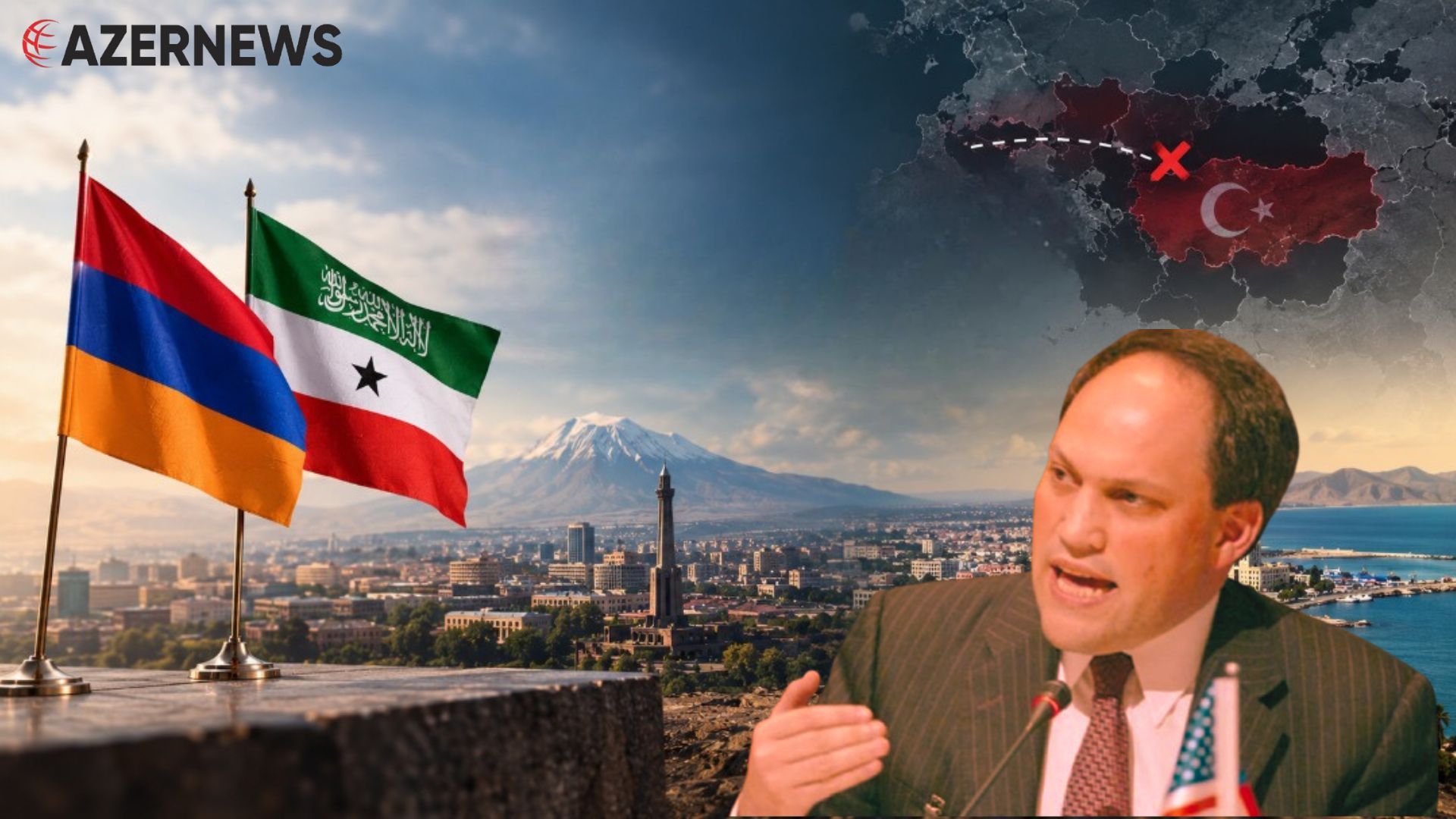
Michael Rubin’s Somaliland idea looks like a new front in an old war
Akbar Novruz
Read moreForging even the smallest measure of peace and normalcy between Azerbaijan and Armenia has never been easy. It has been so difficult, in fact, that the progress witnessed today would once have struck most observers as the least likely, almost absurd, outcome imaginable. There is no doubt that, having come this far along such a difficult path, the hardest task now is sustaining that peace on a sustainable and comprehensive footing. Unfortunately, though, this particular historical moment does not suit everyone. It does not serve the interests of certain lobby groups, or the individuals connected to them, who wield considerable influence from entirely outside the region and show correspondingly little grasp of its realities.
One such figure is Michael Rubin, who was once a "guest" of our newspaper. A senior fellow at the American Enterprise Institute and a former Pentagon official, Rubin frequently writes critical pieces on the Azerbaijani government, its leadership, foreign policy, and regional dealings with Armenia, Türkiye, and Iran.
Now, when I mean by guest is that we had the occasion to examine his work in an earlier piece, "Debunking False Parallels: Azerbaijan's COP29 and the Absurdity of Nazi Comparisons," in which Mr Rubin likened Azerbaijan's hosting of the COP29 climate summit to Nazi Germany's propaganda-driven Olympics, a comparison as inflammatory as it was unconvincing.
None of this should come as much surprise. When the funds, factions, and ideologies built up over decades of conflict suddenly confront a genuine rapprochement between two once-hostile states, it is only natural that those invested in the old animosity start wondering where their rhetoric might turn next.
Now, Rubin has an idea for Armenian diplomats: befriend Somaliland. In a recent essay he draws a lineage from the Armenian genocide of 1915 to the massacre of the Isaaq clan by Siad Barre's regime in the 1980s, casts both territories as plucky democracies hemmed in by predatory neighbours, and proposes that Yerevan open ties with Hargeisa as the nucleus of "an alliance of small-state democracies facing a common adversary", Türkiye, naturally, cast as the villain in both scripts. It makes me sad to see such a tidily written narrative also being mostly wrong.
Let us start with the history. The unification of Somaliland with the Italian Somaliland in 1960 is a voluntary act of pan-Somali nationalism, no matter how poorly it turned out to be; that of Armenia being subsumed into the Soviet Union is far from voluntary. The confusion of a failed marriage within and an invasion without collapses two completely distinct histories into one usable story. The slaughter of the Isaaq was real enough, and terrible, but the placing of it next to 1915 does violence to history.
Then there is the small matter of international law. Both the United Nations and the African Union agree that the borders established during the colonial era are not subject to renegotiation, which is intended to save a continent where various ethnic groups overlap from constant border disputes. Although Somaliland conducts itself more cleanly than the Somali government when it comes to elections, “model democracy” is not a category recognized in international law, and no Western government, despite all the liaison offices it maintains in Hargeisa, is prepared to contradict this point.
Economic arguments for Mr Rubin’s case do not hold up much better. The prevalence of mobile money in Somaliland is often mentioned as proof of technological prowess, but it can easily be interpreted as a result of the country's collapsing currency and lack of traditional banking services. A single well-functioning educational system is no proof of strong institutions in the country either, just as a single successful technology hub does not mean Armenia's development issues have been solved. And casting Türkiye as a unifying enemy across two unrelated regions, the Horn of Africa and the South Caucasus, is such a stretch that it asks readers to ignore that Ankara operates in Somalia at the invitation of its internationally recognised government, chiefly against jihadist militants.
As was previously mentioned, it does not serve the interests of certain groups [people] who typically operate from far outside the region and show correspondingly little grasp of its realities, and who, watching hostility give way to mutual accommodation, are visibly casting about for where their rhetoric might turn next.
Mr Rubin's Somaliland proposal reads like exactly that: a fresh cause built for a writer in search of one. Fortunately, the Armenian foreign ministry has shown no interest in this scheme over the past month - ever since the publication of the article. Such caution on behalf of Yerevan is an understanding that a solidarity based on forced analogies and unrecognized boundaries can hardly substitute for hard and painstaking work towards peace with the real neighbor.
Here we are to serve you with news right now. It does not cost much, but worth your attention.
Choose to support open, independent, quality journalism and subscribe on a monthly basis.
By subscribing to our online newspaper, you can have full digital access to all news, analysis, and much more.
You can also follow AzerNEWS on Twitter @AzerNewsAz or Facebook @AzerNewsNewspaper
Thank you!