
Azerbaijan’s digital push meets Türkiye’s tech boom along Middle Corridor

Qabil Ashirov
Read moreTurkiye’s economy grew by 2.3 percent year-on-year in the second quarter of 2026, a relatively modest figure in an economy still dealing with high inflation and tight monetary policy. One number in the GDP data, however, deserves considerably more attention: information and communication activities expanded by 8.6 percent.
The first point to understand is that “information and communication” is broader than the traditional IT sector. It covers telecommunications, internet infrastructure, software, digital services, data centers and related activities. Turkiye’s sector has now recorded ten consecutive quarters of growth, with annual growth rates in the past four quarters ranging between 8.6 and 9.9 percent. The expansion has been supported by digital transformation, cloud services, data centers, artificial intelligence and major investments related to 5G.
That growth is important for Turkiye itself, but its significance goes beyond the country’s borders. For Azerbaijan and the wider South Caucasus, Turkiye’s expanding digital economy could become another channel of economic integration, alongside energy, transport and trade.
This matters because digital infrastructure increasingly determines how efficiently other parts of the economy operate.
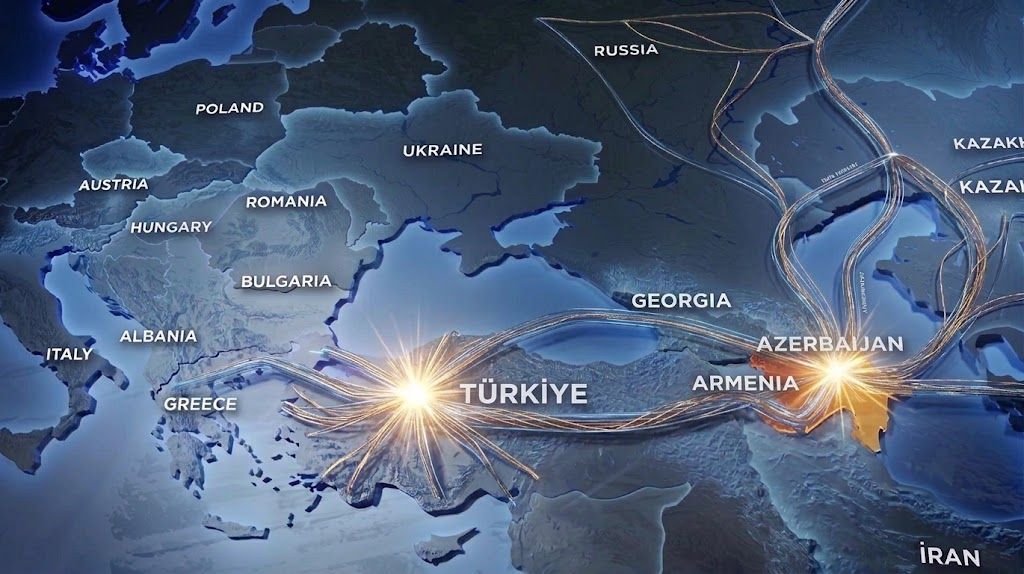
Consider the Middle Corridor. Azerbaijan has spent years positioning itself as a transit country connecting Central Asia with Turkiye and Europe. Traditionally, the discussion has focused on railways, ports, highways and customs infrastructure. The next stage is likely to be digital.
Cargo moving through Azerbaijan and Turkiye generates enormous amounts of information: customs documents, invoices, shipment data, tracking information, insurance records and transport documents. If these systems communicate with each other, the physical movement of goods can become faster and more predictable.
Turkiye and Azerbaijan have already started moving in this direction. In 2026, the two countries launched work on an e-CMR pilot aimed at digitalizing cross-border freight documents. Such projects may sound technical, but their economic consequences can be quite practical. Less paperwork means fewer delays, lower administrative costs and better visibility for logistics companies.
Turkiye’s expanding telecommunications infrastructure strengthens this possibility. Turkish authorities reported that the country’s fiber network reached 697,000 kilometers in the first quarter of 2026, while total broadband subscriptions reached 99.5 million. Investments linked to 5G are also pushing demand for fiber, data centers and network capacity.
Azerbaijan is developing its own digital infrastructure at the same time. During the first half of 2026, 147 government institutions had migrated to the Government Cloud, while 140 private organizations were using data-center services. Azerbaijan also began construction of two additional data centers and expanded its fiber infrastructure.
Turkiye has a much larger technology market, a sizeable telecommunications industry and a growing base of companies developing software, cloud and digital services. Azerbaijan has a strategic geographic position between Turkiye, the Caspian Sea and Central Asia. Connecting these capabilities could create opportunities that neither country would capture as easily on its own.
One particularly interesting possibility is digital services exports. Turkish software, cybersecurity, cloud and business-technology companies could use Azerbaijan as a platform for reaching Central Asian markets. Azerbaijani companies, meanwhile, could benefit from Turkish technology, investment and access to a much larger commercial ecosystem.
The opportunity is already visible in Azerbaijan’s own numbers. In January-July 2026, the country’s information and communication services increased by 10.4 percent in real terms. Software development and related consultancy services grew by 34.8 percent, while internet services increased by 22 percent.
That suggests the relationship could become more balanced than a simple story of Turkish companies entering Azerbaijan. Azerbaijan itself is developing a digital-services industry that could eventually sell into Turkiye, Central Asia and other markets.
There is also a strategic dimension. Azerbaijan has traditionally derived much of its international economic importance from its position as an energy producer and transport corridor. Digital connectivity offers another layer to that position. A country through which physical goods, energy and data move has a different economic profile from a country that simply provides a route for cargo.
Still, it would be a mistake to assume that Turkiye’s 8.6 percent growth automatically benefits Azerbaijan. GDP growth in one country does not spill across borders by itself. The gains depend on investment, cross-border infrastructure, compatible regulations, technology transfers and companies actually using the new systems. The real opportunity is therefore not the 8.6 percent figure itself. It is what that growth is building: fiber networks, 5G infrastructure, cloud capacity, data centers, software capabilities and digital platforms.
For Azerbaijan, the strategic question is whether it can connect these developments to the country’s own ambitions for the Middle Corridor and digital economy. If it succeeds, the corridor linking China, Central Asia, the Caspian, Azerbaijan, Turkiye and Europe could eventually carry far more than containers and commodities, and data, digital services and technology as well.
Here we are to serve you with news right now. It does not cost much, but worth your attention.
Choose to support open, independent, quality journalism and subscribe on a monthly basis.
By subscribing to our online newspaper, you can have full digital access to all news, analysis, and much more.
You can also follow AzerNEWS on Twitter @AzerNewsAz or Facebook @AzerNewsNewspaper
Thank you!