
Between Brussels and Moscow, Armenia's trade policy becomes proxy war
By Farman Aydin | AzerNEWS
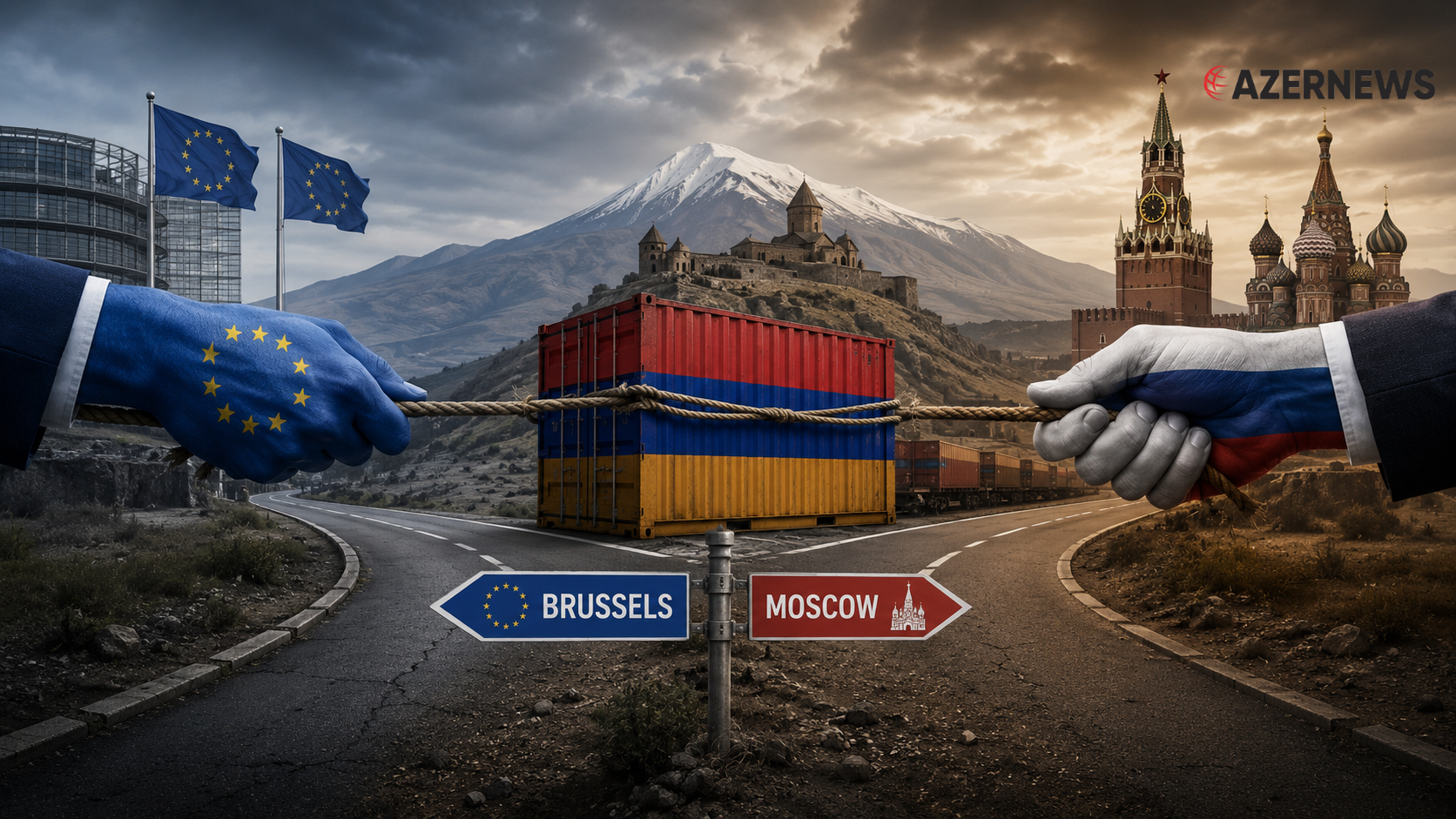
Yesterday, the European Parliament's trade committee waved through, without a single amendment, a plan to scrap tariffs on some 80% of Armenian exports to the European Union for two years. Thirty-five members voted for it, two against, three abstained. Brussels calls this an "economic support measure" for a small Caucasian economy battered by Russian trade restrictions. It is better understood as something else: a geopolitical instrument dressed up in the language of solidarity.
Since May, Russia has banned the import of Armenian brandy, mineral water, fruit, and vegetable products, making their movement through Russia very difficult; this was a response, experts say, to Yerevan's orientation toward Brussels. The European Commission's response is to make duty-free quotas available to Armenia for almost all of its fresh produce, and more than 91% of its beverages and spirits. Helen McEntee, Ireland's foreign minister, put the matter into military context: "in the face of economic pressure, the EU will respond." It seems quite odd for a trading bloc to say such things. The main message of the World Trade Organisation is that market access must never be conditional upon political allegiance. Over many years, the EU has been preaching to its trading partners about non-discrimination, phytosanitary stringency and the "level playing field." If such rules are discarded instantly by the favoured government, then a natural question arises as to what criteria besides competitiveness could have been at stake?
The reason why Armenia enjoys a favorable customs regime does not lie in the improved competitiveness of Armenian wine and cucumbers. It lies in the fact that the Armenian government opted for a European, rather than Eurasian, foreign policy orientation. In contrast to this, the Brussels authorities adopt a much more practical approach to Azerbaijan, which, through the building of its oil and gas infrastructure, has been making tangible contributions to European interests, without receiving preferential treatment in return.
Nor is the concession nearly as generous as it appears at first sight. The grace period lasts for two years and is contingent upon Armenia’s compliance with conditions regarding origin, administration, and the “essential elements” of the CEP Agreement, such as democracy, the rule of law, and human rights. This is an effective way of chaining rather than bridging. Clearly, what Brussels wants is not so much convergence as making sure Yerevan remains sufficiently beholden to Europe so that it cannot afford to step out of line. In case it loses favor, or falls, the waiver will be immediately revoked.
More fundamentally, tariff relief does nothing to fix what actually ails the Armenian economy: thin productivity, a narrow export base, and enterprises too small and too undercapitalised to meet EU standards even once the duties disappear. Access to a market is not the same as competitiveness within it. A two-year holiday from customs duties may cushion Armenian exporters against a Russian squeeze, but it is a palliative, not a cure.
Yerevan's Moscow headache
This is all made clearer yet by the sequence of events. On September 1st, as part of the Shanghai Cooperation Organisation summit in Bishkek, Nikol Pashinyan and Vladimir Putin engaged in one of the most intense conversations the two leaders have ever had. Mr Putin started off by emphasising that there would be a "strategic partnership" between Russia and Armenia, deliberately so because Armenia’s new programme did not include the phrase "strategic partnership" and spoke of transforming relations between the two countries instead. He was also keen to mention Russia’s economic significance in terms of being the biggest trade and economic partner of Armenia, accounting for about 30% of its trade, and that Russian companies pay the most tax in Armenia.
However, Putin confronted Pashinyan about his European aspirations and implied the need for a referendum that would allow Armenians to pick either the European Union or the Eurasian Economic Union led by Russia since membership of both is mutually exclusive according to law. This was, in effect, the most intense confrontation between the two states in years, coming after spring when Russia's president made his most explicit ultimatum in Moscow: choose. The response was clear from Pashinyan: Armenia, in contrast to Russia, does not have any political prisoners.
This is precisely the context within which the generous customs policy pursued by the European Union should be viewed. It is not a technical gesture made to compensate for Armenian deficiencies but rather a bid, in the midst of the contest between Brussels and the Kremlin over Armenian loyalty, to make the European option more appealing than the Eurasian one. The European Union is not simply extending a helping hand but also purchasing some influence in a bidding process with another participant in the Kremlin. As regards Nikol Pashinyan's intent, we might say the true goal of all this appears to be renegotiation rather than a complete break. This political maneuvering can be described as a game of diplomacy. He is not planning to withdraw himself from the Kremlin independently, and instead, he is open to some sort of bargaining. This situation should be viewed through the lens of politics, rhetoric, and posturing. Pashinyan is not breaking ranks independently as it seems. Rather, he is showing his willingness to negotiate.
He has, to be sure, committed Armenia to a formal EU membership application in the near future. But it turns out that the Commission's rush to offer Armenia the 'carrot of tariff' concessions was not an example of institutional building but a temporary safety net, to allow Yerevan to have some tangible gains from defying Russia at the very beginning of accession talks, which still have to come. The crucial bit is accession talks, however. It is the so-called "merit-based process," which may sound dismissive to those involved in it, but it actually ensures that reforms take root, as they are linked to external standards that any future Yerevan government cannot reverse without triggering a formal response from Brussels. It is the same role that EU conditionality played in Central and Eastern Europe during the 1990s and 2000s, when domestic political processes were deemed unreliable in terms of ensuring domestic reforms.
None of which makes the concession less valuable to Armenian exporters, who no doubt will appreciate two years of improved access to a market of 450 million consumers. But it serves to put into perspective the idea of disinterested solidarity. Economic concessions, when made conditional upon political proximity, make it all the more difficult to maintain the “level playing field” that Europe claims to be upholding, first for Armenia, and second for anyone else watching in the region.
Here we are to serve you with news right now. It does not cost much, but worth your attention.
Choose to support open, independent, quality journalism and subscribe on a monthly basis.
By subscribing to our online newspaper, you can have full digital access to all news, analysis, and much more.
You can also follow AzerNEWS on Twitter @AzerNewsAz or Facebook @AzerNewsNewspaper
Thank you!