
Armenia’s ‘Fourth Republic’: real break with past or new political narrative?
Akbar Novruz
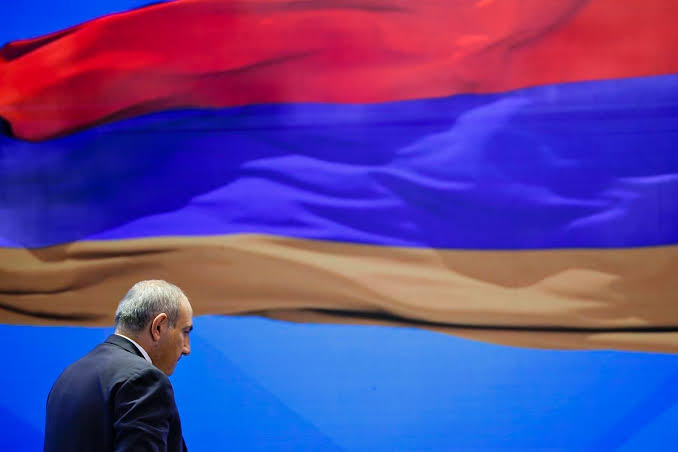
Read moreOver the past week, Armenia’s Prime Minister Nikol Pashinyan announced what he described as the country’s new “Fourth Republic,” presenting a new constitution as the institutional foundation of a political era built around peace rather than conflict.
The announcement carries particular significance for Armenia’s relations with Azerbaijan. Baku has consistently identified constitutional change as a non-negotiable precondition for signing a final peace treaty, arguing that Armenia’s existing constitutional framework contains latent territorial claims against Azerbaijan through its reference to the 1990 Declaration of Independence, which itself invoked the reunification of Karabakh with Armenia.
Pashinyan, however, has sought to frame the constitutional process not as a concession to Azerbaijan, but as a domestic transformation driven by the Armenian public’s purported rejection of the old conflict-oriented political paradigm.
“We cannot do this, especially after the 2026 elections, in which our people voted for peace,” Pashinyan said today.
Pashinyan and his government continue to push for a new constitution, arguing it will establish a "Fourth Republic" and fix judicial gaps, while maintaining that the process is a domestic priority rather than a concession to outside pressure.
Official Yerevan has not set a specific final date to adopt a new constitution. Pashinyan's administration plans to put a new draft through a public discussion and eventually a nationwide referendum, but the timeline remains uncertain after the ruling party did not secure a constitutional majority in the June 2026 parliamentary elections.
Pashinyan also formally declared the establishment of Armenia's "Fourth Republic," a new political era built around a "logic of peace" rather than conflict.
It follows the country's June 7, 2026 parliamentary elections and is built on the doctrine of "Real Armenia," shifting the nation's core focus from historical conflict to regional peace and sovereign development.
But how reachable is that idea? And what does it say about Armenia's political landscape in broader implications?
In his assessment to AzerNEWS, political commentator Levon Ghazaryan, being positive in regard to the initiative, still thinks it is institutionally underspecified.
“The "Fourth Republic" language Pashinyan uses is indeed one of the clearest statement of this intent. Breaking the country free from the past ideologies, that includes institutional corruption, external dependency, or any revolutionary chaos, and so on. We can talk for hours about that. The intention as a whole is indeed ambitious, and most probably preparing in some sort of programme, declaring and stating it out loud wants strong political willpower. However, as much as it is laudable, we need to pinpoint certain issues – given the fact how underspecified it was.”
The expert then argues that this is precisely where Armenia’s European trajectory becomes significant:
“This whole thing seems like an act of describing a clean-break democratic state with European standards of governance, judicial independence, and economic openness. Now, the Armenian parliament passed the relevant bill in March 2025, beginning the process of accession to the EU. Pashinyan has pledged to make an official application for membership in the near future. The 2026–2031 governmental program provides for the signing of a peace treaty with Azerbaijan and reopening the border with Türkiye. It is no figure of speech but a formal commitment contained in the official governmental program for five years.
The problem of institutions here is that accession to the EU necessitates harmonization of legislation in the spheres of trade, phytosanitary, customs, competition, financial services and the rule of law according to the body of European law, which is in direct contradiction with Armenian EAEU commitments. As it appeared from the Russian side’s displeasure, Mr. Pashinyan and his administration will face contradiction on several occasions.”
Specifying the possible problems, he also hopes for this declaration as a great foundation for the future:
With all being said, what makes the idea of the Fourth Republic plausible is the external anchoring offered by the very process of EU accession. Indeed, although the so-called "merit-based process," which Brussels talks about and which might appear dismissive at first glance, is nothing but the mechanism that ensures the durability of institutional reform by linking Armenian legislative initiatives with external standards which any future government in Armenia will not be able to easily undo without incurring EU sanctions. The same logic was applied to the EU accession process in the Central and Eastern Europe in the 1990s and 2000s.
This should also be analyzed over the course of its implications in the region as well.
The peace process [between Azerbaijan and Armenia] is at the most advanced stage it has reached in thirty years, and the institutional architecture being built around it is more durable than the previous formats precisely because it is bilateral rather than mediated. The economic logic for completing the process is stronger than it has been at any previous point. Azerbaijan is already Armenia's fuel supplier. Now, Yerevan hopes to make the same progress with Türkiye as well. A normalised Armenian-Turkish relationship removes one of the most politically charged obstacles to Ankara deepening its EU engagement, which was the case of the Armenian genocide. Pashinyan has been explicit that improving relations with Türkiye takes priority over the genocide recognition agenda as a foreign policy instrument. And Ankara might also be the biggest winner in the longer run, gaining influence in the region, getting closer to the EU, etc.”
In conclusion, Ghazaryan, thinking of the initiative as a consequential step, at the end thinks the honest answer lies in which scenario Armenia will take in the longer run.
“But the five-year stakes are really meaningful, and in my view, the straightforward truth is that we will not know whether Armenia is in Scenario One or Scenario Two until 2028 or 2029 – that is, until after there is either a peace treaty signed or a failure at the constitutional referendum; there is either an open Turkish border or a closed Turkish border; and there is either candidacy to the EU process or a nice equilibrium in which the West supports Armenia's development without pushing for membership.
In the case that Scenario One plays out – that is, if there is a peace treaty, an open Turkish border, an EU candidacy status, the construction of the TRIPP, and energy diversification – Armenia in 2031 is going to look like a completely different place than Armenia in 2026. Its GDP growth trajectory, its export markets, its institutions, and its geopolitics are all meaningfully improved. Fourth Republic would have some empirical content.
In the case that Scenario Two plays out – that is, if Pashinyan is still in power and holds institutional control, if he is prosecuting his predecessors, if he is rhetorically deepening his country's connections to the West, but the constitutional referendum doesn't happen, the Turkish border is still closed, the EU membership process still aspirational, and Russia's infrastructural concessions never re-negotiated – then Armenia in 2031 is Armenia in 2026 with nicer press coverage.”
Here we are to serve you with news right now. It does not cost much, but worth your attention.
Choose to support open, independent, quality journalism and subscribe on a monthly basis.
By subscribing to our online newspaper, you can have full digital access to all news, analysis, and much more.
You can also follow AzerNEWS on Twitter @AzerNewsAz or Facebook @AzerNewsNewspaper
Thank you!