
Europe’s gas squeeze is giving Azerbaijan bigger role in energy security

Qabil Ashirov
Read moreThe geopolitical processes unfolding across the world are creating a new gas challenge in Europe, the world’s largest premium gas market. Europe is not facing an immediate physical gas crisis, and the European Commission has said that there are currently no immediate concerns over supply. Yet the growing tension in the market is already impossible to ignore. Dutch TTF October gas futures rose 4.4% to €69.9 per megawatt-hour on August 31, the highest level since January 2023. European gas storage facilities were only 64.7% full, below the historical average for this time of year.
The roots of Europe’s current gas vulnerability go back to Russia’s full-scale invasion of Ukraine in 2022. Before the war, Russia was by far one of Europe’s most important gas suppliers. In 2021, Russian pipeline gas accounted for around 40% of EU pipeline gas imports. By 2025, that share had fallen to approximately 6%, while Russia’s combined share of EU gas imports, including LNG, stood at around 12%. The European Union has now moved further toward eliminating Russian gas altogether, with a ban on Russian LNG and pipeline gas imports scheduled to take effect through 2026-2027.
This transformation has fundamentally changed the European gas market. Europe replaced a large portion of Russian pipeline gas with liquefied natural gas from the United States, Qatar and other producers. LNG gave European buyers flexibility, but it also made them more exposed to global competition. Unlike pipeline gas, LNG is traded internationally and can be redirected toward whichever market offers the highest price.
The latest crisis in the Gulf has exposed this vulnerability precisely. Qatar, which previously supplied roughly 20% of global LNG, has seen its LNG exports collapse by 96% amid the disruption around the Strait of Hormuz. According to Reuters, Qatar shipped only 18 LNG cargoes during the period compared with 509 in the same period a year earlier. Two Qatari LNG tankers were also attacked.
The consequences for Europe are significant. The EU sourced around 7% of its LNG from Qatar last winter, equivalent to about 4% of its total winter gas imports. The Strait of Hormuz is also a critical global energy chokepoint, normally handling roughly one-fifth of global LNG supplies. With shipments disrupted, European buyers increasingly have to compete with Asian buyers for the remaining LNG cargoes. Asian LNG prices have also risen sharply, making it more difficult for Europe to attract additional supplies without paying a substantial premium.
This is where Azerbaijan’s position becomes increasingly important.
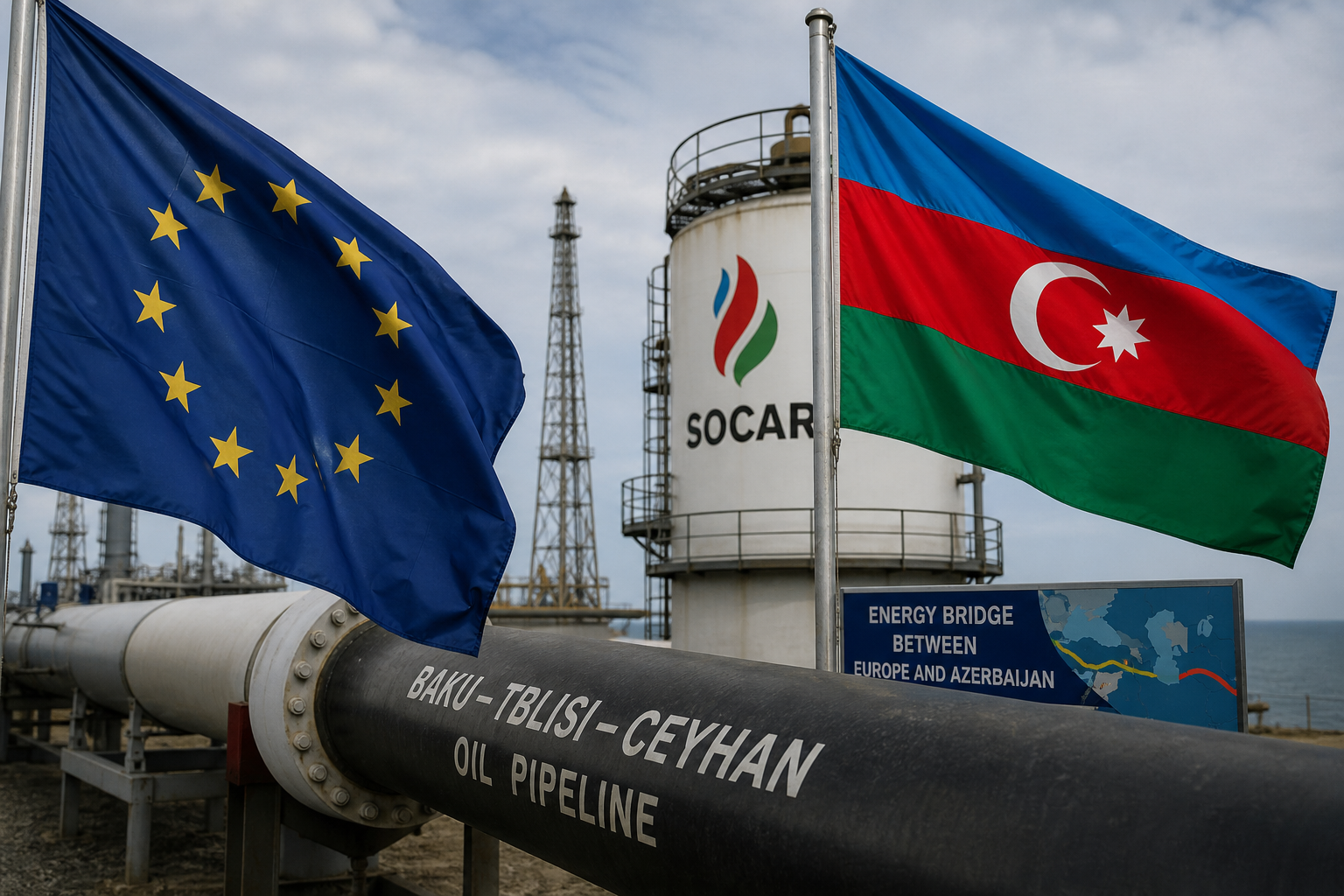
Azerbaijan cannot replace Russia or Qatar in terms of sheer volume. But it offers something increasingly valuable to Europe: a stable pipeline supply route that does not depend on Russia or the Strait of Hormuz. Gas from the Shah Deniz field reaches European consumers through the Southern Gas Corridor, passing through the South Caucasus Pipeline, TANAP and TAP. The Shah Deniz project currently supplies around 10 billion cubic metres of gas annually to European consumers.
Azerbaijan is already becoming a more important part of Europe’s gas diversification strategy. In the first half of 2026, Azerbaijan exported 12.7 bcm of natural gas, of which 5.9 bcm went to Europe. Turkiye received another 4.9 bcm, including 3 bcm through TANAP. In 2025, Azerbaijan exported around 12.8 bcm of gas to Europe, while SOCAR also began supplying Germany and Austria in 2026 under new commercial arrangements. SOCAR signed a 10-year agreement with Germany’s SEFE for 1.5 bcm of gas annually.
The economic benefit for Azerbaijan is straightforward. Higher European gas prices can improve the value of Azerbaijani gas sold under contracts linked to European gas hubs, although not every Azerbaijani gas contract is priced directly against TTF. Higher prices therefore do not automatically mean that every cubic metre of Azerbaijani gas suddenly becomes worth €69.9 per MWh. But they can increase revenues from relevant contracts and improve the economics of future sales.
The financial impact is already visible in Azerbaijan’s hydrocarbon revenues. During January-June 2026, the State Oil Fund of Azerbaijan received 437.1 million manats from the Shah Deniz field in gas and condensate revenues. If European gas prices remain elevated for a prolonged period, higher-value gas sales could strengthen both SOCAR’s cash flows and SOFAZ revenues.
Yet the larger opportunity is political rather than purely financial.
Europe’s energy policy is increasingly about security of supply. After losing much of its dependence on Russian gas and facing uncertainty over LNG routes through the Middle East, European governments have stronger incentives to secure reliable pipeline supplies from alternative producers. Azerbaijan can position itself as one of those suppliers.
For Baku, this means higher bargaining power with European buyers, stronger justification for expanding gas production and transmission capacity, and greater political importance for the Southern Gas Corridor.
Europe does not currently have a gas shortage. But its margin for error has become smaller. Storage levels are low, LNG supply is vulnerable to geopolitical shocks, and competition with Asia is intensifying. In such an environment, Azerbaijani pipeline gas becomes more valuable not simply because it is another source of energy, but because it is a source that bypasses some of the world’s most dangerous geopolitical chokepoints.
For Azerbaijan, therefore, Europe’s gas problem is more than a short-term opportunity to earn more money from gas. It is an opportunity to increase the strategic value of Azerbaijani energy, strengthen its position in European markets and turn the country’s role as an alternative gas supplier into a long-term geopolitical asset.
Here we are to serve you with news right now. It does not cost much, but worth your attention.
Choose to support open, independent, quality journalism and subscribe on a monthly basis.
By subscribing to our online newspaper, you can have full digital access to all news, analysis, and much more.
You can also follow AzerNEWS on Twitter @AzerNewsAz or Facebook @AzerNewsNewspaper
Thank you!