
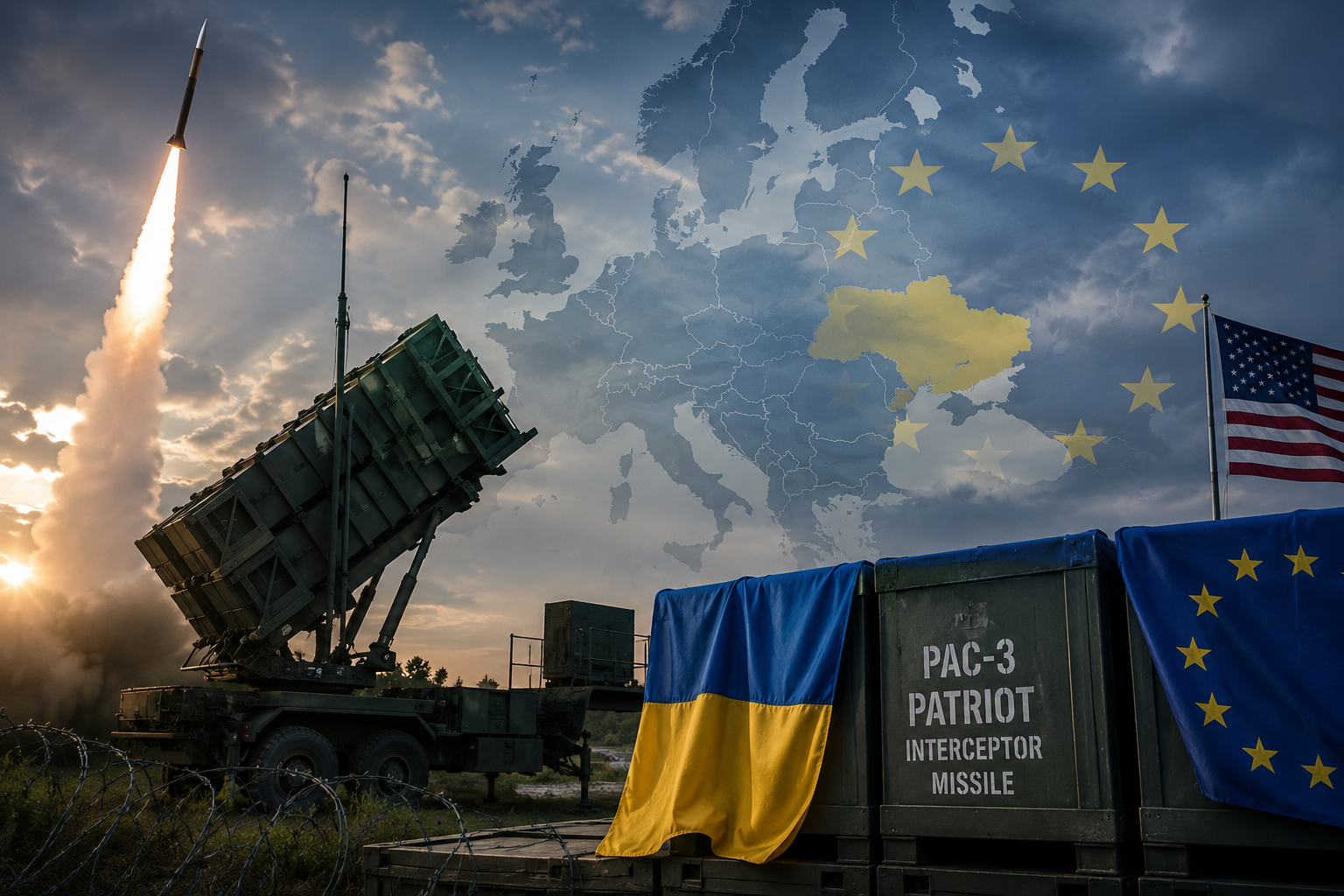
US Patriot shortage puts Ukraine and Europe in tough spot

Ulviyya Poladova
Read moreWhen Zelenskyy left the White House after his July 28 meeting
with Trump, he said the U.S. president had agreed to provide
Ukraine with licenses to produce Patriot interceptors. For Kyiv,
this would have been a major breakthrough. Ukraine has been asking
for more Patriot systems for years, but the supply of missiles has
become one of the biggest constraints on its air defense.
Two days later, however, Trump appeared to shut the door. "We have
not agreed to that," he said on July 31, referring to the transfer
of Patriot production technology.
The most immediate reason for Washington's hesitation may have less
to do with Ukraine itself than with the state of America's own
missile inventories. The war with Iran has dramatically increased
demand for Patriot and other high-end interceptors. Under normal
circumstances, Washington could theoretically compensate for
technology-transfer concerns by supplying Ukraine with more
interceptors. But when the United States itself is worried about
maintaining sufficient stocks for Europe, the Middle East and the
Indo-Pacific, every missile sent abroad becomes part of a much
larger strategic equation. The United States has used up about two
thirds of its reserves. According to CSIS analysts, the reserve of
the latest interceptors in the United States has dropped to about
759 units.
The PAC-3 is an extremely sophisticated hit-to-kill interceptor. It
is expensive, technologically demanding and produced in limited
quantities. Defense News has reported that a replacement PAC-3 can
take up to two years to build, while the cost is measured in
millions of dollars per missile.
The European Commission has already approved €6.1 billion in
additional defense procurement for Ukraine, including air and
missile defense, missiles, ammunition and radars. Brussels is now
considering a new Ukrainian request worth several billion euros
specifically for air defense, including PAC-3 interceptors. The
problem is that Patriot is American, while the EU's funding rules
are designed to favor suppliers. As Foreign Policy notes, Europe
will not be able to rapidly scale up production of interceptors:
Western production lines are not expected to have a significant
impact before 2030. The European Freyja project - a coalition of
countries developing a missile-defense system - is not expected to
conduct its first test launches until the first half of 2027, with
full production capacity likely to take another three to five
years.
European governments want to spend more on their own defense industries and reduce their dependence on American weapons. At the same time, when Ukraine urgently needs advanced ballistic-missile defense, Europe still does not have enough domestic alternatives.
The shortage of modern air defense systems and interceptor missiles has become a growing security challenge not only for Ukraine but also for countries seeking to protect themselves against increasingly sophisticated missile and drone threats, according to Ukrainian security analyst Oleksandr Kovalenko, a leading expert at the Ukrainian Center for Security Studies.
"We can observe a situation where there are genuinely not enough air defense systems in the world to fully protect a particular country or even a group of countries belonging to the same alliance from existing threats," Kovalenko said.
He noted that the problem concerns both slow-moving targets, such as drones, and increasingly advanced missile systems. Drone production, in particular, can be scaled up relatively quickly, creating a serious challenge for traditional air defense architectures.
"The problem is that we do not see the same level of diversification and scaling in air defense production," he said.
According to Kovalenko, major Western air defense producers are increasingly reconsidering their approach to technology transfer and licensing. France and Italy, for example, have agreed to provide Ukraine with licenses for the production of SAMP/T systems and Aster 30 B1NT missiles, which have demonstrated capabilities against ballistic targets.
The United States, meanwhile, is still considering how far it is prepared to go in terms of licensing and transferring technology, he added.
Ukraine is also attempting to develop its own air defense architecture. Kovalenko said the country is working on a new system known as Freya, which could eventually provide a cheaper alternative to the U.S.-made Patriot while maintaining significant interception capabilities.
"We think that within the next six months we may see a cheaper but no less effective analogue of the Patriot air defense system," Kovalenko stressed.
However, the immediate challenge remains the availability of interceptors and launchers.
"The problem is not only with ammunition, but also with launchers, because there are simply not enough of them for the entire country," Kovalenko noted. He pointed out that Ukraine currently lacks sufficient Patriot launchers to provide comprehensive protection for all major cities, regional centers and other strategically important areas. Kyiv remains relatively better protected, but even the capital's defenses depend heavily on the availability of interceptor missiles.
This makes the shortage of Patriot ammunition one of the most pressing issues for Ukraine, Kovalenko added.
Kyiv is therefore pursuing several parallel strategies. These include diversifying sources of supply, finding additional routes for obtaining existing Western-made missiles and continuing diplomatic efforts to secure U.S. approval for the licensed production of PAC-3 interceptors in Ukraine.
At the same time, Ukraine is developing the Freya system and preparing it for further testing. Kovalenko said the Ukrainian missile for the system already exists, but additional equipment from European partners is required before full-scale testing can begin. Several European countries have agreed to participate in the project, including Sweden, Denmark, Germany, France and Italy.
"This can significantly ease the task of scaling up production of this particular component," an expert emphasized.
One of the most ambitious possibilities under consideration is the integration of Ukrainian-made interceptors into existing Patriot systems.
Meanwhile, Ukrainian military analyst Oleg Zhdanov expressed skepticism about whether the United States and European countries can significantly increase the production and supply of Patriot interceptors in the near term.
The analyst pointed to the growing gap between demand for PAC-3 interceptors and actual production capacity. He said Lockheed Martin had ordered 900 PAC-3 missiles for Patriot systems. At the same time, the American company indicated that it would be difficult to deliver even slightly more than half of that number by the end of the year. At the same time, the demand for Patriot interceptors is increasing because of their use against ballistic missile attacks.
Beyond increasing production, Zhdanov believes the central challenge for modern missile defense is reducing the cost of interceptors.
The PAC-3 interceptor can cost several million dollars, while ballistic missiles are becoming increasingly widespread and can be produced in significant numbers. This creates an unfavorable economic equation for countries trying to defend themselves against sustained missile attacks.
"Any interceptor that does not cost three or four million dollars, like the Patriot PAC-3, but is cheaper to produce than the ballistic missile it is designed to intercept could save the situation not only militarily but also economically," Zhdanov said.
He emphasized that the war in Ukraine has demonstrated how quickly the balance between offensive weapons and defensive systems can change.
"Every new war brings its own adjustments and new discoveries," an expert noted.
According to Zhdanov, air defense planning previously placed a greater emphasis on technical performance and interception effectiveness, while the cost of individual interceptors received less attention.
"That is why today the main direction is to reduce the cost and scale up the production of inexpensive interceptors," he stressed.
This trend is already visible in Europe, Zhdanov noted. European countries are developing missiles capable of intercepting ballistic targets, while Germany has begun research aimed at enabling its IRIS-T air defense systems to engage ballistic threats. He added that he has no doubt that the United States and Norway are conducting similar research for their joint NASAMS system. The result, Zhdanov suggested, could be the emergence of new missiles for existing air defense platforms as well as entirely new anti-missile systems.
Despite his concerns about production capacity, Zhdanov believes Europe could partially compensate for reduced access to American Patriot interceptors. According to estimates cited by the analyst, as many as 5,000 PAC-3 missiles could currently be deployed across Patriot systems around the world. The problem, however, is that these missiles are distributed among dozens of countries. He argued that a coordinated effort by NATO or European countries could produce a meaningful result even without any single country making a major contribution.
In his view, the issue is therefore not simply whether Patriot interceptors exist, but whether countries are willing to share part of their limited stocks. Zhdanov pointed to Canada and Germany as examples of countries that have provided or announced plans to provide Patriot missiles from their own inventories.
For Ukraine, the immediate priority remains securing enough Patriot interceptors to maintain existing systems. But in the longer term, Zhdanov suggests, the key will be to develop cheaper missiles that can be produced at scale and provide countries with a sustainable way to defend themselves against increasingly numerous ballistic threats.
Here we are to serve you with news right now. It does not cost much, but worth your attention.
Choose to support open, independent, quality journalism and subscribe on a monthly basis.
By subscribing to our online newspaper, you can have full digital access to all news, analysis, and much more.
You can also follow AzerNEWS on Twitter @AzerNewsAz or Facebook @AzerNewsNewspaper
Thank you!