
What Big Mac Index says about Azerbaijan’s manat?

Akbar Novruz
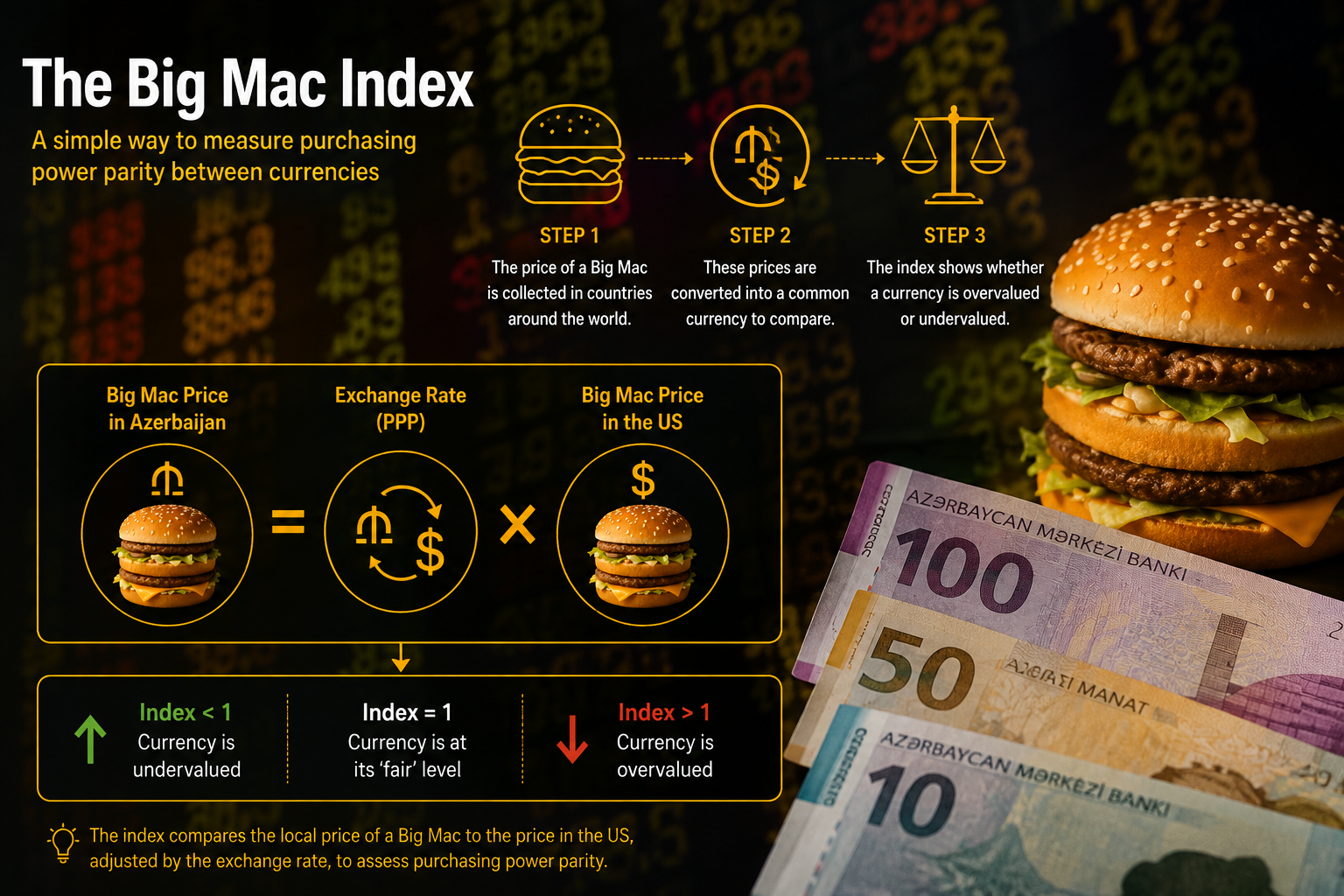
Read moreThe Big Mac Index by The Economist is described as a "lighthearted guide to whether currencies are at their correct level." The characterization fails to reflect the analytical significance of a price series that has spanned more than four decades and has tracked real purchasing power disparities with considerable accuracy. In the case of Azerbaijan during August 2026, the tale told is not so light and not quite heart-warming for those who want to know what is wrong with the structural position of the manat: at 7.25 manats versus $6.22 for a Big Mac in the United States, the purchasing power parity exchange rate works out to be 1.17 manats to the dollar. The actual exchange rate is 1.70. The discrepancy - a 31.4% undervaluation - has been narrowing through the year. However, it is still considerable and is part of a collection of macroeconomic statistics that make Azerbaijan's currency situation a very interesting one in emerging market monetary policy circles.
This gap has closed by 4.8 percentage points since January, and 5.4 percentage points since H1 2025, owing to an interesting process: the rate of price inflation in Azerbaijan exceeds that of the United States. The Big Mac Index in Azerbaijan increased by 9% between January and August 2026, compared to a lower rate of price increase in the USA. It should be noted that the convergence in question occurs due to the internal dynamics of price increases, and not through the nominal exchange rate adjustment since it has been fixed at 1.70 manats since March 2017 — that is, over nine years. According to the adjusted index, taking into account the disparity in GDP per capita, the underestimation is only 13.5%, a reasonable estimate for a middle-income commodity-exporting country with a managed currency. It was 16.2% in January 2026.
Trade surplus and CBA's do's and don'ts
As much as the economy (as a field of study itself) likes coherence, at times, certain numbers are affected not only by practical reasons but also by psychological effects. In Azerbaijan, particularly since the two major devaluations, public perception of the manat has been conditioned by the idea that “devaluation can happen at any time.” The Big Mac Index offers an interesting perspective on the currency question. While it captures certain aspects of purchasing-power parity, it should be considered alongside the practical fundamentals shaping the foreign-exchange market. The trade figures published by the State Customs Committee for the first seven months of the year are those that put the currency situation into focus. Foreign trade in Azerbaijan amounted to $29.2 billion in the period from January to July 2026 – 1.3% more compared to the same period a year ago. Exports stood at $19.3 billion (+27% y-o-y). Imports were recorded at $9.9 billion (-27.4%). Consequently, the trade surplus of $9.46 billion is not a record technically – Azerbaijan had posted positive trade balances before. However, what is noteworthy is the sheer size of the shift: the January-July 2026 trade surplus is some 5.9 times higher than the January-July 2025 counterpart. A six-fold growth of the trade balance within a year due to sharply rising exports of energy resources and deliberate limitation of imports is the main driver pushing the supply of foreign currency above its demand on the Azerbaijani market – making the Central Bank of the country buy the excess foreign currency via intervention measures.
The Central Bank of Azerbaijan has been a net buyer of foreign currency throughout 2026, absorbing dollar supply to prevent the manat from appreciating beyond 1.70. The scale of this intervention is now substantial enough to have materially altered the bank's reserve position. CBA foreign exchange reserves increased by $2.2 billion, or 19.5%, since the beginning of 2026, reaching $13.8 billion, a significant strengthening of the monetary buffer that adds to SOFAZ's separate $72+ billion asset base. Exchange offices received $482 million more in cash foreign currency from customers than they sold in H1 2026. The dollarisation level of resident individual deposits fell 3.8 percentage points over the past twelve months to 25.6%; the de-dollarisation trend that has been underway since 2017 is accelerating.
The single most interesting component of the CBA’s recent communication is not the data on interventions, but a particular sentence in its latest discount rate press release: the bank promises that “it will consider the persistence of the strengthening pressure on the manat exchange rate in the next interest rate decisions.” This is a new phraseology. For almost all of the life of the manat peg, some nine years now, the CBA’s communication regarding monetary policy had presented the exchange rate of 1.70 as a given parameter of monetary operations, not as a variable, whose adjustments may be called for by future monetary policy considerations. A central bank openly talking about appreciation pressure as an independent consideration for interest rate decisions is a central bank thinking about circumstances under which the parameters of the peg may have to be reconsidered. It does not mean revaluation. But it is departing from the language of a regime that treats the current rate as permanent and self-evidently correct.
The Big Mac Index, with all its acknowledged limitations, the prices are affected by wages, rent, logistics, taxes, and local market structure in ways that vary significantly across countries, is pointing at a real phenomenon. The manat is undervalued according to its actual productivity level, and depreciation is happening at the rate dictated by domestic inflation and not by the change in the nominal exchange rate. A surplus of nearly $9.46 billion within seven months in the country with annual GDP of about $75 billion is a surplus hard to maintain for long under any managed currency system without either inflation, revaluation, or an expensive sterilization program.
Indeed, Azerbaijan has enough money to sterilize for a very long time; $13.8 billion with the CBA and over $72 billion with SOFAZ represent quite an impressive external position, which provides enormous flexibility to the authorities. But the point is not whether they can afford to keep the current rate indefinitely. The point is whether they are going to do it, and at what moment the cost of keeping an undervalued peg in terms of imported inflation, an inefficient monetary policy transmission mechanism, and constant accumulation of reserves, which should better be utilized somewhere else, becomes higher than the stability benefits provided by the 1.70 rate since 2017. Judging from the statements by the CBA, the question is being discussed internally, although publicly the authorities prefer to claim that "they are not considering the issue of revaluation". In currency policy matters, the difference between these two points of view may often turn out to be rather small. The manat was standing at 1.70 for nine years already; the trade balance was just sextupled; the country's reserves have reached a record high level; the Big Mac index claims that the currency is undervalued by 31%. All the conditions for a discussion of a currency policy are met now.
Here we are to serve you with news right now. It does not cost much, but worth your attention.
Choose to support open, independent, quality journalism and subscribe on a monthly basis.
By subscribing to our online newspaper, you can have full digital access to all news, analysis, and much more.
You can also follow AzerNEWS on Twitter @AzerNewsAz or Facebook @AzerNewsNewspaper
Thank you!