
From copper to howitzers, Azerbaijan builds new industrial strategy

Qabil Ashirov
Read moreTwo developments that have attracted attention in Azerbaijan’s industrial policy in the autumn of 2026 are, in fact, separate parts of a broader picture. On September 23, the State Program for the Development of the Mining and Metallurgical Industry for 2027–2030 was approved. On October 1, Czech company CSG announced plans to establish a second joint venture in Azerbaijan and start production of self-propelled howitzers in the country from 2027. The key concept connecting these two areas is an industry that creates high added value.
Azerbaijan’s metallurgical program for 2027–2030 is expressed in substantial figures. The sector’s contribution to GDP is targeted to increase from ₼700 million ($411.8 million) to ₼1.8 billion ($1.06 billion) by 2030, while annual export potential is expected to rise from ₼1.3 billion ($764.7 million) to ₼3.4 billion ($2 billion). To achieve these objectives, ₼5.3 billion ($3.12 billion) in investment is envisaged for 2027–2030. Of this amount, ₼1.1 billion ($647.1 million) is expected to come from the state budget, ₼2.2 billion ($1.29 billion) from state-owned enterprises, and ₼2 billion ($1.18 billion) from the private sector. Thus, around 80 percent of the total ₼5.3 billion ($3.12 billion) investment package is expected to be attracted from non-budget sources.
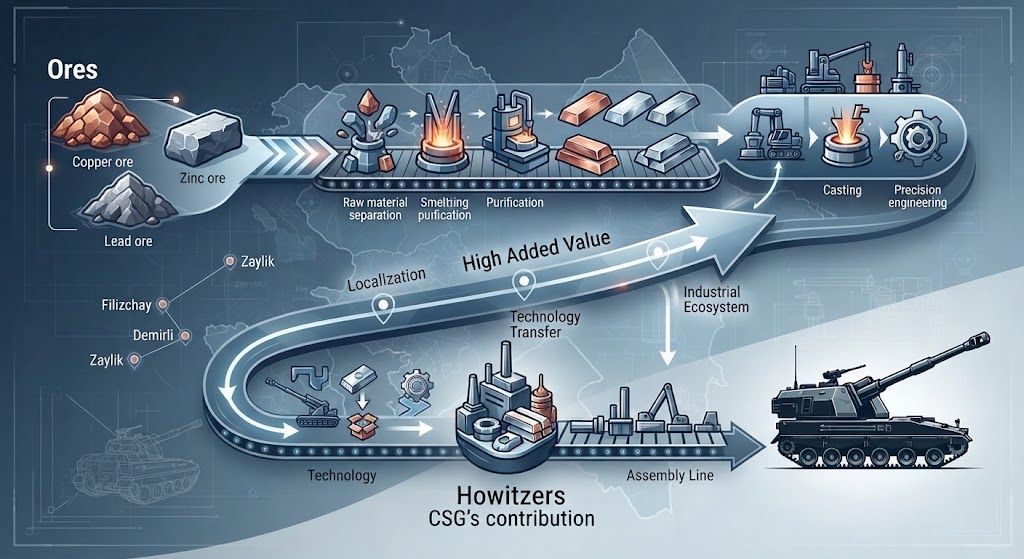
Behind these figures is the formation of a broad industrial chain covering the development of new mines, the processing of raw materials and the production of high value-added products. A key direction of the State Program is the development of the value chain from raw materials to finished products. The program envisages bringing copper, zinc and lead reserves at the Filizchay deposit into economic circulation, assessing the use of approximately 470,000 tons of additional copper reserves at the Demirli deposit, and developing the Zaylik alunite deposit as a raw material base for the aluminum value chain. At the same time, the possibility of establishing a new primary aluminum plant with an annual production capacity of approximately 200,000 tons is being examined.
The scale of the Filizchay project deserves particular attention. Over the deposit’s 34-year operating period, plans call for 363,000 tons of copper, 2.7 million tons of zinc and 1 million tons of lead resources to be brought into production. The project’s economic value is estimated at ₼29.7 billion ($17.47 billion), while the required investment is estimated at approximately ₼1 billion ($588.2 million). Initial production at the Ortakand gold deposit in Nakhchivan is scheduled to begin in 2029; the deposit has resources of 246,000 ounces, an economic value of ₼1.8 billion ($1.06 billion), and an investment requirement of ₼255 million ($150 million).
Adding CSG’s new project in Azerbaijan to this picture reveals another dimension of the country’s industrial policy. The Czech company plans to establish a second joint venture with a local partner in December 2026 and begin production of self-propelled howitzers in 2027. CSG envisages the gradual localization of production, along with the transfer of technology and manufacturing know-how to Azerbaijan. According to the company’s current medium-term plan, the project is expected to generate €1.8 billion in business over seven years.
Here, the structure of the project is more important than the figure itself. CSG’s first joint venture in Azerbaijan, VEXA DS, operates in the repair, maintenance and modernization of armored and other ground military equipment. The second venture adds production and technology transfer to this chain. In this way, servicing, modernization, manufacturing and technology become different stages of an industrial ecosystem.
This is precisely where the connection between metallurgy and the defense industry emerges. Modern defense industries rely on the combined activities of numerous sectors, including metal processing, mechanical engineering, electronics, optics, engineering, software and logistics. The expansion of metallurgy strengthens the raw-material and materials base of this industrial chain. The CSG project, meanwhile, represents a concrete example of foreign technology being combined with local production capabilities in Azerbaijan.
This process can create a broader industrial model for Azerbaijan: ore extraction, metal processing, materials production, mechanical engineering, defense manufacturing, technical services and exports. This is why it is interesting to consider the ₼3.4 billion ($2 billion) annual metallurgical export potential targeted under the State Program alongside CSG’s €1.8 billion seven-year business opportunity. The first figure represents the 2030 target for the sector as a whole, while the second reflects the seven-year business potential of a specific international industrial project.
The next stage in Azerbaijan’s industrial history is defined by the amount of added value that can be generated from the country’s resources domestically, alongside the scale of those resources themselves. The ₼5.3 billion ($3.12 billion) metallurgical investment program, projects such as Filizchay, Demirli, Zaylik and Ortakand, the potential 200,000-ton aluminum plant, and CSG’s planned howitzer production from 2027 represent different elements of this direction.
Thus, a new chain is taking shape on Azerbaijan’s industrial map: mineral resources, processing, metal, technology, manufacturing and exports. Each link strengthens the economic weight of the others. The ₼1.8 billion ($1.06 billion) GDP contribution and ₼3.4 billion ($2 billion) export potential targeted for 2030 demonstrate the scale of this process. CSG’s planned new production in 2027, meanwhile, represents a notable example of this industrial transformation moving toward more sophisticated and technology-oriented stages.
Here we are to serve you with news right now. It does not cost much, but worth your attention.
Choose to support open, independent, quality journalism and subscribe on a monthly basis.
By subscribing to our online newspaper, you can have full digital access to all news, analysis, and much more.
You can also follow AzerNEWS on Twitter @AzerNewsAz or Facebook @AzerNewsNewspaper
Thank you!