
Jabbarov: Azerbaijan and Central Asia target $20 billion trade

Akbar Novruz
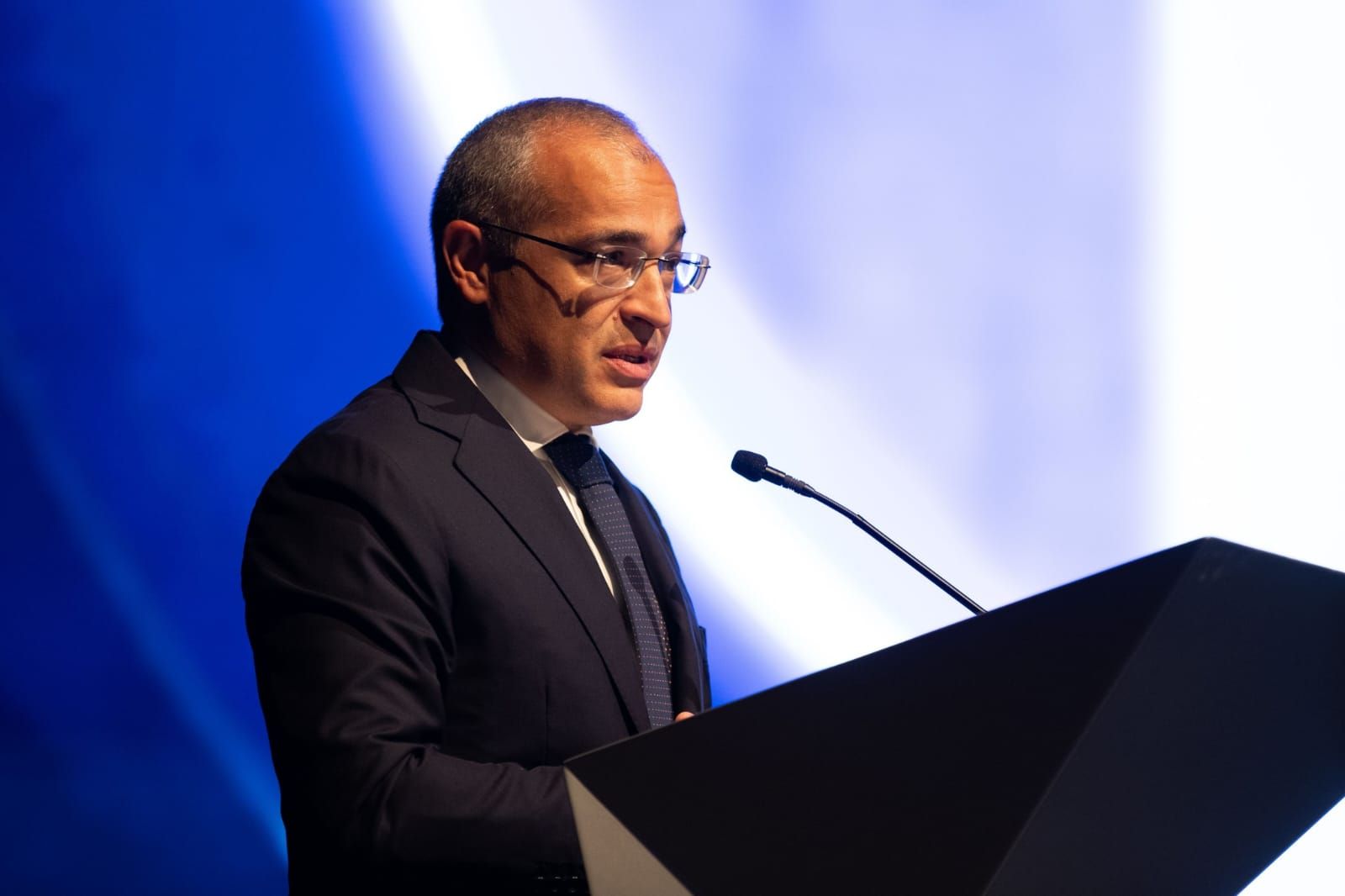
Read moreAzerbaijan and Central Asian countries are aiming to increase regional trade to $20 billion while developing joint production under the “Made in Central Asia” brand, Azerbaijan’s Minister of Economy Mikayil Jabbarov said at the CAMCA 2026 Regional Forum in Baku.
“Our future is most clearly reflected in the relations between the South Caucasus and Central Asia. Over the years, we have become part of this regional architecture,” Jabbarov said.
The minister noted that the political dimension of these ties deepened after Azerbaijan became a full participant in the Consultative Meeting format of Central Asian heads of state in Tashkent in November 2025.
“Azerbaijan was the first country from outside the region to join this format,” he said.
Jabbarov also pointed to the first meeting of trade and investment ministers from Azerbaijan and Central Asian countries, held several days ago, as another step toward greater economic integration.
“Our goal is to bring the volume of regional trade to $20 billion and establish joint production under the ‘Made in Central Asia’ brand,” the minister said.
According to Jabbarov, Azerbaijan has already established joint investment funds with Kazakhstan, Uzbekistan and Kyrgyzstan, creating mechanisms to combine several mid-sized markets into a broader investment platform.
“Azerbaijan holds a share of at least 50% in each of these funds. Thus, Azerbaijan and the Central Asian countries are forming a unified economic space that connects, on one side, Türkiye and Europe, and, on the other, Asia,” he said.
Trans-Caspian fiber-optic link nearing launch
The expansion of regional economic ties is increasingly extending beyond traditional trade and transport infrastructure into digital connectivity.
Jabbarov announced that the Trans-Caspian Fiber-Optic Cable Line connecting Azerbaijan and Kazakhstan is expected to become operational in less than a month.
“The launch of the fiber-optic cable line between Azerbaijan and Kazakhstan will create a new high-capacity communication channel between Europe and Asia. The line is expected to go into operation in less than a month,” he stated.
The minister emphasized that modern regional corridors should no longer be viewed solely through the movement of physical cargo, as energy and digital connectivity are increasingly becoming integral components of the emerging East-West infrastructure network.
Under the Trans-Caspian Fiber-Optic Cable Line project implemented by AzerTelecom and Kazakhtelecom, a 380-kilometer subsea fiber-optic cable has been laid between Sumgayit in Azerbaijan and Aktau in Kazakhstan.
The first subsea digital route across the Caspian Sea is expected to provide high-speed connectivity with capacity exceeding 400 terabits per second, facilitating large-scale data exchange and supporting the development of digital services across the region.
The cable is a key component of the broader “Digital Silk Way” project.
Spanning Azerbaijan, Georgia, Türkiye, Kazakhstan and Bulgaria, the telecommunications corridor is designed to provide a shorter, high-capacity route with minimal latency for data transmission between Asia and Europe while strengthening regional digital cooperation.
New connectivity opportunities after peace
Jabbarov also linked the changing political environment in the South Caucasus with emerging economic and transport opportunities.
“The agreements reached in Washington in August 2025 also opened a new chapter for the South Caucasus,” the minister said.
According to him, the Zangezur Corridor is expected to directly connect mainland Azerbaijan with the Nakhchivan Autonomous Republic and eventually integrate with the infrastructure of the Middle Corridor.
“Central Asian countries are interested in further expanding transit capacity. Thanks to this, we see how connectivity is transforming from an aspiration into bankable projects,” Jabbarov emphasized.
The development would add another dimension to the growing network of transport links connecting Central Asia with the South Caucasus and onward toward Türkiye and European markets.
Despite lacking direct access to the world's oceans, Azerbaijan has sought to turn its geographical position between Europe and Asia into a strategic advantage through sustained investment in connectivity, Jabbarov said.
“Azerbaijan is a country without direct access to the world's oceans, yet this very fact has shaped our path: recognizing our geographic position, we place great emphasis on connectivity, do not hesitate to invest in transport infrastructure, and strive to mitigate the challenges associated with our geography,” he noted.
The minister said Azerbaijan consequently attaches particular importance to transport and logistics projects and continues to direct significant investment toward infrastructure development.
Among the projects highlighted by Jabbarov were the Middle Corridor and the Baku International Sea Trade Port in Alat, both of which form key elements of Azerbaijan's strategy to position itself as a transport, trade and increasingly digital bridge between Central Asia and markets to the west.
Taken together, the $20 billion trade ambition, joint investment mechanisms, plans for shared production, expanding transport infrastructure and the imminent launch of the Trans-Caspian digital connection point toward a broader effort to integrate Azerbaijan and Central Asia economically while strengthening their links with Türkiye and Europe.
Here we are to serve you with news right now. It does not cost much, but worth your attention.
Choose to support open, independent, quality journalism and subscribe on a monthly basis.
By subscribing to our online newspaper, you can have full digital access to all news, analysis, and much more.
You can also follow AzerNEWS on Twitter @AzerNewsAz or Facebook @AzerNewsNewspaper
Thank you!