
Research into Noah’s Ark formation in eastern Türkiye completes fieldwork

AzerNEWS Staff
Read moreBy News Center
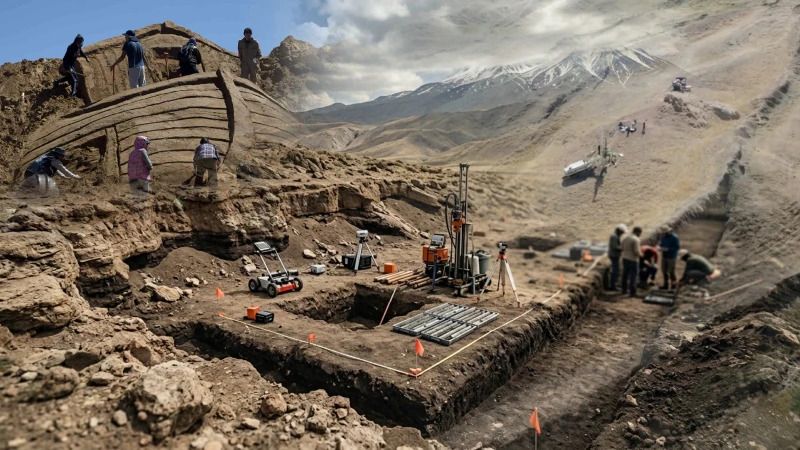
Fieldwork has been completed as part of research conducted by Sivas Cumhuriyet University at a ship-shaped geographical formation in Ağrı’s Doğubayazıt district that is believed by some to be the remains of Noah’s Ark.
American researcher Andrew Jones, who serves as deputy head of the research team, said continuous soil samples had been collected during core drilling operations, while radar scans had detected several anomalies beneath the surface.
Jones said laboratory studies were continuing to determine whether the formation was natural or man-made, adding that the final report is expected to be completed in April or May next year.
The ship-shaped formation was discovered on September 11, 1959, by Army Captain İlhan Durupınar, a mapping engineer who was surveying the geography of eastern Türkiye from a Turkish Armed Forces aircraft. Following the discovery, numerous Turkish and international researchers conducted studies in the area amid claims that the formation could be the remains of Noah’s Ark.
Most recently, the Noah’s Ark Research Project was launched in May 2026 under the leadership of Prof. Dr. Cenker Atila, a faculty member in the Department of Archaeology at Sivas Cumhuriyet University’s Faculty of Letters. Around 20 scientists from five countries took part in the project, which conducted approximately 90 days of fieldwork at the ship-shaped formation located between the villages of Telçeker and Üzengili in Doğubayazıt.
As part of the research, drones were used to create a current model of the terrain, while a new-generation radar system was deployed to scan beneath the surface. Around 1,000 soil samples were collected from different points of the formation and sent to laboratories for analysis. Core drilling operations were also carried out at the site.
Jones, who serves as deputy head of the project, said one of the most significant findings of this season’s research was the observation that the formation does not consist of a single mass of solid rock.
Jones said continuous soil samples were obtained during the core drilling operations.
“Some people had argued that this was a natural formation, that it was a solid mass of rock that had been eroded over millions of years into the shape of a ship. However, the biggest finding we obtained through drilling is that the structure is entirely soil. There are some large blocks of rock in the area, but the core drilling machine continuously brought up soil samples,” he said.
Jones stressed that the data obtained so far do not point to a definitive conclusion.
“This could be a natural formation, or it could be a man-made structure. What we are doing now is investigating it using scientific methods. We are conducting studies on soil samples taken from deep underground. We found highly enriched, organic, very dark soil beneath the surface. We will determine through testing whether this is decomposed wood or evidence of human activity,” he said.
Jones said radar scans conducted in August detected several anomalies beneath the surface, but the final report on the radar data has not yet been prepared.
“The preliminary radar results showed interesting findings, namely anomalies. We identified points that could indicate unnatural objects or structures beneath the surface. However, we are still waiting for the final report from the American radar scientist. This was exactly one of the reasons why we carried out drilling. We wanted to reach those depths and obtain samples,” Jones said.
Explaining why the research has focused on the ship-shaped area, Jones said various studies had been conducted by different researchers in the region since its discovery in 1959.
He said previous research had largely focused on the ship-shaped appearance visible on the surface, while the current project was designed to investigate what lies beneath it.
“Since Captain İlhan Durupınar first discovered this place in 1959, different researchers have come here and conducted scans. However, this is the first time that a university, with government permission, has been able to go underground and see what is there. We wanted to see what was beneath the surface, so we obtained permission for core drilling. Under the permission granted for this project, core drilling was carried out underground for the first time,” Jones said.
Jones said fieldwork had now been completed and that the final report is targeted for completion in April or May next year after the radar data and collected samples have been evaluated together.
He also cautioned against claims circulating on social media and in some news outlets before the research findings have been finalized, saying that definitive statements should not be made before the scientific studies are completed.
“Some people want to make statements before all the facts have been gathered. Around the world, you can see people and news organizations presenting this as a fact. Some say it has been 100 percent confirmed, while others make claims about what we have discovered that we have never actually told them,” Jones said.
“There are still laboratory studies to be conducted and final reports to be written. Therefore, our work is not finished, and we cannot make such a statement until it is. We are continuing our research. If it really turns out to be true, we hope it will be very good for Türkiye and the world. We are doing everything we can to conduct the research in the best possible way. However, the results are not yet conclusive, and we are continuing the testing process,” he added.
Here we are to serve you with news right now. It does not cost much, but worth your attention.
Choose to support open, independent, quality journalism and subscribe on a monthly basis.
By subscribing to our online newspaper, you can have full digital access to all news, analysis, and much more.
You can also follow AzerNEWS on Twitter @AzerNewsAz or Facebook @AzerNewsNewspaper
Thank you!