
Azerbaijan’s mud volcanoes offer new bet on tourism beyond Baku

Qabil Ashirov
Read moreAzerbaijan’s tourism industry has expanded considerably over the past decade, but the country still faces the challenge of turning its diverse natural and cultural assets into sustainable sources of visitor spending. Among the less conventional opportunities is mud volcano tourism, an area where Azerbaijan possesses an unusually large natural advantage but where the economic potential remains only partly developed.
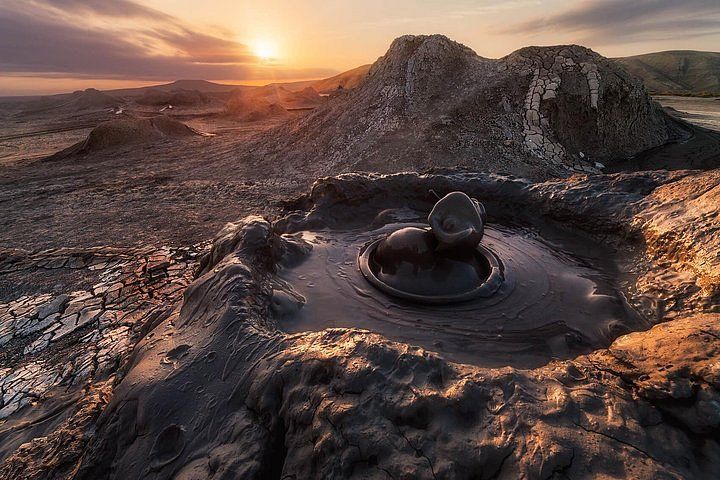
More than 2,000 mud volcanoes are known worldwide, and more than 350 of them are located in eastern Azerbaijan and the Caspian Sea basin. The concentration is particularly notable around the Absheron Peninsula, Baku, Gobustan, Shamakhi and southeastern Shirvan. This makes mud volcanoes one of Azerbaijan’s most distinctive geological tourism assets.
The opening of the Mud Volcanoes Tourism Complex on June 13, 2024, in the Absheron district near Pirakashkul marked an attempt to turn that natural attraction into a more structured tourism product. President Ilham Aliyev attended the opening of the complex, which covers 12 hectares. The facility includes a tourism information center, exhibition spaces devoted to minerals and mud volcanoes, workshops and a natural history exhibition, as well as observation areas and a restaurant. The complex also created more than 60 jobs for residents of nearby areas.
The more important question now is whether mud volcanoes can become a meaningful part of Azerbaijan’s broader tourism economy.
The scale of that economy provides some context. Azerbaijan received 2.57 million foreign visitors in 2025. However, in January-August 2026, the country received 1.586 million foreigners and stateless persons from 191 countries, down 7.8% from the same period of 2025. At the same time, arrivals from EU countries increased by 6.6% to 77,800, while arrivals from CIS countries rose by 3.1% to 619,500.
These figures show both the size and volatility of Azerbaijan’s tourism market. The country has a substantial international visitor base, but visitor numbers alone do not determine the economic value of tourism. Spending, length of stay and the geographical distribution of that spending are equally important.
The accommodation sector illustrates the point. In January-June 2026, hotels and similar establishments generated 279 million manats in revenue, 3.8% less than a year earlier. Foreigners accounted for 59.2% of hotel nights, while 40.8% were generated by Azerbaijani citizens. At the same time, 81.9% of foreign visitors’ hotel nights were recorded in Baku, showing how heavily tourism activity remains concentrated in the capital.
This is where mud volcano tourism could have a role. In the first eight months of 2026, the Mud Volcanoes Tourism Complex recorded 28,979 ticketed visitors. Of these, 26,235 were foreign tourists and 2,744 were Azerbaijani citizens. Foreign visitors represented more than 150 countries, with tourists from China, Russia, Türkiye, India, Poland, Germany, Italy, Bahrain and the United States among the groups specifically identified by the State Tourism Agency.
The 26,235 foreign visitors represent roughly 1.7% of all foreign arrivals to Azerbaijan during the first eight months of 2026. That is still a relatively small share, but it is significant for a specialized attraction that has operated for just over two years.
The economic potential could increase if mud volcanoes were incorporated into broader tourism itineraries rather than marketed as a standalone destination. The location is particularly relevant. The complex is roughly 100 kilometers from Baku and close to Gobustan, allowing geological tourism to be combined with cultural and archaeological attractions.
Such packages could increase visitor spending on transport, restaurants, guides, entrance fees and other services. They could also help shift some tourism-related economic activity away from Baku and toward surrounding communities.
There are, however, practical limitations. The complex currently lacks dedicated public transport, and reaching attractions outside the main tourism routes can be more difficult for independent travelers. Murad Agabayli, Chairman of the Board of the State Tourism Agency’s Reserve Management Center, has acknowledged that organizing dedicated transport for individual tourism products is not straightforward.
Infrastructure therefore remains as important as promotion. Regular shuttle services, organized excursions from Baku, multilingual information, trained geological and nature guides and stronger cooperation between hotels, tour operators and nearby attractions could determine whether mud volcanoes remain a niche attraction or become a more established component of Azerbaijan’s tourism offering.
The numbers suggest that the market already exists. Nearly 29,000 ticketed visits in eight months, more than 26,000 foreign visitors and tourists from over 150 countries provide evidence of international interest. But these figures should also be kept in perspective: mud volcano tourism currently represents only a small fraction of Azerbaijan’s overall tourism activity.
Its value may therefore lie less in becoming a mass tourism product and more in adding another distinctive reason for international visitors to spend an additional day, make another excursion and spend more money outside the capital. For a tourism economy seeking greater regional diversification, that could be a more realistic measure of the sector’s long-term potential.
Here we are to serve you with news right now. It does not cost much, but worth your attention.
Choose to support open, independent, quality journalism and subscribe on a monthly basis.
By subscribing to our online newspaper, you can have full digital access to all news, analysis, and much more.
You can also follow AzerNEWS on Twitter @AzerNewsAz or Facebook @AzerNewsNewspaper
Thank you!