
Uzbekistan eyes Zangezur Corridor as its shortcut to Europe

Ulviyya Poladova
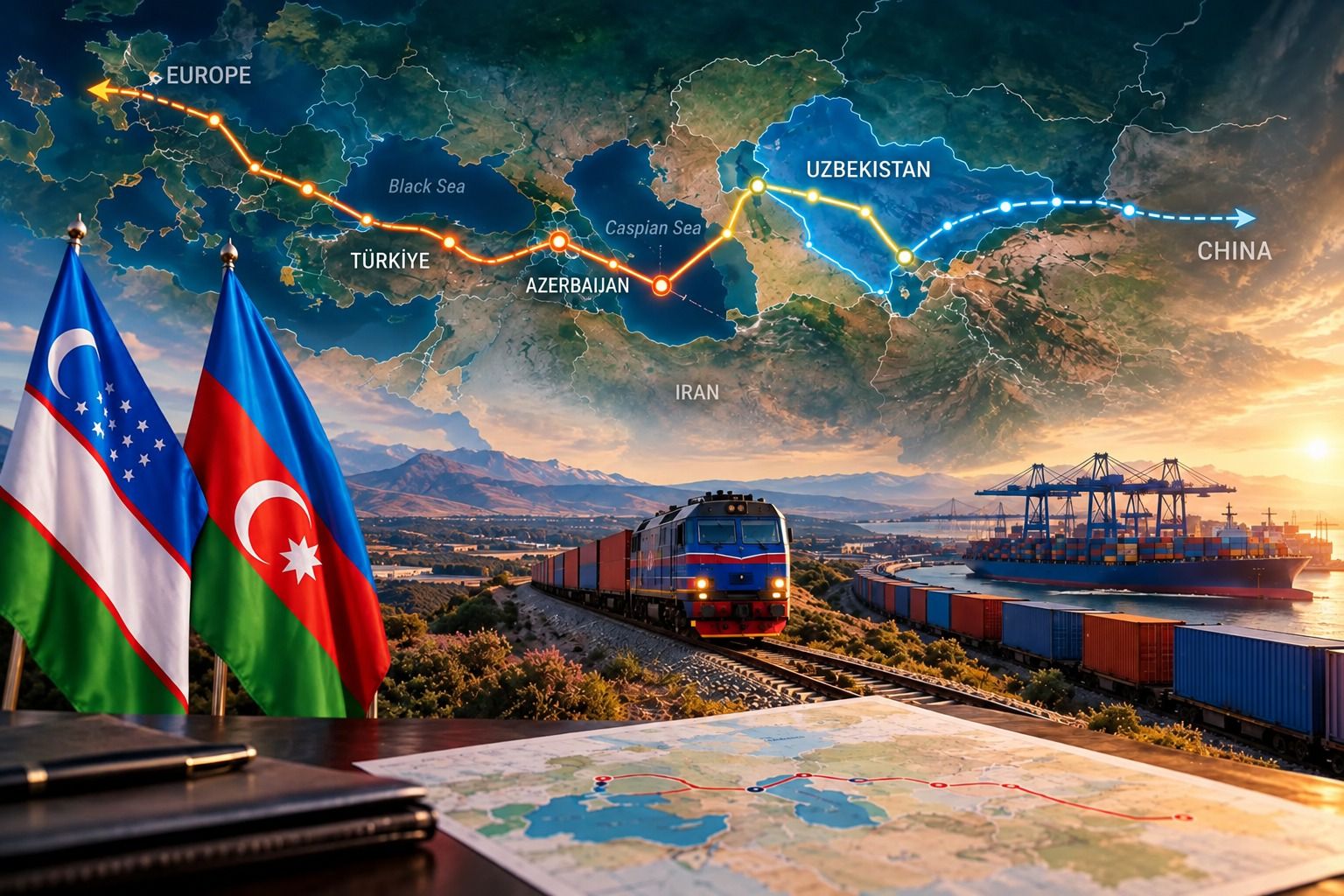
Read moreThe TRIPP (Zangezur) Corridor no longer looks like just another road or transport line. If it manages to tie together the countries of Central Asia, American companies and the South Caucasus into a single transit system, its economic and political weight will grow considerably. Official documents name one of the project's main goals as opening up new transit routes from Central Asia across the Caspian and on to Europe.
More and more countries are showing serious interest in the Zangezur corridor. Uzbekistan is one of them, and Tashkent has gone as far as setting up a separate working group to study whether the country could take part in building the railway running from Nakhchivan toward Türkiye. According to the country's transport minister Ilhom Makhkamov, for now this is only an assessment of the project, but ministries are already looking into it. He also noted that after President Shavkat Mirziyoyev's foreign trips, instructions were handed down on several fronts. Among them are the use of Caspian infrastructure, the purchase of ferries and possible equity participation in railway construction on Azerbaijani territory. Each of these questions is being handled by its own group.
The reason behind all this activity is fairly obvious. Uzbekistan needs to ship more and more goods to foreign markets. The more industrial and agricultural products the country sells, the more it cares about the cost and reliability of delivery. Taking part in the project creates the conditions for pushing Uzbek goods more actively onto European and Middle Eastern markets through multimodal routes, and for drawing in foreign partners to handle processing, storage and transport.
Uzbekistan's minister of investment, industry and trade Laziz Kudratov, speaking at the II Azerbaijan International Investment Forum (AIIF 2026), said that Uzbekistan intends to invest in building up additional transport capacity within the Middle Corridor, including its component part, the Zangezur corridor. That is a clear sign that the corridor is drawing in more investment, and therefore that it works to the benefit of many countries in the region.
The numbers speak for themselves too. By some estimates, building the corridor will cost somewhere between three and five billion dollars, while the annual savings on logistics once it is up and running could reach twenty to thirty billion. According to Bloomberg's calculations, transit time for cargo across Eurasia will drop by twelve to fifteen hours. That is a real chance to grab a bigger share of global trade.
For Azerbaijan this kind of partnership pays off as well. Baku is building up its rail link with Nakhchivan, and steady freight volumes matter for that future line. Back in August, Ilham Aliyev floated the idea of setting up an international consortium made up of investors interested both in the returns and in using the route. This is exactly where the interests line up. Uzbekistan needs a stable way to reach markets, and Azerbaijan needs the cargo that will keep its new infrastructure busy.
For now Tashkent is moving carefully and is in no hurry to make loud announcements. But the very fact that Uzbekistan wants to be part of this story says a great deal. A new logistical architecture is taking shape in the region, and nobody wants to be left standing on the sidelines while the question of who controls the flows between Asia and Europe gets decided. Among the recent developments, it is worth recalling the latest phone conversation between Uzbek President Shavkat Mirziyoyev and Armenian Prime Minister Nikol Pashinyan, where the head of the republic came out in favor of strengthening connectivity by developing the logistics and transport corridors that tie together the regions of Central Asia and the South Caucasus.
Azerbaijan, Uzbekistan and Türkiye have already agreed to develop transport links together and clear away the obstacles that slow down shipments. If Tashkent does join in building the Nakhchivan railway, that agreement will gain a very concrete follow-through. Cargo from Central Asia will be able to move across the Caspian and through Azerbaijan into Türkiye.
Uzbekistan’s decision to take an active role in the construction of the railway section linking Türkiye with Nakhchivan as part of the Zangezur Transport Corridor reflects the growing importance of the route for Central Asian countries, political analyst Ilgar Velizade said in a commentary to AzerNEWS.
According to the expert, Uzbekistan is one of the most dynamically developing countries in Central Asia. He noted that the country’s GDP has nearly doubled over the past decade, while its export-oriented production and range of exported goods continue to expand.
He pointed out that Uzbekistan is a double-landlocked country, meaning it has no direct access to the sea and is surrounded by countries that are also landlocked. This geographical situation creates additional challenges for the country’s foreign trade and makes reliable transport routes particularly important.
"In these circumstances, Uzbekistan is trying to find reliable ways to deliver its products to foreign markets. The Zangezur Transport Corridor is one such route," the analyst said.
Velizade noted that the Zangezur Corridor is generally viewed by Central Asian states, as well as by other countries, as an additional route within the Trans-Caspian or Middle Corridor. As he stated, the Baku-Tbilisi-Kars railway, which passes through Georgia, remains the main route at present, while the Zangezur route would provide an alternative. The two routes diverge on Azerbaijani territory and offer access to different markets.
"The route through Georgia provides access to the markets of Eastern Europe and the Black Sea region, while the Zangezur Transport Corridor would provide a direct link to the countries of the Middle East and the Eastern Mediterranean," Velizade explained.
In his view, this would give cargo operators greater flexibility in choosing routes for deliveries to different destinations.
At the same time, Velizade stressed that the Zangezur Transport Corridor is still taking shape. Construction is nearing completion on the Azerbaijani side, while construction under the TRIPP project on the Armenian side has yet to begin.
According to the analyst, as the relevant infrastructure projects move forward, many countries will seek to take their interests into account and ensure a long-term presence in what he described as a strategically important project.
He also highlighted the close relations between Azerbaijan and Uzbekistan, noting that the two countries have signed numerous agreements underpinning bilateral ties.
Velizade recalled Azerbaijani President Ilham Aliyev’s state visit to Uzbekistan in August, during which the two countries signed an agreement on eternal friendship.
"This creates a long-term interest for Tashkent in developing relations with Azerbaijan, including in the transport sector," he added.
Here we are to serve you with news right now. It does not cost much, but worth your attention.
Choose to support open, independent, quality journalism and subscribe on a monthly basis.
By subscribing to our online newspaper, you can have full digital access to all news, analysis, and much more.
You can also follow AzerNEWS on Twitter @AzerNewsAz or Facebook @AzerNewsNewspaper
Thank you!