
Caucasus after Karabakh: from conflict zone to connectivity corridor
By Mazahir Afandiyev, in collaboration with the Editorial Team
The 27th of September 2020 began for the entire Azerbaijani people as a long-awaited and proud day. It once again demonstrated the strength, determination and bravery of the victorious Azerbaijani Army, a strength that Azerbaijan had experienced throughout its history of statehood and that was demonstrated to the whole world.
On that very day, the Armenian armed forces, which grossly violated the ceasefire regime, launched another aggression against Azerbaijan by intensively striking the positions of the Azerbaijani armed forces along the entire front line, while deliberately subjecting populated areas of the Tartar, Aghdam, Fuzuli and Jabrayil districts to artillery fire. As a result, alongside military personnel, 11 Azerbaijani civilians, including two children, were killed.
Guided by the norms and principles of international law, as well as the four well-known resolutions of the United Nations Security Council that had remained on paper for 27 years, and with the aim of repelling the enemy's military provocation and putting an end to its aggression, as well as ending the occupation of our territories that had continued for more than 30 years, Supreme Commander-in-Chief and Great Commander, President Ilham Aliyev, immediately ordered the Azerbaijani Army to launch a counter-offensive along the entire front.
Thus, our activities aimed at liberating Karabakh, for which we had yearned for 30 years, began on September 27 with the “Iron Fist” counter-offensive operations and turned into the 44-day Second Karabakh–Patriotic War, ending with the liberation of Shusha, the pearl of Karabakh, from occupation. As a result of successful military operations, by November 9, five cities, four settlements and 286 villages were liberated from occupation, while the victorious Azerbaijani Army defeated the Armenian armed forces and the terrorist groups formed in Karabakh.
On November 10 of the same year, following Armenia's official appeal to the Russian Federation, the war was stopped with the direct participation of Russia and by agreement of the heads of all three states. A declaration consisting of nine provisions was adopted between Azerbaijan and Armenia, and thus Armenia signed an act of capitulation. As stated by Armenian Prime Minister Nikol Pashinyan, Armenia had no choice but to accept defeat before our Glorious Army. Therefore, the occupying side admitted its defeat and the conflict was officially brought to an end.
Yet the end of active hostilities did not mean that the consequences of the conflict disappeared overnight. The post-war period created a second and equally important task: to turn military victory into a durable political, economic and social reality. This meant restoring communities, rebuilding infrastructure, returning people to their homes, reviving economic life and, ultimately, changing the physical and economic geography of a region that had been shaped by conflict for decades.
As a result of continuing the victory achieved on the military front at the political level, within 20 days after the 44-day Patriotic War, three districts—Aghdam on November 20, Kalbajar on November 25, and Lachin on December 1—were handed over to Azerbaijan. On August 26, 2022, the city of Lachin, as well as the villages of Zabukh and Sus, were taken under control. Thus, in accordance with the trilateral statement, the process of peacefully returning the Aghdam, Kalbajar and Lachin districts was completed.
The War, which lasted only 44 days, and the bravery of our heroic officers and soldiers turned the centuries-old aspirations of our grateful people into reality, liberated our lands that had been under occupation, and restored historical justice.
From the very first day of this war, hundreds of patriotic young Azerbaijanis wholeheartedly volunteered to go to the front and fought heroically against the enemy. Unfortunately, war has its own laws. If there is war, there are also martyrs, veterans and losses. This war was not without casualties either. A total of 2,908 Azerbaijani servicemen made the ultimate sacrifice in the struggle to liberate our lands, while six remain missing and thousands of brave soldiers became war veterans.
As President Ilham Aliyev stated, “I once again bow my head before the souls of the martyrs of the First and Second Karabakh Wars and pray to God to have mercy upon them. We avenged their blood! Our heroic soldiers and officers who presented us with this Victory are our source of pride. Their heroism, their bravery and their sacrifice have already become an epic.”
It is no coincidence that September 27, which has become a celebration of national will, national spirit and national dignity, is observed every year in the Republic of Azerbaijan as Remembrance Day, in accordance with the Order of President Ilham Aliyev dated December 2, 2020, as a sign of deep respect for our soldiers and officers who fought heroically in the Second Karabakh–Patriotic War and sacrificed their lives for the territorial integrity of our country, as well as for all our martyrs.
In general, the Azerbaijani state has always shown the highest respect for the memory of our martyrs who sacrificed their lives for the Motherland, keeping the perpetuation of their memory, as well as the treatment and restoration of the health of our veterans, at the centre of its attention.
The Victory Park, created with the aim of perpetuating the names of our martyrs and heroic sons; the Victory Arch, built as a symbol of the 44-day Patriotic War, with a height of 44 metres, a width of 22 metres and 44 columns; the Patriotic War Memorial Complex; and the Victory Museum will always keep alive the heroic epic of our people.
But remembrance is only one part of the post-war transformation. The other is rebuilding the geography of everyday life. Roads, railways, airports, energy infrastructure, digital networks, industrial zones, residential settlements and social facilities are changing the physical landscape of Karabakh and Eastern Zangezur. Reconstruction is therefore not simply about repairing what was destroyed. It is about creating the infrastructure through which people, goods, capital and ideas can move again.
This is where the meaning of the post-Karabakh period becomes broader than the restoration of territories. The strategic question is increasingly how a region that was once associated with closed borders, military positions and competing territorial claims can become a region of roads, railways, trade routes and economic cooperation.
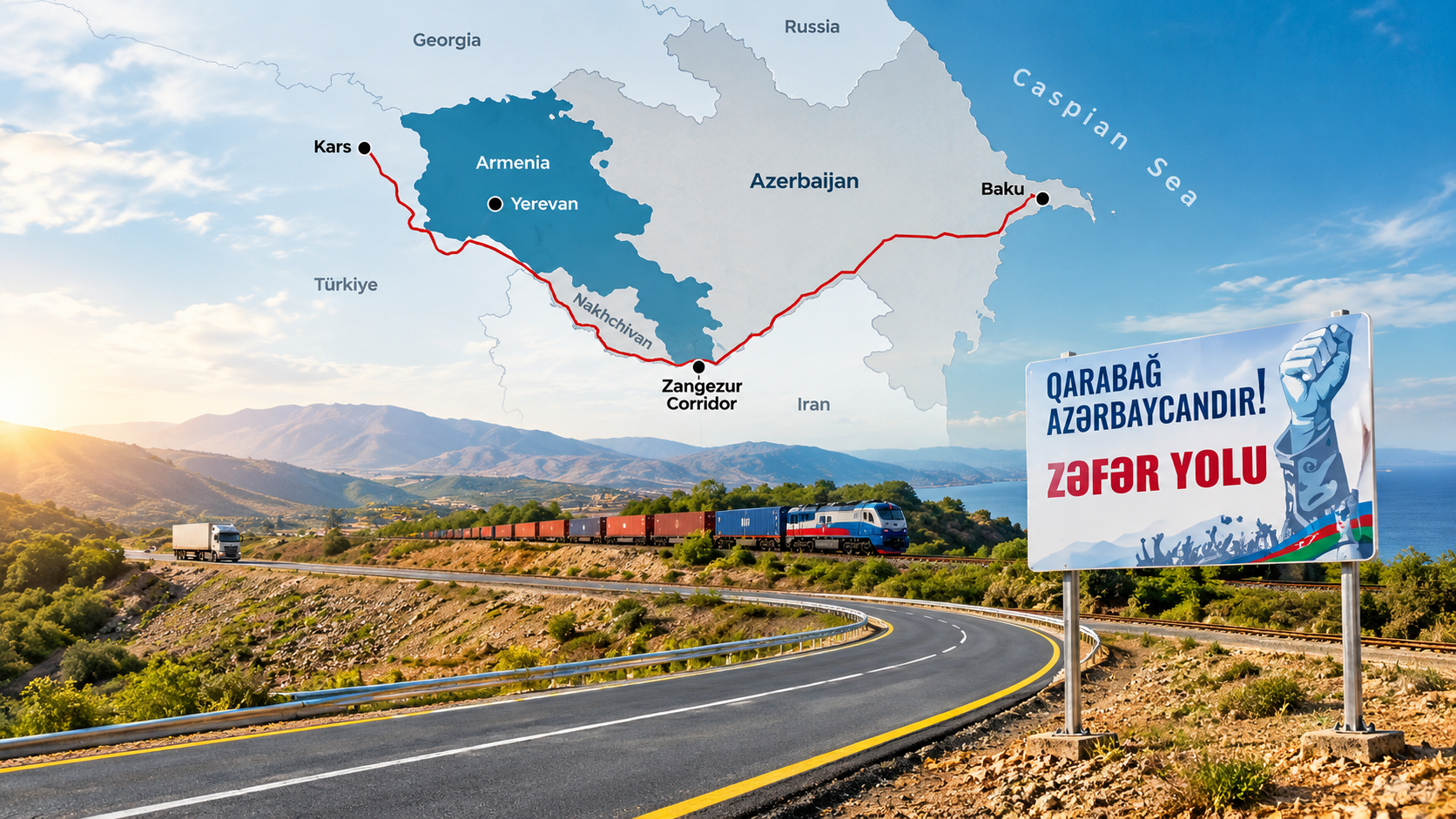
Today, the Azerbaijani people are closer to peace than ever before. The South Caucasus is transforming from a centre of conflict into a region where all peoples can live in prosperity. The signing of the Washington Declaration on August 8, 2025, between President of the Republic of Azerbaijan Ilham Aliyev, President of the United States Donald Trump and Prime Minister of the Republic of Armenia Nikol Pashinyan, as well as the initialling of the text of the Peace Agreement, became an important point towards achieving lasting peace. The Washington Declaration explicitly emphasised the opening of communications between Azerbaijan and Armenia for domestic, bilateral and international transportation and referred to unimpeded connectivity between mainland Azerbaijan and the Nakhchivan Autonomous Republic through the territory of Armenia, with reciprocal benefits for regional connectivity. It also established the framework for the proposed Trump Route for International Peace and Prosperity, or TRIPP.
This is an important change in the language of the South Caucasus. For decades, the region was discussed primarily through the vocabulary of conflict: ceasefires, front lines, occupied territories, displaced populations, security arrangements and negotiations. The emerging agenda increasingly uses a different vocabulary: connectivity, transit, investment, logistics, energy, digital infrastructure and trade.
The strategic significance of this shift should not be underestimated. Geography, which once appeared to be one of the region's greatest sources of vulnerability, can increasingly become one of its greatest economic assets. Azerbaijan's position on the Caspian Sea places it at the intersection of routes connecting Central Asia with the South Caucasus, Türkiye and Europe. The Middle Corridor, or Trans-Caspian East-West International Transport Corridor, already connects China and Central Asia with the Caucasus and Europe through a multimodal network of rail, maritime and road infrastructure.
In this emerging architecture, Karabakh and Eastern Zangezur are no longer viewed only through the prism of their recent conflict history. Their reconstruction is becoming connected to a wider economic geography that includes the Caspian Sea, the Middle Corridor, Nakhchivan, Türkiye and European markets. The restoration of roads and railways inside Azerbaijan can therefore serve not only local communities but also the wider movement of goods and people across the region.
The logic is particularly significant because connectivity is rarely limited to transportation. A functioning corridor requires customs cooperation, border infrastructure, logistics centres, digital systems, energy supplies, investment and predictable commercial conditions. In this sense, a transport corridor can become an economic ecosystem. The more efficiently these components operate together, the greater the potential for transit routes to generate investment, employment and new commercial relationships.
The restoration and reconstruction work being carried out in our Karabakh and Eastern Zangezur economic regions in accordance with modern urban planning standards, the further growth of the region's economic potential against the backdrop of geopolitical changes taking place in our world, and Azerbaijan's transformation into a strategic transportation hub between East and West, as well as North and South, are increasing the international community's interest in achieving lasting peace.
A peaceful South Caucasus would also have significance far beyond Azerbaijan and Armenia. The region sits between major economic spaces and transport networks. Its stability can affect routes linking Central Asia with Europe, the Caspian basin with the Black Sea, and Türkiye with the wider Turkic world. For this reason, the economic value of peace is increasingly inseparable from the strategic value of connectivity.
The same principle applies to energy. Azerbaijan's established role as an energy supplier to European markets has already given the country an important position in the continent's diversification efforts. The next stage is broader: energy corridors can increasingly develop alongside transport and digital corridors, creating a more integrated regional infrastructure network. The result could be a South Caucasus in which energy, logistics, communications and trade reinforce one another rather than developing as separate projects.
This is also why the post-war reconstruction of Karabakh should be viewed within the wider transformation of Azerbaijan's economy and infrastructure. The rebuilding of roads and settlements, the development of industrial and economic zones, the expansion of renewable energy capacity and the strengthening of transport connections can collectively create the foundations for a new regional economic model.
In this context, the recent visit of representatives of the diplomatic corps accredited in Azerbaijan to Karabakh and Eastern Zangezur from September 11 to 13, 2026, was not accidental. That visit once again demonstrated that the countries they represent unequivocally recognise and support Azerbaijan's territorial integrity. At the same time, within Armenian society, revanchist forces that are hostile towards our country made unfounded and false statements and attempted to undermine the process of achieving peace.
The diplomatic visits to the liberated territories also carry a wider message. For years, international attention to Karabakh was overwhelmingly associated with conflict, displacement and political negotiations. Today, international representatives can also see reconstruction, new infrastructure and the changing economic landscape on the ground. This creates an opportunity for the international community to assess the region not only as a former conflict zone but as an emerging component of a wider connectivity network.
The transformation will not happen automatically. Infrastructure alone cannot guarantee economic integration. Roads and railways must be accompanied by political stability, functioning institutions, investment, cross-border cooperation and confidence among the countries of the region. Sustainable connectivity requires predictable rules and respect for sovereignty, territorial integrity and jurisdiction. The Washington Declaration itself places these principles alongside its call for the opening of communications.
This is particularly important because the South Caucasus has historically been influenced by competing geopolitical interests. A new connectivity model can succeed only if the region's countries and external partners see economic cooperation not as a zero-sum competition but as an opportunity to expand the overall regional market.
The emerging role of Azerbaijan is therefore not simply that of a country rebuilding territory after war. It is increasingly that of a country attempting to connect different economic and geographical spaces. The Middle Corridor gives Azerbaijan a role in the movement of goods between Asia and Europe, while routes towards Nakhchivan and Türkiye create additional possibilities for north-south and east-west connectivity. The planned TRIPP framework, meanwhile, places the opening of communications between Azerbaijan and Nakhchivan within a broader regional connectivity agenda.
The United States and Azerbaijan have also explicitly placed regional connectivity, including the Middle Corridor, energy, trade, transit, data connectivity and multimodal logistics within the framework of their strategic partnership. This demonstrates how the post-war transformation of the South Caucasus is increasingly connected to wider international economic and strategic calculations.
In this sense, the phrase “after Karabakh” should not be understood merely as a reference to a period that follows a war. It describes a fundamental change in the region's strategic logic. The question is no longer only how the South Caucasus can prevent another war. It is increasingly how peace can produce tangible economic benefits for societies that have lived with conflict for decades.
Connectivity can become one of the mechanisms through which that peace is made visible in everyday life. A functioning railway, a modern highway, a logistics centre, an industrial facility, an energy project or a digital connection may appear to be an economic development individually. Together, however, they can change the strategic importance of the entire region.
For Azerbaijan, this transformation is particularly significant because the country's geography has historically been both a challenge and an opportunity. Situated between the Caspian Sea, Russia, Iran, Georgia, Armenia and Türkiye, Azerbaijan occupies a position through which multiple regional routes can converge. The post-war environment creates the possibility of linking this geography more effectively with neighbouring countries and international markets.
For Armenia, the opening of regional communications could also create new economic possibilities, particularly if connectivity develops on the basis of mutually agreed principles and reciprocal benefits. For Georgia, Türkiye, Central Asian states and European partners, greater stability and improved transport links could provide additional routes for trade and investment. In this sense, the benefits of connectivity need not be confined to the countries directly involved in the former conflict.
The transformation of the South Caucasus from a conflict zone into a connectivity corridor is therefore not merely an infrastructure project. It is a long-term political and economic process. Its success will depend on whether the region can replace the habits and structures of confrontation with practical cooperation.
The legacy of the 44-day war will always remain inseparable from the sacrifices of Azerbaijan's martyrs and the suffering caused by decades of conflict. The remembrance of those who lost their lives cannot be separated from the country's determination to protect its sovereignty and territorial integrity. At the same time, the strongest guarantee that the next generation will not experience the same cycle of conflict may be the creation of conditions in which peace becomes economically valuable, politically sustainable and socially meaningful.
The South Caucasus is therefore standing at a historic crossroads. The road that once carried armies can become a road that carries trade. Territories once defined by military confrontation can become places of reconstruction and investment. Borders that once represented division can become points of regulated movement and economic exchange. And geography that once intensified strategic competition can become the foundation of regional connectivity.
Despite all this, under the leadership of the Victorious Supreme Commander-in-Chief, Azerbaijan will not take even a single step back from its firm position and will continue to shape new realities in the region. This new reality created by our Glorious Victory will protect not only the sovereignty and territorial integrity of our country, but also the peaceful, secure and prosperous future of the region and its peoples as a whole.
The next chapter of the South Caucasus will ultimately be judged not only by what was won on the battlefield, but by what is built after the battlefield falls silent. If the region succeeds in converting peace into connectivity, connectivity into trade, and trade into shared economic opportunity, then the post-Karabakh era could mark something much larger than the end of a conflict. It could mark the beginning of a new economic geography for the South Caucasus, one in which the region moves from being known primarily as a frontier of confrontation to becoming a bridge between continents.
* image created by AI
Here we are to serve you with news right now. It does not cost much, but worth your attention.
Choose to support open, independent, quality journalism and subscribe on a monthly basis.
By subscribing to our online newspaper, you can have full digital access to all news, analysis, and much more.
You can also follow AzerNEWS on Twitter @AzerNewsAz or Facebook @AzerNewsNewspaper
Thank you!