
Azerbaijan seeks to turn COP29 legacy into lasting green energy influence at COP31 [COMMENTARY]

Ulviyya Poladova
Read moreThe global climate agenda is entering a new and increasingly challenging phase. While governments continue to announce ambitious emissions reduction targets and renewable energy commitments, the gap between political declarations and their practical implementation remains one of the biggest obstacles to international climate cooperation. Against this backdrop, the 31st session of the Conference of the Parties to the UN Framework Convention on Climate Change (COP31), taking place in Antalya, Türkiye, from November 9 to 20, provides an important opportunity to reassess global priorities and accelerate the implementation of existing commitments.
For Azerbaijan, the conference carries particular significance. Having hosted COP29 in Baku in November 2024, the country now has an opportunity to build on its experience, maintain its role in international climate diplomacy and present its growing renewable energy ambitions to a wider international audience.
Azerbaijan is participating in COP31 with a broad delegation, while President Ilham Aliyev is scheduled to attend the Leaders' Summit on November 11 at the invitation of Turkish President Recep Tayyip Erdogan. The country's participation reflects its intention to remain actively involved in shaping the international climate agenda beyond its own COP presidency.
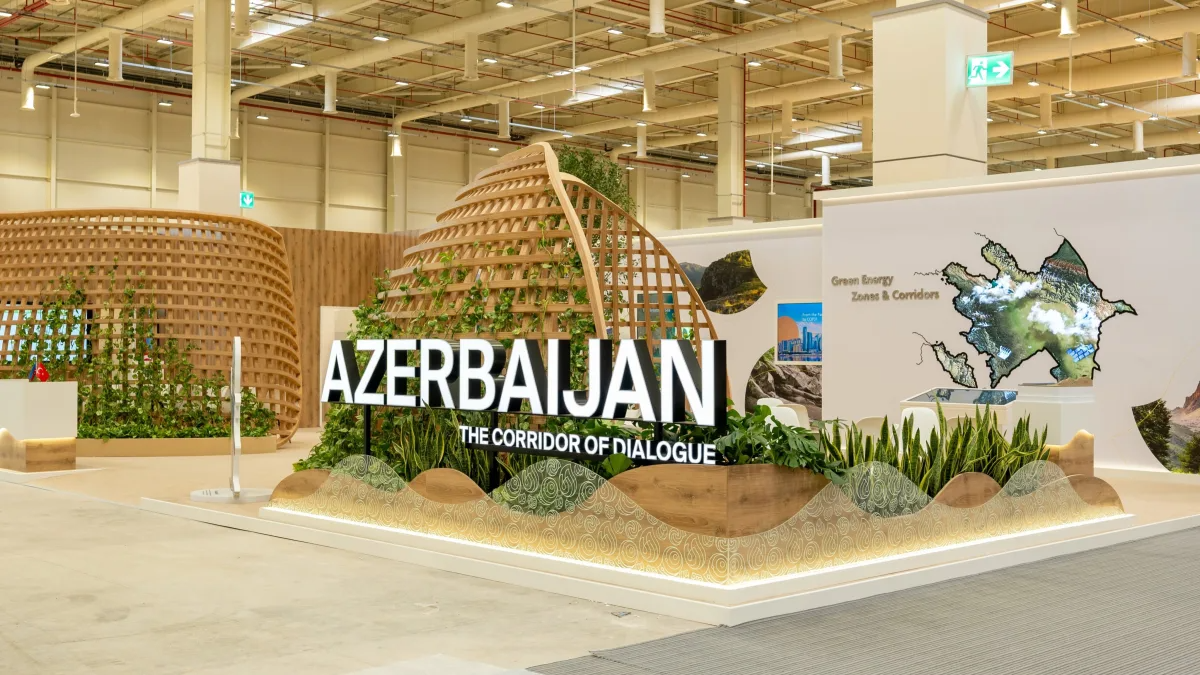
Azerbaijan's national pavilion, developed around the concept of a "Dialogue Corridor", presents the country's renewable energy potential, green energy corridor initiatives, projects in Karabakh and East Zangezur, its first battery-based energy storage system, and efforts to protect the biodiversity of the Caspian Sea. More than 40 events, panel discussions and meetings are planned at the pavilion, providing a platform for presenting national projects, attracting partners and exchanging experience.
The format of COP31 itself reflects an attempt to introduce a different approach to international climate negotiations. Türkiye is responsible for the organisational leadership of the conference, while Australia is leading the negotiations. The presidency is built around three principles: dialogue, consensus and action. Ankara and Canberra have also presented COP31 as an "Implementation COP", signalling that the focus should move beyond announcing new targets towards delivering on commitments made at previous conferences.
The agenda includes the Antalya AI Commitment, zero waste, the protection of marine and ocean ecosystems, food security, climate-resilient cities, youth and education, green industrialisation and the transition to clean energy. These priorities demonstrate that climate policy is increasingly connected with technological development, economic competitiveness and energy security.
However, the central question remains whether the international community can turn these priorities into measurable results.
Speaking to AzerNEWS, expert Emre Diner argued that international climate diplomacy is facing a serious crisis of confidence. In his assessment, governments have spent years announcing ambitious objectives, but the results achieved on the ground have not matched the scale of their political commitments.
The situation has become more complicated as strategic competition between the United States and China, Europe's efforts to strengthen energy security, regional conflicts and uncertainty in the global economy have reshaped national priorities. For many governments, economic stability and reliable energy supplies have become just as important as climate objectives. Diner also highlighted the difficulties faced by developing countries. While these economies are being encouraged to accelerate their energy transitions, many lack sufficient access to financing and technology to make this possible.
"We are asking these countries to accelerate their energy transition, yet we are not providing them with sufficient financing and technology to achieve it. I do not believe this approach is sustainable," he noted.
According to the analyst, COP31 should therefore be assessed not by the number of new promises included in its final declaration, but by the extent to which existing commitments translate into actual investment and functioning financial mechanisms.
"Tangible progress on climate finance, easier access to clean-energy investment for developing countries, and realistic implementation schedules for national emissions reduction targets will be essential," Diner emphasized.
He also called for stronger financial monitoring mechanisms to ensure greater transparency regarding when announced commitments will be fulfilled, which projects will receive funding and how investments will be monitored.
The private sector, in his view, must play a more active role, as government declarations alone cannot provide the scale of financing required for the global energy transition. Infrastructure investment, technology transfers, financial guarantees and long-term economic planning are all necessary to turn political commitments into practical outcomes. This issue is particularly relevant to Azerbaijan, which has sought to position itself as a bridge between traditional energy-producing economies and the emerging green energy market.
Azerbaijan's presidency of COP29 in November 2024 marked an important stage in the country's international engagement. The conference demonstrated Baku's ability to facilitate dialogue between countries with different economic interests and approaches to climate policy, while strengthening its profile as a platform for international cooperation.
One of the most significant achievements of COP29 was the agreement on a new collective quantified climate finance goal, under which developed countries are expected to take the lead in mobilising at least $300 billion annually for developing countries by 2035. The conference also completed negotiations on the rules governing Article 6 of the Paris Agreement, establishing a framework for international carbon markets. In addition, the Loss and Damage Fund became fully operational, while the summit brought greater attention to the particular vulnerabilities of small island developing states.
COP31 President and Turkish Minister of Environment, Urbanisation and Climate Change Murat Kurum has acknowledged Azerbaijan's contribution to the international climate process. He thanked COP29 President and Azerbaijani Presidential Representative for Climate Issues Mukhtar Babayev for sharing the experience and knowledge accumulated during Azerbaijan's presidency.
Kurum also emphasised the close cooperation between Türkiye and Azerbaijan, describing the two countries as brotherly partners. He highlighted the transfer of experience from Azerbaijan's COP29 presidency to Brazil's COP30 and now to Türkiye's COP31.
Referring to the outcomes of the Baku conference, Kurum particularly underlined the new climate finance target and the completion of the rules for implementing Article 6 of the Paris Agreement. He stressed that the next challenge for the international community is to translate these decisions into tangible benefits for countries and their populations.
For decades, Azerbaijan's international economic significance has been closely associated with oil and natural gas exports and its contribution to regional and European energy security. COP29 allowed the country to demonstrate that its diplomatic interests also extend to climate finance, sustainable development and the economic challenges facing developing nations.
Diner believes Azerbaijan has two important advantages in this regard: its understanding of the realities of international energy markets as an energy-producing country and its ability to appreciate the economic priorities of developing economies.
These characteristics could allow Baku to play a constructive role in facilitating dialogue between developed countries and emerging economies. Nevertheless, maintaining this position will require consistency between the country's international climate commitments and its domestic energy investment policies.
Azerbaijan's green energy ambitions are supported by substantial natural resources. The country estimates its renewable energy potential at approximately 135 GW onshore and 157 GW in the Azerbaijani sector of the Caspian Sea. Harnessing even part of this capacity could significantly change the country's energy profile and create new opportunities for electricity exports. The government's strategy is not based on abandoning oil and natural gas in the short term. Rather, it seeks to diversify the energy sector, preserve the country's position as a reliable hydrocarbon supplier and gradually develop renewable energy as another major component of the economy.
Several projects have already moved into the operational stage. This year has seen the opening of the Khizi-Absheron Wind Power Plant, the Absheron Battery Energy Storage Centre and the Gobustan Solar Power Plant. Construction is also underway on the Shams 1 and Western Horizon solar power plants in Nakhchivan.
Karabakh and East Zangezur, designated as green energy zones, have become another important part of this strategy. Over the past five years, nearly 40 small hydropower plants have been constructed in these regions using state funding. These projects are intended to make more efficient use of local natural resources while supporting the development of sustainable energy infrastructure.
Diner views Azerbaijan's approach to maintaining its traditional energy exports while expanding renewable generation as a realistic economic strategy.
"Azerbaijan cannot completely move away from hydrocarbon revenues in the short term. However, an economic model dependent solely on oil and gas exports also carries certain long-term risks," he explained.
In this context, renewable energy investment represents not only an environmental choice but also a tool for economic diversification and the expansion of Azerbaijan's energy diplomacy. One of the most ambitious elements of this strategy is the development of regional electricity corridors designed to connect renewable energy producers with international markets. Azerbaijan is cooperating with its partners on several initiatives, including the Black Sea Energy submarine cable, an overland electricity route linking Azerbaijan, Georgia, Türkiye and Bulgaria, and a proposed green energy cable connecting Azerbaijan with Kazakhstan and Uzbekistan across the Caspian Sea. These projects could eventually create a broader electricity network linking Central Asia, the South Caucasus and European markets. They would also allow Azerbaijan to expand its role from a traditional supplier of oil and gas into a regional electricity transit and export hub.
Türkiye is particularly important to this ambition. Its geographical position, established energy infrastructure and connections with European markets make it a strategic partner for Azerbaijan. Expanding cooperation from natural gas supplies into electricity trade could mark a new stage in bilateral energy relations.
At the same time, cooperation with Kazakhstan and Uzbekistan could give the proposed green energy corridors a wider regional dimension. Both countries possess significant renewable energy resources, particularly in solar and wind generation, which could eventually contribute to electricity exports across the Caspian Sea.
However, Diner cautioned against assuming that these projects can be implemented quickly through political agreements alone.
"Green-energy corridors cannot be established through political declarations alone. They require subsea cables, high-capacity transmission lines, technical infrastructure, financing, and long-term commercial agreements between countries," he added.
Investors must also have a clear understanding of how these projects will generate revenue and at what prices electricity will be sold. Without reliable financial arrangements and commercially viable conditions, large-scale investment will remain difficult to secure.
Azerbaijan's participation in COP31 reflects a broader transformation in its economic and diplomatic priorities. The country is seeking to retain its importance in traditional energy markets while developing new capabilities in renewable electricity generation, energy storage and cross-border infrastructure. The significance of this transition extends beyond environmental policy. Regional green energy corridors could strengthen economic ties with Türkiye and Central Asian states, create new export opportunities and reinforce Azerbaijan's position along the routes connecting Europe and Asia.
At the same time, the country's experience as a hydrocarbon producer gives it an understanding of the practical challenges associated with energy security, infrastructure financing and the transition towards cleaner energy systems.
The broader challenge facing COP31 is much the same. The international community has already established numerous targets and adopted important agreements. What matters now is whether these commitments will produce investment, infrastructure and measurable improvements.
In this sense, the shift from promises to implementation could determine not only the legacy of COP31, but also the future role of countries such as Azerbaijan in the emerging global green energy landscape.
Here we are to serve you with news right now. It does not cost much, but worth your attention.
Choose to support open, independent, quality journalism and subscribe on a monthly basis.
By subscribing to our online newspaper, you can have full digital access to all news, analysis, and much more.
You can also follow AzerNEWS on Twitter @AzerNewsAz or Facebook @AzerNewsNewspaper
Thank you!