
Aghdam's industrial sales reach 2.96 billion manats as new factories boost growth

Qabil Ashirov
Read morePresident Ilham Aliyev inaugurated two new manufacturing facilities and visited a major agricultural enterprise in Aghdam on November 7, marking another important step in the transformation of the liberated district into an emerging centre of industrial production and commercial agriculture. The three projects, spanning metal manufacturing, consumer goods and large-scale olive cultivation, illustrate how Azerbaijan's reconstruction strategy is gradually evolving into a broader economic development model built around private investment, employment, domestic production and export potential.
The significance of these developments extends beyond the individual facilities. Together, they demonstrate the growing economic diversity of Aghdam, where industrial capacity, agricultural resources and modern production technologies are increasingly becoming interconnected elements of a regional growth strategy.
One of the most substantial industrial investments is the metal products manufacturing facility established in the Aghdam Industrial Park. With a total project value of 24.9 million manats, the investment is being implemented in two phases, with 8.8 million manats allocated to the first stage and another 16.1 million manats planned for the second. The project combines private capital with approximately 4.7 million manats in bank financing subsidised through the Azerbaijan Business Development Fund.
The production profile of the facility reflects its potential contribution to Azerbaijan's industrial supply chains. During the first phase, the plant is designed to manufacture 4,920 tonnes of steel mesh, 3,480 tonnes of drawn wire, 3,180 tonnes of nails, 1,800 tonnes of annealed wire, 12,000 tonnes of wire and 1,080 tonnes of cold-deformed reinforcing steel annually. The second phase will add annual capacities of 10,000 tonnes of galvanised wire and 8,240 tonnes of high-carbon drawn wire.
These products have direct applications in construction, infrastructure development and industrial projects. Their local production creates opportunities for shorter supply chains, more efficient procurement and lower transportation costs, particularly as large-scale reconstruction continues across the liberated territories. The facility also plans to supply international markets, creating an additional channel for expanding Azerbaijan's non-oil industrial exports.
The employment dimension adds another layer to the investment's economic importance. The plant currently employs 26 people, with the workforce expected to reach 100 once operations achieve full capacity. Its equipment has been supplied by leading companies from Italy, Germany, Türkiye and China, reflecting the integration of international industrial technology into the region's emerging manufacturing base.
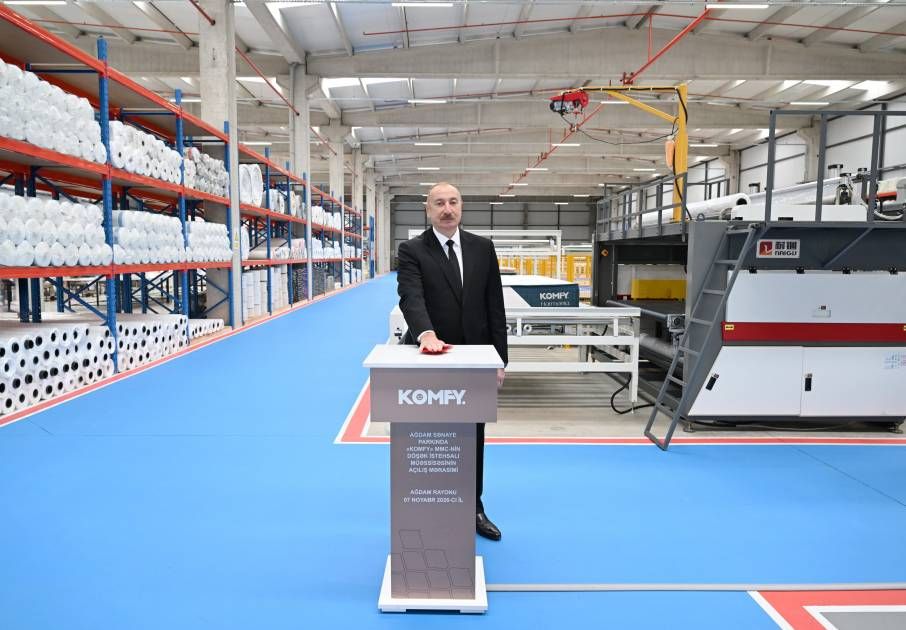
A second investment in the Aghdam Industrial Park introduces another important dimension: the production of consumer goods with export-oriented characteristics. The company has established a mattress manufacturing facility with an annual production capacity of 130,000 units. The project, valued at 2.5 million manats, will employ 65 people and manufacture mattresses of different sizes, structures and firmness levels, alongside Bonnell and pocket spring systems.
A particularly important feature is the introduction of roll-pack technology, which allows mattresses to be compressed and packaged in cylindrical form. This technology offers practical commercial advantages through more efficient storage, handling and transportation. Lower logistical requirements can improve price competitiveness and create additional opportunities for reaching foreign markets.
The facility's product range also targets hotels and hospitality businesses, both domestic and international. This gives the enterprise access to a broader customer base, connecting local manufacturing with the development of Azerbaijan's tourism and accommodation sectors. With an annual capacity of 130,000 mattresses, the factory represents a meaningful addition to the country's consumer goods production potential.
The two manufacturing projects also highlight the importance of the Aghdam Industrial Park as an investment platform. Established in 2021 across 190 hectares, the park has registered 39 enterprises, comprising 37 residents and two non-residents. Their combined project value stands at 375.5 million manats, while actual investment has reached 192.6 million manats. More than 1,000 people are already employed across the park's projects.
The cumulative sales volume of industrial park residents has reached 2.96 billion manats, including 132.6 million manats in exports. These figures provide a broader context for understanding the economic importance of the latest openings. Aghdam's industrial development is increasingly supported by an established investment ecosystem, where infrastructure, preferential financing and tax and customs incentives encourage private-sector participation.
Agriculture, meanwhile, represents the third pillar of this emerging economic structure. The large-scale olive cultivation project demonstrates how the region's agricultural potential can be converted into a substantial commercial production base.
The enterprise covers 1,150 hectares and currently contains more than 700,000 olive trees. Its production target stands at 10,000 tonnes of olives annually, equivalent to approximately 2,000 tonnes of olive oil. The longer-term development plan envisages increasing the number of olive and almond trees to 1.5 million, further expanding the project's agricultural scale.
The project's development trajectory is particularly significant from an economic perspective. Preparatory work began in December 2020, following the clearance of landmines and unexploded ordnance from the territory. Initial agricultural activity focused on grain cultivation, with productivity reaching 40 centners per hectare. The transition towards intensive olive cultivation subsequently established the foundation for a specialised agricultural enterprise.
The investment also incorporates supporting infrastructure, including temporary irrigation channels, a renovated 3,690-metre section of the Eyvazkhanbeyli-Khachinchay road, administrative and technical facilities, a meteorological station and a fuel station. A 10-hectare forest area has already been established, with another 50 hectares planned. Modern agricultural machinery, drip irrigation and meteorological monitoring systems further strengthen the project's operational capacity.
From a wider economic perspective, the olive plantation offers several potential advantages. Large-scale cultivation can support the development of food processing, packaging, storage and distribution activities, creating additional business opportunities throughout the agricultural value chain. A planned annual output of 2,000 tonnes of olive oil also provides a foundation for developing a stronger domestic olive oil industry and exploring export markets.
The three projects therefore represent complementary components of a wider regional economic transformation. Metal manufacturing supplies industrial and construction markets, mattress production expands the consumer goods sector, while olive cultivation creates opportunities for agricultural processing and food exports. Their combined development contributes to a more diversified economic structure, supported by private investment and expanding production capacity.
President Ilham Aliyev's November 7 visit to the enterprises also highlighted the strategic importance attached to private-sector participation in the economic reintegration of the liberated territories. The projects demonstrate how public investment in infrastructure, industrial park facilities, financing mechanisms and fiscal incentives can create conditions for businesses to establish long-term operations.
The next stage of Aghdam's development will increasingly depend on the ability of these enterprises to achieve their planned production capacities, develop reliable supplier networks, attract skilled workers and establish sustainable commercial relationships with domestic and international customers. Strong connections between manufacturing, agriculture, logistics and processing can generate multiplier effects across the regional economy.
Aghdam is gradually acquiring the characteristics of a diversified production centre, where industrial investment and agricultural development reinforce each other. The combination of a 24.9-million-manat metal manufacturing project, a 130,000-unit annual mattress production facility and a 1,150-hectare olive plantation illustrates the scale and variety of economic activity taking shape in the district.
Ultimately, the success of reconstruction will increasingly be reflected in productive assets, operating businesses, skilled employment and competitive goods entering domestic and international markets. Aghdam's emerging economic landscape offers a compelling example of how reconstruction can create the foundations for a new regional economy, with industry and agriculture serving as key engines of sustainable growth.
Here we are to serve you with news right now. It does not cost much, but worth your attention.
Choose to support open, independent, quality journalism and subscribe on a monthly basis.
By subscribing to our online newspaper, you can have full digital access to all news, analysis, and much more.
You can also follow AzerNEWS on Twitter @AzerNewsAz or Facebook @AzerNewsNewspaper
Thank you!