
The exclamation mark that changed the course of Azerbaijan's history
Elnur Enveroglu
Read moreAzerbaijan's victory over Armenia in the 44-day Patriotic War of 2020 was more than a decisive military triumph, as it marked the beginning of a profound transformation in the country's political landscape, national consciousness and strategic position in the South Caucasus. Six years after the liberation of Shusha, and three years after the restoration of full sovereignty over its internationally recognised territory, the symbolism of victory has acquired an additional dimension, reflecting the determination of a nation to turn the page on a painful chapter of its history and build a future on its own terms.
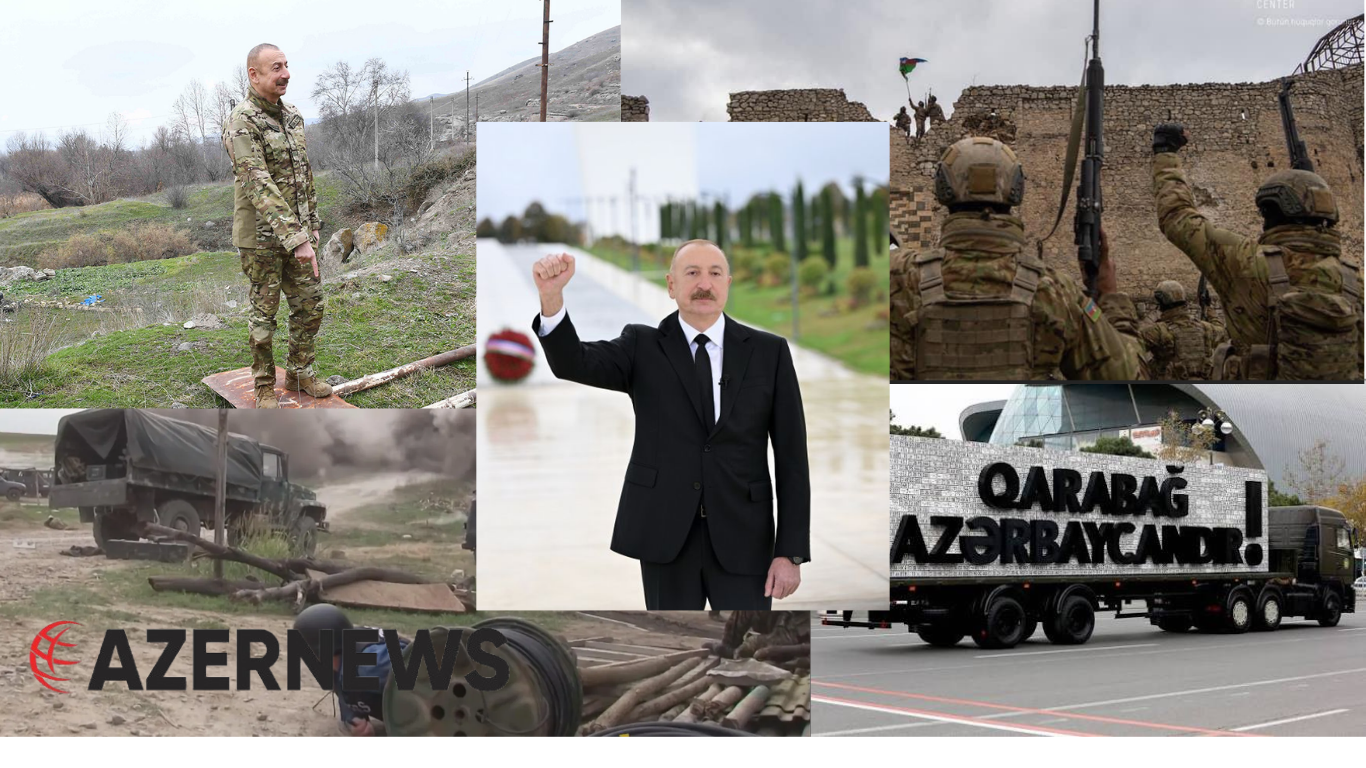
President Ilham Aliyev's decision to deliver his address in Khankandi, in front of the second Victory Arch erected in honour of Azerbaijan's triumph, was a particular choice of location. It was a carefully meaningful setting in which history, political symbolism and the realities of the post-war landscape converged, allowing the Azerbaijani leader to revisit a defining moment in the country's modern history from the very place where its final political and military consequences became visible.
There is particular significance in recalling President Aliyev's famous declaration, "Karabakh is Azerbaijan, and an exclamation mark!", which became one of the defining political statements of the struggle for the restoration of territorial integrity. The exclamation mark was not simply a rhetorical flourish intended to underline Baku's position. Although many initially interpreted this as a political leader basking in the glory of a great victory, time revealed it to be both a declaration of political resolve and an unmistakable expression of a people's unbreakable pride and profound sense of honour. On 20 September 2023, following Azerbaijan's one-day anti-terrorist operation, that symbolic punctuation mark was effectively placed in Khankandi itself, bringing an end to the separatist structures that had challenged the country's sovereignty for decades.
The transformation of the former administrative building, once occupied by the separatist leadership, into a Victory Museum offers another striking illustration of how dramatically the political geography of Karabakh has changed. The Azerbaijani leader's recollection of visiting the building in October 2023 is particularly revealing, as he described opening its windows to allow what he called the building's "evil spirit" to leave. Once the final works are completed, the same structure that served as a centre of separatist rule will preserve the memory of Azerbaijan's victory, turning a place associated with occupation and confrontation into a site of historical remembrance. The contrast could hardly be more profound: those who once exercised unlawful authority there are now serving prison sentences in Baku for their involvement in war crimes, while the building itself is being given an entirely different purpose.
However, the road to this outcome was neither straightforward nor inevitable. During the 44-day war, Azerbaijan's armed forces liberated more than 300 cities, towns and villages through military operations, while the liberation of Shusha on 8 November 2020 became the decisive turning point that effectively determined the outcome of the conflict. The strategic and psychological importance of Shusha, perched in the mountains and regarded as the cultural heart of Azerbaijan, extended far beyond its military value, as its liberation demonstrated that the Armenian occupation forces could no longer maintain their positions in the face of the Azerbaijani army's advance.
Following Armenia's acceptance of the capitulation terms and the signing of the trilateral statement on 10 November 2020, the remaining occupied territories were returned to Azerbaijan without further fighting or additional casualties. This distinction matters because it demonstrated that the military outcome had fundamentally altered the balance of power, leaving Yerevan with little room to continue a conflict whose strategic direction had already been decided. The contrast in military morale was equally telling, with Azerbaijan reporting no desertions from its armed forces during the 44-day campaign, while the Armenian side acknowledged that nearly 12,000 servicemen had deserted.
Azerbaijan's victory, however, cannot be explained by military technology or battlefield tactics alone, even though modern weapons systems, professional training and operational planning played an indispensable role. Its foundations had been laid over many years through economic modernisation, infrastructure development, the strengthening of state institutions and the expansion of Azerbaijan's international standing. Under Aliyev's leadership, the country pursued a strategy of building economic resilience, strengthening its diplomatic relationships and developing an increasingly capable military, while refusing to allow external pressure to dilute its position on territorial integrity.
This combination of political determination, diplomatic engagement and military preparedness proved decisive. Azerbaijan's armed forces entered the war with modern equipment and considerable operational experience, but the most sophisticated weapons could not, on their own, have delivered victory without the determination of soldiers and the collective resolve of society. National unity, solidarity between the state and its citizens, and a deeply rooted sense of historical justice provided the human foundation upon which military success was built. The one-day anti-terrorist operation of 19-20 September 2023 subsequently completed this process, restoring Azerbaijan's sovereignty and territorial integrity in full.
The challenge that followed was no less formidable: rebuilding territories that had been devastated during nearly three decades of occupation. Cities and villages had been reduced to ruins, religious monuments and mosques had been destroyed or damaged, and much of the region's infrastructure had to be reconstructed virtually from scratch. What was once a landscape of destruction is gradually becoming a landscape of reconstruction, with new roads, residential settlements, schools, hospitals and economic infrastructure reshaping the liberated territories.
The Great Return programme represents the human dimension of this transformation, as nearly 100,000 people have already returned to, settled in or begun working in the liberated areas. Their presence is more than a demographic indicator; it is a tangible expression of the restoration of normal life and the gradual reintegration of territories that had remained separated from the country's social and economic fabric for decades. The return of families, the reopening of schools and the revival of economic activity are arguably among the most meaningful measures of the country's post-war achievements.
There is also a broader ideological dimension to Azerbaijan's post-conflict trajectory, rooted in the concept of Azerbaijanism, which places national identity, shared civic values and social cohesion at the centre of statehood. Built upon the political philosophy of Heydar Aliyev, the country's national leader, this ideology has sought to unite citizens of different ethnic backgrounds and religious beliefs under a common national identity, presenting Azerbaijan as a state whose strength derives from its diversity and shared sense of belonging. In a region where ethnic and religious divisions have repeatedly been exploited for political purposes, this principle has particular significance.
Ultimately, the most important lesson of Azerbaijan's recent history is that sovereignty cannot be secured through declarations alone; it requires economic strength, political stability, military preparedness, diplomatic credibility and a society capable of maintaining unity when confronted with existential challenges. Azerbaijan has emerged from the conflict as a politically, economically and militarily independent state, increasingly confident in its ability to shape its own regional and international agenda.
The objective now is not simply to preserve the achievements of the past, but to build a country so strong, resilient and strategically capable that no external actor would consider challenging its sovereignty or territorial integrity. The Victory Arch in Khankandi therefore represents more than a monument to a successful military campaign; it stands as a reminder of the distance Azerbaijan has travelled, from the uncertainty of occupation to the confidence of restored sovereignty, and of the responsibility that comes with turning a historic victory into a lasting foundation for national development.
Here we are to serve you with news right now. It does not cost much, but worth your attention.
Choose to support open, independent, quality journalism and subscribe on a monthly basis.
By subscribing to our online newspaper, you can have full digital access to all news, analysis, and much more.
You can also follow AzerNEWS on Twitter @AzerNewsAz or Facebook @AzerNewsNewspaper
Thank you!