
Armenian lobby’s old playbook meets new geopolitical reality

Elnur Enveroglu
Read moreThis pamphlet is not intended to humiliate, discredit or antagonise any nation or its people. Nor does it seek to question the right of any society to preserve its history, identity or national aspirations. Its purpose is to examine how hostility takes root, survives across generations and becomes deeply embedded in public consciousness when nurtured by destructive ideologies. No nation can build a prosperous future on inherited animosity, selective historical narratives or the politics of perpetual grievance. Ideology should serve as a compass for progress, not a weapon for perpetuating enmity. At a moment when Azerbaijan and Armenia have an opportunity to turn decades of confrontation into lasting peace, it is essential to recognise the forces that could undermine that prospect. Exposing the roots of hostility is not an act of antagonism; it is a call for political maturity, historical responsibility and a more peaceful future.
Besides, ideology gives people belonging and binds them to a cause. But conviction is not proof of good faith or a guarantee of constructive ends. At its worst, ideology becomes more corrosive than poison: it outlives the circumstances that produced it, refuses to adapt and traps societies in grievances that should have been consigned to history.
The recent US midterm results appear to have encouraged renewed confidence among supporters of the Armenian lobby. For years, organisations aligned with this cause have sought political shelter among Democrats while directing accusations and inflammatory claims at Azerbaijan and Türkiye. Democrats have won control of both chambers of Congress and will take over in January 2027. That shift may offer lobby groups a new opening, but it does not mean the party endorses every cause seeking its attention.
A recent post on X offers an example. David Nanigian, who presents himself as founder of Mount Ararat Financial Services, used the platform to make disparaging remarks about Azerbaijan on a subject apparently unrelated to his professional role. The post drew Azerbaijan into an issue that had no evident bearing on Baku or Armenia’s security. It was framed as concern for Armenian society, but did little to explain how the claims would serve ordinary Armenians.
The author’s examination found that Nanigian is also associated with azeriwarcrimes.org, a website whose material is directed against Azerbaijan. Such activity raises questions about those who turn ethnic grievance into political messaging. Their reach may be limited; there is no need to exaggerate one activist’s influence. But repeated allegations, circulated by networks presenting themselves as defenders of national interests, can normalise hostility and make compromise look like betrayal.
This matters because the Azerbaijan-Armenia peace process has reached a consequential stage. The agreement initialled by the two governments still needs to be signed and ratified. Baku argues that Armenia’s constitutional framework must no longer contain claims incompatible with Azerbaijan’s sovereignty and territorial integrity. Yerevan disputes that interpretation. The disagreement is not a technical footnote: it concerns whether the two states can build relations on mutual recognition rather than competing historical narratives.
The constitutional debate is moving into public view. On 2 November, Prime Minister Nikol Pashinyan said the government planned to publish a draft new constitution in November, followed by public discussions and consideration of proposals. He also identified signing and ratifying the peace agreement as a major objective. If constitutional change requires a referendum, Armenian voters will have to decide whether peace and normalisation outweigh the preservation of provisions that keep old disputes alive. The result cannot be assumed, nor can a referendum be treated as a formality.
Against this backdrop, more aggressive lobbying and social-media campaigns in the United States are possible, though this remains a forecast, not an established fact. As the treaty approaches the difficult stages of signature, ratification and implementation, opponents of compromise may seek to influence debate abroad, portraying Azerbaijan as an obstacle and Armenian concessions as surrender. The incoming Democratic majorities may become an audience for such efforts, but they are not a blank cheque.
One striking feature of Nanigian’s messaging is that it targets Azerbaijan rather than Türkiye. The organisation with which he identifies invokes Mount Ararat, a symbol bound up with historical and territorial disputes involving Türkiye. Yet Ankara has not been the principal target in this intervention. Perhaps some in Yerevan still hope to open the Turkish-Armenian border without a comprehensive settlement with Baku, and prefer temporarily to avoid antagonising Türkiye. That is an interpretation, not a confirmed explanation, and it may not last.
Armenia has work ahead if it is to turn the promise of peace into a functioning regional order. It must address Baku’s concerns, make its constitutional debate compatible with reciprocal recognition and prepare society for the benefits of open borders, trade and connectivity. Denunciation cannot substitute for those decisions.
Presenting Azerbaijan as an eternal enemy may serve activists whose relevance depends on grievance. It offers Armenia no strategy for security or prosperity. A country cannot build its future while allowing an ideology of hostility to dictate the limits of its choices. Yerevan’s test is whether it can move beyond that inheritance and choose a peace that lasts.
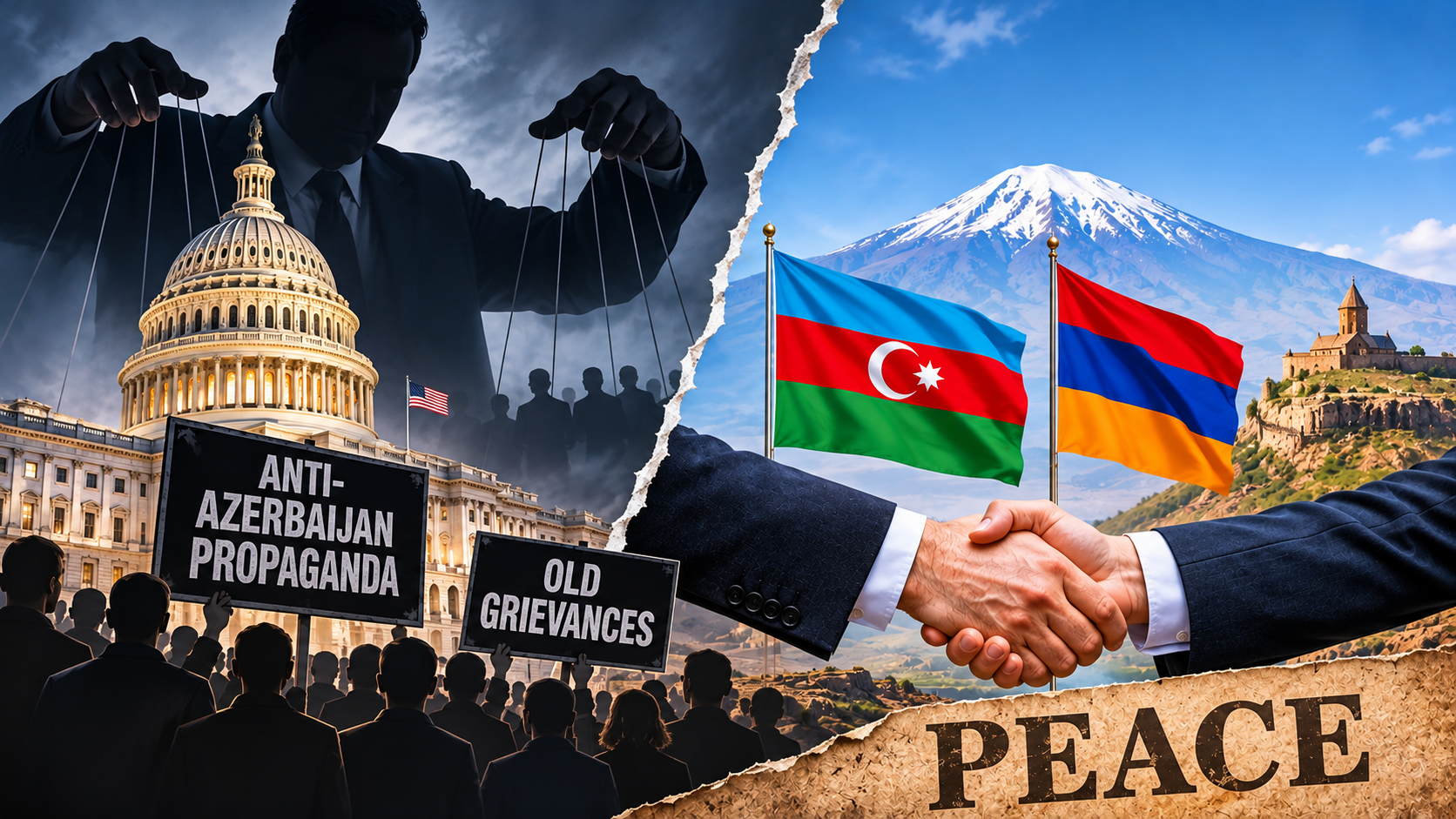
* Image was created by AI
Here we are to serve you with news right now. It does not cost much, but worth your attention.
Choose to support open, independent, quality journalism and subscribe on a monthly basis.
By subscribing to our online newspaper, you can have full digital access to all news, analysis, and much more.
You can also follow AzerNEWS on Twitter @AzerNewsAz or Facebook @AzerNewsNewspaper
Thank you!