
2020 exposed limits of international law: what President Aliyev’s Al Jazeera interview revealed
Elnur Enveroglu
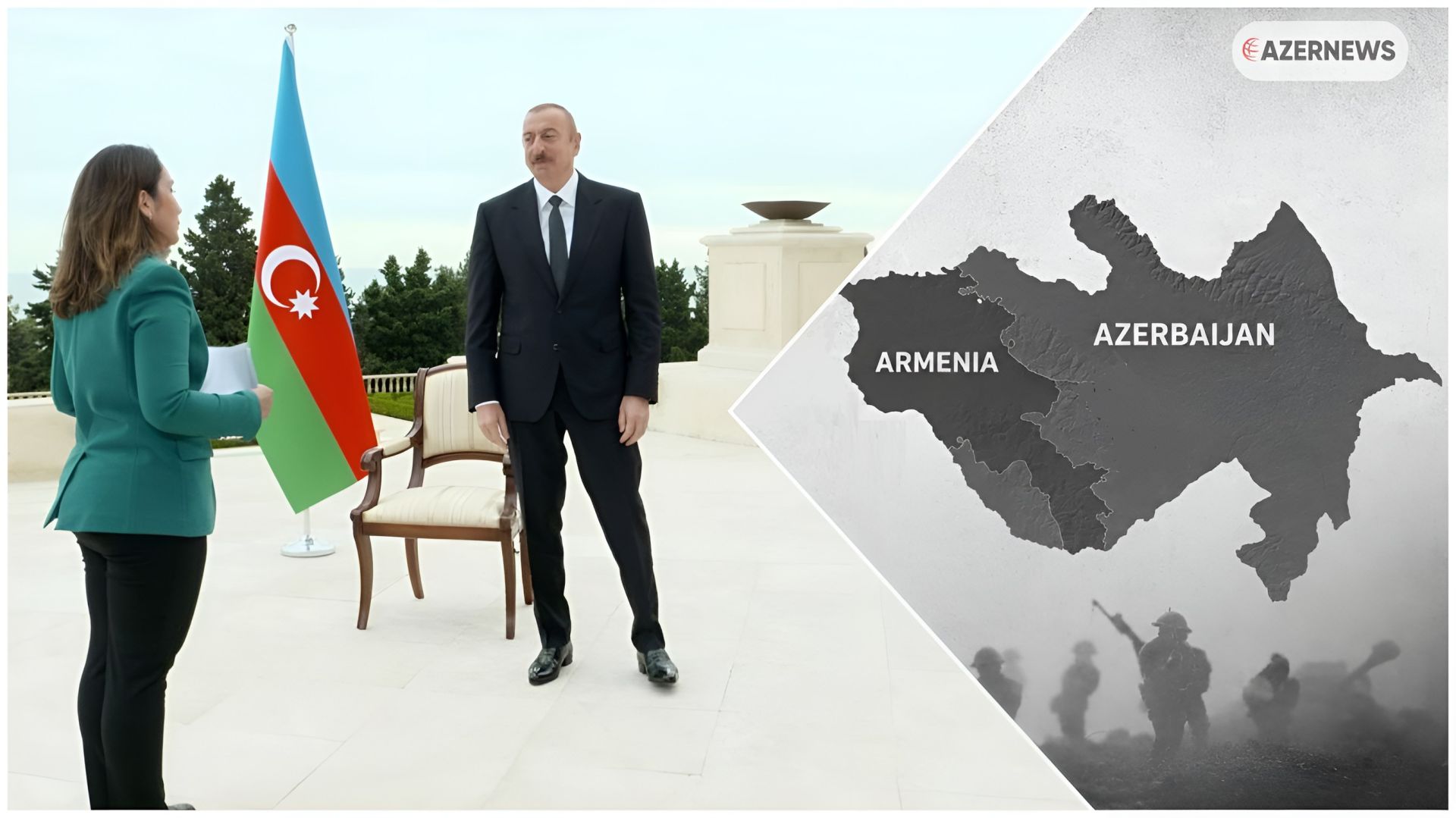
Read moreThe most revealing part of President Ilham Aliyev’s 2020 Al Jazeera interview was not what the Azerbaijani leader said about the war that had just begun. It was the chronology behind his argument.
For President Aliyev, the events of September 2020 did not begin on 27 September. They began almost three decades earlier, when the conflict over formerly occupied Karabakh turned into a war that left Azerbaijan with large areas of its internationally recognised territory outside its control. By 1993, the UN Security Council had adopted four resolutions calling for the withdrawal of occupying forces from Azerbaijani territory and urging a negotiated settlement. Those resolutions were unanimous, though their implementation remained elusive.
That gap between legal language and political reality became the central grievance in the Azerbaijani President’s argument. The problem, he said, was not the absence of international law but the absence of consequences for failing to implement it. Besides, there is a difficult truth behind that frustration, as events in the past portrayed quite a different picture. For example, the OSCE Minsk Group spent decades trying to mediate the conflict, while the status quo survived. For Azerbaijan, every year of unsuccessful diplomacy was not simply another year without peace. It was another year in which hundreds of thousands of displaced people remained unable to return to their homes.
However, what happened in the past was not left unnoticed, and the turning point came gradually. The April 2016 fighting demonstrated that the old ceasefire was fragile and that talks and promises at the negotiation table yileded results in favour of only one side - Armenia - the party that was appetised with every single negligence by international organisations and mediators. Perhaps it was the first test of Armenia itself on the battleground since its first invasion of Azerbaijani territories and its old and dilapidated military arsenal that it inherited from the Soviet leftovers. Then came the political upheaval in Armenia in 2018 and increasingly confrontational rhetoric. That was another major event in the history of Armenia where political collisions revealed real weakness in the transformation from an occupant to a self-declared so-called 'republic' mode. In July 2020, fighting erupted around Tovuz, far from the main Karabakh frontline, and President Aliyev presented this sequence as evidence that the existing diplomatic process was being hollowed out.
Then finally came 27 September.
The international response was familiar, with calls for an immediate ceasefire and a return to negotiations. The OSCE Minsk Group co-chairs after a long time of silence and blindness, condemned the use of force and insisted that there was no alternative to a negotiated settlement. The European Union took a similar position, calling for a halt to hostilities and substantive negotiations without preconditions. But this is where the political argument became more complicated.
We are not even talking about the ICRC and a number of humanitarian organisations raising an outcry and sounding the alarm under the guise of humanitarianism, or the manoeuvring attacks by certain Western media groups. Until Armenia raised the white flag on the battlefield, why were these organisations so remarkably quiet about the very issues they are now making so much noise about?
Nevertheless, in Baku, such appeals were increasingly heard as another demand to preserve a status quo that had itself become intolerable. The European Parliament's debate reflected the competing narratives surrounding the conflict. Some MEPs stressed Azerbaijan's territorial integrity and the long-standing UN framework, while others focused heavily on the humanitarian consequences of the renewed fighting and allegations concerning Turkiye's role. Moreover, this reinforced a long-standing perception for Azerbaijan that European institutions applied international principles inconsistently. Whether one accepts that interpretation or not, it became an important part of Baku's political worldview.
So here it should definitely be brought to the attention of those who blamed Azerbaijan for escalation in the South Caucasus, where the war eventually answered the diplomatic stalemate on the battlefield.
Azerbaijan regained substantial territory during the 44-day war, including Shusha, which was the honour and core of the country's culture. On 10 November, Azerbaijan, Armenia and Russia signed a statement establishing a ceasefire and providing for the return of Aghdam, Kalbajar and Lachin to Azerbaijani control. That indicated that the political geography of the South Caucasus had changed.
President Aliyev's most consequential argument in that 2020 interview was therefore about perseverance. Azerbaijan, he insisted, had spent years pursuing negotiations while maintaining that territorial integrity was non-negotiable. When diplomacy failed to produce implementation, Baku was prepared to change the balance itself. So, that neither makes war a substitute for diplomacy nor does it erase the human cost suffered by civilians on both sides. But it does explain why the Azerbaijani leadership viewed the 2020 campaign not as an isolated military episode but as the culmination of a political strategy.
Certainly, the deeper lesson here is about the credibility of international institutions. Let's assume that a resolution without enforcement can remain legally significant while becoming politically powerless. A mediation process can preserve dialogue while also, unintentionally, preserving the conditions that produced the dispute.
Therefore, for Azerbaijan, 2020 was the moment that contradiction ended. The country stopped waiting for the international system to deliver the outcome it believed the system had already endorsed in principle, and most significantly, the victory did not simply change the map. It changed Baku's understanding of its own place in the regional order.
And that may be the most enduring message of President Ilham Aliyev's 2020 interview: Azerbaijan's policy was built around patience, but patience was never presented as surrender. When the old diplomatic formula failed to change the reality on the ground, Baku eventually decided that the reality itself had to change.
Here we are to serve you with news right now. It does not cost much, but worth your attention.
Choose to support open, independent, quality journalism and subscribe on a monthly basis.
By subscribing to our online newspaper, you can have full digital access to all news, analysis, and much more.
You can also follow AzerNEWS on Twitter @AzerNewsAz or Facebook @AzerNewsNewspaper
Thank you!