
As Iran’s leadership is targeted, the state holds - but for how long?
Elnur Enveroglu
Read moreThe threads within Iran’s system of governance are growing thinner by the day. Beginning on 28 February, during the first days of large-scale attacks on Iran by the joint forces of the United States and Israel, the assassination of Iran’s Supreme Leader, Ali Khamenei, further accelerated the wave of targeted killings against leadership figures. However, the relative stability of the situation in Iran following Khamenei’s death, more precisely, the fact that the pillars of power did not entirely collapse, has added a somewhat different shade to perceptions about Iran’s future. Some believe that, given the abundance of alternatives for leadership positions in Iran, such operations will not significantly contribute to the plans of the United States and Israel.
Interestingly, in recent days, the killings of both high-ranking military generals and, according to the latest reports, figures at the highest levels of governance, including Ali Larijani, and the IRGC’s Basij force commander, Gholamreza Soleimani, have returned the tempo to its previous intensity. This suggests that the United States believes that the central pillar of Iran’s governance, which has turned into a myth of “invincibility”, may at some point become fragile and collapse altogether.
It is also noteworthy that, according to earlier speculation, US President Donald Trump had shared a list of preferred candidates in Iran. Conversely, Ali Larijani was reportedly included in the list of leaders considered targets by the United States.
Trump’s objective is not a total regime collapse, but rather a “change within the regime” through what he calls the “Delcy Model.” Referencing the 2026 extraction of Nicolas Maduro in Venezuela, he aims to bypass hardline successors such as Mojtaba Khamenei (whom he has explicitly rejected) in favour of a “great and acceptable” insider willing to surrender unconditionally and cooperate with Washington. While he has not publicly named a specific favourite, he appears to be seeking a pragmatic figure from within the existing establishment, potentially a more moderate cleric such as Hassan Khomeini or a technocrat, who could ensure the survival of the system while dismantling Iran’s nuclear programme and ending regional hostilities.
Let us take a closer look inside Iran.
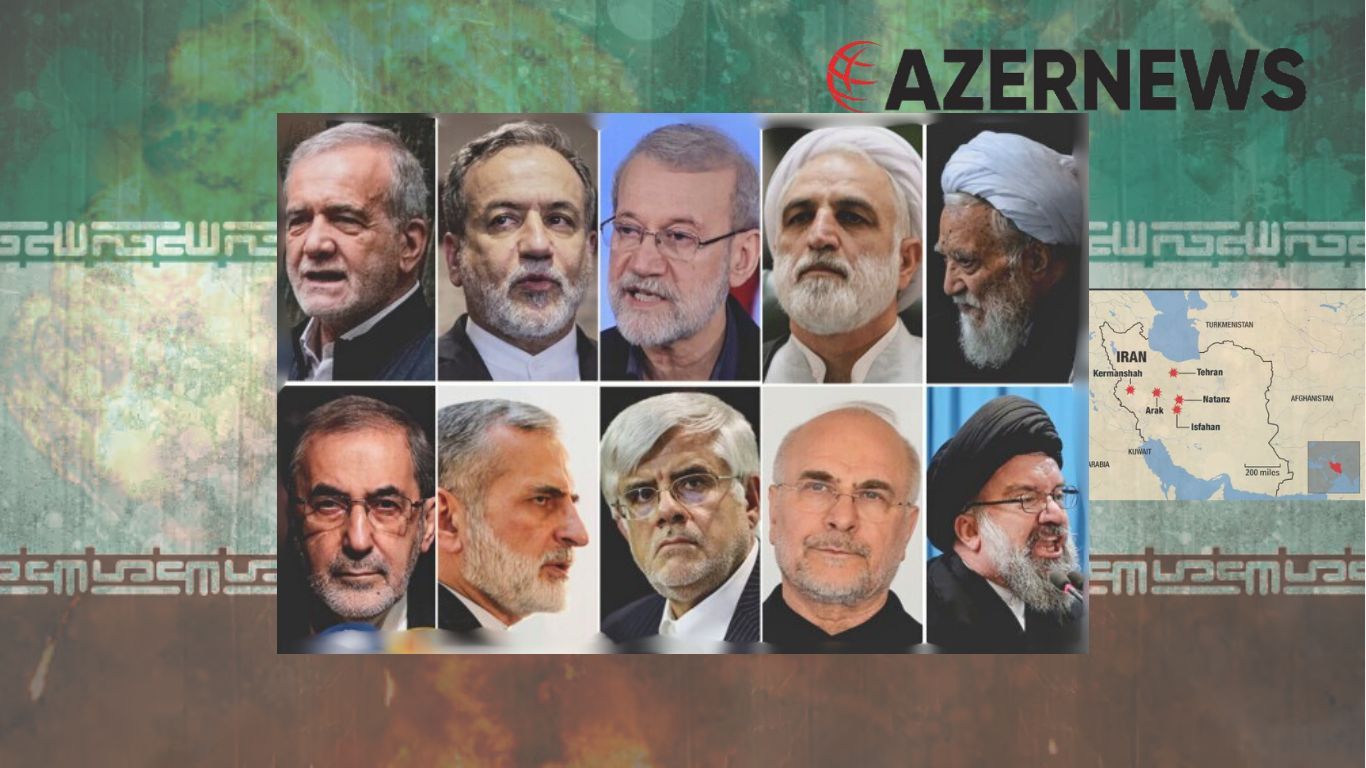
As of March 2026, the main political figures in Iran are led by Supreme Leader Mojtaba Khamenei, who assumed office on 8 March 2026. Key officials navigating the country’s power structure include President Masoud Pezeshkian, Parliament Speaker Mohammad Bagher Ghalibaf, and various security and clerical leaders within a complex, authoritarian, and largely conservative-controlled system.
Masoud Pezeshkian (President), elected in July 2024 following the death of Ebrahim Raisi, manages the day-to-day operations of government, although his authority is largely overshadowed by the Supreme Leader. Even according to some speculative views, Pezeshkian is considered the most neutral figure for the United States, and in the event of a regime transformation within Iran, he may have a significant chance of remaining in power.
Mohammad Bagher Ghalibaf (Parliament Speaker), a powerful conservative figure, IRGC general, and former mayor of Tehran who leads the legislative branch.
Ahmad Jannati (Guardian Council), who is the Secretary of the influential Guardian Council, and vets candidates for office and ensures that legislation complies with Islamic law.
Abbas Araghchi (Foreign Minister) is also a key figure handling foreign affairs. At the same time, according to Western analysts, Araghchi is seen as one of the most suitable figures for diplomacy, and there has been ongoing discussion about his secret yet episodic contacts with the U.S. presidential envoy Steve Witkoff.
Gholam-Hossein Mohseni-Ejei (Chief Justice): Head of the judiciary.
Sadiq Larijani, Chairman of the Expediency Discernment Council.
And finally, Ali Larijani, who served as a key adviser to the supreme leadership and often acted as a bridge between factions, was killed as a result of the Israeli strike. Ali Larijani was one of the most significant allies of the Supreme Leader and a staunch defender of the radical theocratic system. For Israel, the presence of such figures poses an obstacle to the implementation of its future plans regarding Iran. It appears that, unlike the United States, Israel has no interest whatsoever in conducting negotiations with Iran in any form, and that the removal of key figures plays a crucial role in undermining the foundations of Iran’s theocratic structure.
Today, a serious question arises: to what extent does Iran plan to continue resisting the United States and Israel while sacrificing its leaders one by one?
If Iran continues to lose its leadership figures, this points either to a significant weakness in its security apparatus or to the ease with which espionage networks are operating within the country. In such a case, regardless of which alternatives Iran seeks to activate, it may be considered inevitable that its leading figures will become targets in the next phase.
Or perhaps Iran’s system itself is already beginning to collapse? For instance, many family members of Iran’s radical religious elite are today seeking refuge in the West. It is claimed that Ali Larijani’s daughter, Fatemeh Ardeshir Larijani, emigrated to the United States in 2021 through a Green Card and has since worked there as a professor and doctor in the medical field, reportedly attempting to remain outside the political radar of her father and the Iranian regime. Similarly, Mahmoud Mouradkhani, the nephew of the late Supreme Leader Ali Khamenei, has long opposed the Iranian regime and sought asylum in France.
All of this suggests that the relatives of Iran’s ruling elite are increasingly dissatisfied with the system, and, as the saying goes, “a fish rots from the head.” The reality that Iran’s authority is gradually eroding from within appears to be proving itself more and more with each passing day.
Here we are to serve you with news right now. It does not cost much, but worth your attention.
Choose to support open, independent, quality journalism and subscribe on a monthly basis.
By subscribing to our online newspaper, you can have full digital access to all news, analysis, and much more.
You can also follow AzerNEWS on Twitter @AzerNewsAz or Facebook @AzerNewsNewspaper
Thank you!