
Novruz ringing the doorbell
Novruz Bayrami is broadly marked around the world as a holiday
marking the advent of spring. Closely related to the astronomic
calendar, Novruz is celebrated in the northern hemisphere as the
beginning of a new year on March 20-22. A number of nations around
the globe link the outset of the spring season with the revival of
nature and hold festivities on this occasion.
Novruz meaning "New day" has become the most important among
Azerbaijan's national holidays. It has been ingrained in the
people's memory for many centuries and became a social event in
their history.
Azerbaijan has historically celebrated the vernal equinox, "The
Coming Day of Spring", just like Iran, Afghanistan, Central Asian
states Kazakhstan, Tajikistan, Uzbekistan, and other Eastern
countries.
People begin to mark the holiday a month ahead of time. They mark
Tuesdays of the last month of winter which are associated with four
elements - Wind, Fire, Water and Soil. Novruz brings people hopes
of putting an end to a bad day, replacing Winter with Spring, and
signifies the start of the harvesting season.
Scholars say Novruz has ancient roots. The holiday, referred to by
ancient Turks as Ergenekon, dates back as far as five millennia,
according to research.
Islamic figures have always tried to add a religious coloring to
the holiday, but public events held on the occasion were actually
unrelated to Muslim canons. Most nations, including Azerbaijanis,
have preserved a host of traditions based on the true essence of
the spring holiday.
The food that is put on the table over Novruz Bayrami is distinct.
Seven dishes starting with the letter "S" are to be served.
Vinegar, milk and Samani (a green sprout of wheat) are also among
traditional items. Moreover, candles and a looking glass are put on
the table, and dyed eggs are laid around the looking glass. A
candle symbolizes fire and light, while a looking glass - clarity,
and an egg signifies the beginning of life. Special sweets are
cooked and served over Novruz Bayrami, including "gogals" (salty
flat cakes), "pakhlava" and "shakarbura", as well as pilaff.
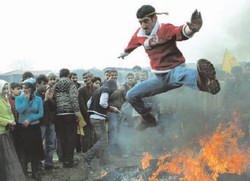
On the eve of the holiday, people usually take care of their houses
and yards, plant trees, clear the fields, start bonfires and jump
over them. Under the tradition, everyone should stay home on the
first day of the holiday. A saying goes that "if you don't, you
will not be home for seven years". In the past, people used to
leave the doors to their abodes open and keep the lights on through
the night on the first day of the new year. An extinguished fire or
turned-off light was considered a sign of misfortune. All those who
were at odds are supposed to make amends.
The Azerbaijani people celebrated national holidays in a rather
low-key way during the Soviet Union times. The USSR leadership
authorized celebration of Novruz Bayrami for the first time in 1967
on the initiative of the Azerbaijan Communist Party's secretary on
ideology issues, writer and playwright Shikhali Gurbanov, who
managed to agree marking the holiday on state level with the
central government in Moscow.
But the festive spirit of 1967 unfortunately did not last long.
Despite Novruz's being the most festive holiday in Azerbaijan,
which was then part of the Soviet empire, the celebrations were
discontinued after Gurbanov's mysterious death. Azerbaijanis were
able to mark the holiday again only after 1989 when the national
liberation movement started in the republic. The government issued
a decree to solemnly celebrate Novruz that year.
Here we are to serve you with news right now. It does not cost much, but worth your attention.
Choose to support open, independent, quality journalism and subscribe on a monthly basis.
By subscribing to our online newspaper, you can have full digital access to all news, analysis, and much more.
You can also follow AzerNEWS on Twitter @AzerNewsAz or Facebook @AzerNewsNewspaper
Thank you!