
Trust and skepticism toward AI-generated cultural content
Laman Ismayilova
Read moreThe rapid integration of artificial intelligence into art, music, and media has created a paradox. AI-generated cultural content is increasingly widespread and sophisticated, yet public trust in it remains deeply unstable.
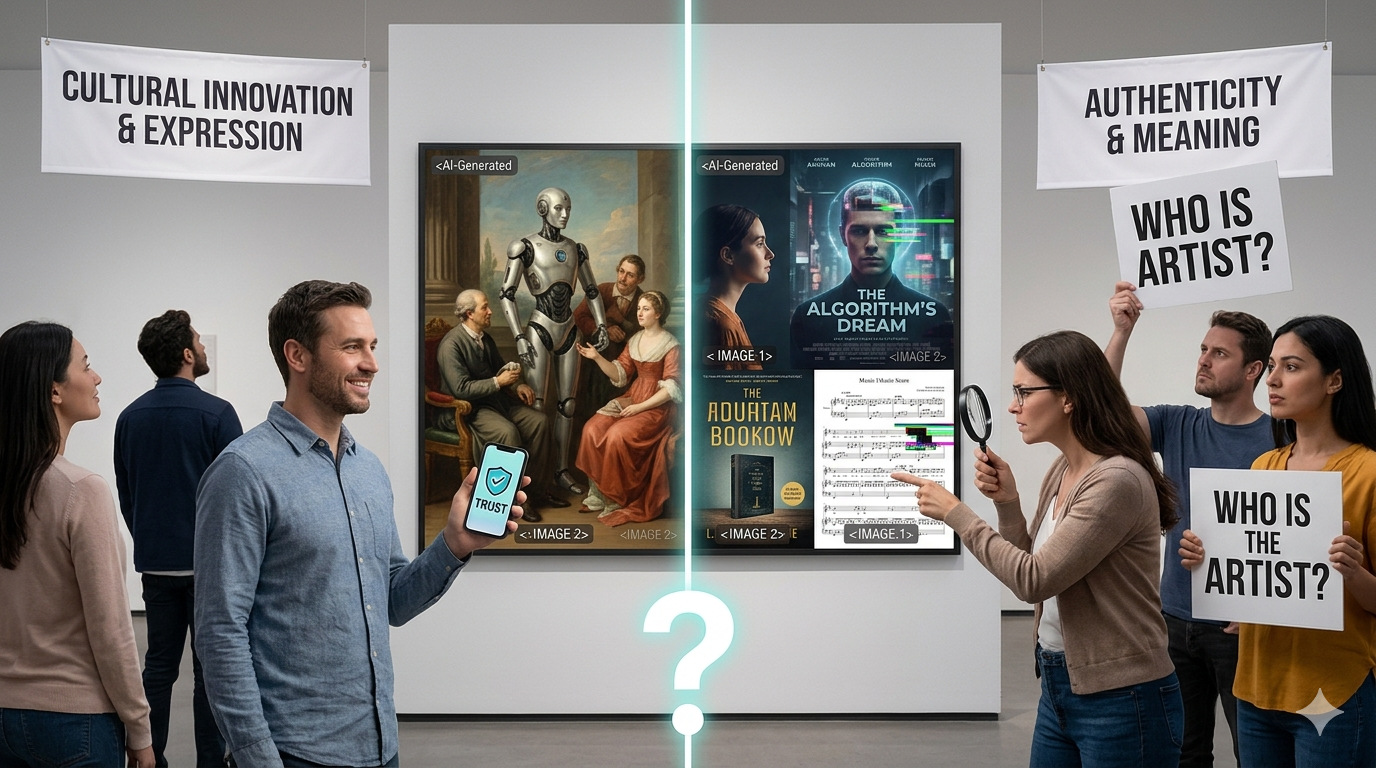
Research in psychology, sociology, and media studies suggests that people's trust in AI-driven creative work depends not only on the work itself but also on their perceptions, beliefs, and broader cultural concerns.
At the center of this is what researchers call ambivalent trust. Many people recognize AI's technical skill but remain uncertain about its intentions and whether its output can be fully relied upon. Audiences may appreciate that AI can produce convincing art, music, or writing, but they often hesitate to accept it as a cultural creator in the same way they would a human artist.
One of the clearest patterns observed is that knowledge about AI influences trust. When people know a piece of content was AI-generated, their perception changes. Even when the content is identical, labeling it as AI-made tends to reduce trust and emotional engagement.
This is tied to a broader psychological principle: belief shapes aesthetic experience. People evaluate creative works differently depending on whether they think a human or a machine created them. AI-generated works often face negative bias in terms of creativity and authenticity, even when their quality matches that of human-made works. Paradoxically, many people cannot reliably distinguish AI-generated content from human-created content, which highlights a tension between perception and reality.
Trust also depends on individual attitudes and personal factors. A person's prior experience with AI, openness to technology, and familiarity with creative tools strongly influence how they respond to AI-generated music, art, or writing. In other words, trust is not an inherent property of the content, it is constructed through personal and cultural frameworks.
Broader social concerns also play a role in skepticism. Many audiences associate AI-generated content with risks such as misinformation, manipulation, or the erosion of human creativity. People often expect AI to become a dominant force in cultural production while still showing a preference for human-created work.
Another emerging trend is what some scholars describe as sensorial distrust. As AI produces increasingly realistic images, voices, and performances, traditional sensory cues are no longer reliable indicators of authenticity. This shifts audience engagement toward critical evaluation, where emotional trust is replaced by careful scrutiny.
Importantly, skepticism is not purely negative. In many cases, it acts as a form of cultural resistance. Online communities develop verification practices to distinguish human work from AI-generated content, reflecting the ongoing importance of authenticity and trust in shared cultural spaces. Younger audiences, in particular, often show a mixture of curiosity and caution, engaging with AI content while questioning its reliability.
Looking ahead, the long-term trajectory of trust in AI-generated culture appears dynamic. While AI adoption continues to accelerate, public concern and skepticism remain high. Exposure alone does not guarantee acceptance; trust must be nurtured through transparency, ethical practices, and cultural adaptation.
Ultimately, the relationship between trust and AI-generated cultural content is defined by contradiction. People recognize AI's technical sophistication, yet question its authenticity, intentions, and cultural legitimacy. Trust is shaped less by the content itself and more by context, belief, prior attitudes, and social narratives.
What this research suggests is that society is not simply adapting to a new creative tool. We are renegotiating the foundations of cultural trust.
In an environment where human and machine outputs are increasingly indistinguishable, trust becomes a psychological and social construct rather than a given.
AI Generated Photo
Here we are to serve you with news right now. It does not cost much, but worth your attention.
Choose to support open, independent, quality journalism and subscribe on a monthly basis.
By subscribing to our online newspaper, you can have full digital access to all news, analysis, and much more.
You can also follow AzerNEWS on Twitter @AzerNewsAz or Facebook @AzerNewsNewspaper
Thank you!