
Ukraine’s deep-strike campaign redefines Russia-Ukraine War strategy

Qabil Ashirov
Read moreThe contemporary landscape of the Russia-Ukraine conflict has undergone a profound transformation, moving away from a traditional war of attrition localized strictly along the front lines toward a dynamic paradigm defined by long-range asymmetric warfare. In recent months, international media and military analysts have increasingly focused on Ukraine's ability to project power deep into Russian territory. This structural pivot represents more than a series of sporadic retaliatory measures; it is a calculated, multi-year strategic evolution aimed at dismantling the core logistical, financial, and psychological foundations of the Russian war machine. By taking the conflict hundreds and sometimes thousands of kilometers past the internationally recognized borders, Ukraine has introduced a new layer of complexity that challenges established military doctrines and alters the strategic calculus of both Moscow and its Western allies.
To fully understand the current intensity of these deep-strike operations, it is essential to trace their historical trajectory, which developed across several distinct phases. During the initial period of the full-scale invasion, Ukraine's capacity to strike targets inside Russia was severely restricted by both material scarcity and political constraints. Western partners, anxious about potential escalation and the threat of a direct confrontation between NATO and a nuclear-armed power, strictly prohibited the use of supplied advanced weaponry against targets on Russian soil. Consequently, early Ukrainian attempts to disrupt the Russian rear were largely symbolic, utilizing modified reconnaissance drones and covert operations. These initial endeavors were designed primarily to signal resilience and test the vulnerabilities of Russian air defense networks rather than to inflict crippling economic or military damage.
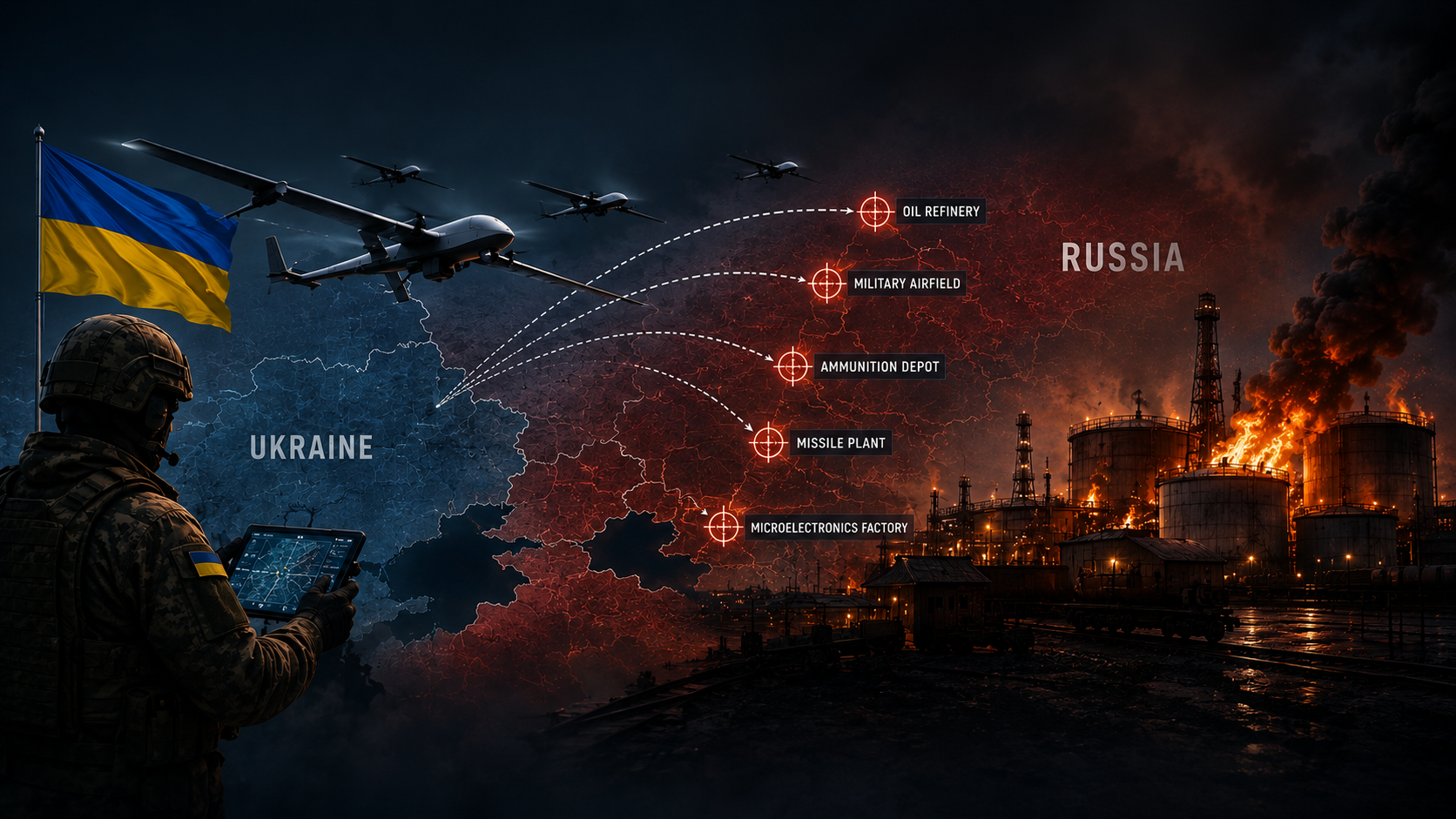
The genuine inflection point occurred when Ukraine systematically reoriented its domestic defense industry toward the mass production of long-range unmanned aerial vehicles and strike systems. Recognizing that reliance on foreign arms came with operational limitations, Ukrainian engineers and private tech enterprises successfully designed and scaled indigenous drone platforms capable of bypassing sophisticated electronic warfare and air defense nets. This shift marked the beginning of a highly organized campaign targeting Russian energy infrastructure, particularly oil refineries, fuel depots, and processing plants. By hitting these facilities, Ukraine directly targeted the economic bloodstream that finances the Russian military apparatus while simultaneously creating localized fuel shortages that rippled down to the mechanized divisions operating on the front lines.
As the conflict progressed into its current phase, the scale, frequency, and sophistication of these long-range operations reached an unprecedented peak. Recent intelligence reports indicate that Ukraine's monthly deployment of domestic strategic strike drones has surpassed several thousand units, occasionally eclipsing Russia's own long-range strike output. This massive increase in volume has allowed Ukrainian forces to execute saturation tactics, overwhelming local air defenses and successfully striking high-value targets deep within the Russian interior, including military airfields, missile assembly plants, and microelectronics factories. The geographic boundaries of the conflict have effectively dissolved, with strikes regularly reaching industrial centers located over fifteen hundred kilometers from the border, proving that geographical depth no longer guarantees absolute immunity.
The strategic benefits derived from this deep-strike capability are multifaceted and extend far beyond immediate physical destruction. Economically, the continuous targeting of key refineries forces Russia to divert immense financial resources toward repairing critical infrastructure and deploying defensive assets away from the active war zone to protect civilian industrial hubs. Logistically, the destruction of ammunition depots and fuel networks near the border forces the Russian command to store vital supplies further back, introducing severe delays and vulnerabilities into their front-line supply chains. Culturally and psychologically, these strikes shatter the narrative of domestic invulnerability within Russia, forcing the civilian population and political elite to confront the immediate, tangible realities of a conflict that was previously perceived as distant and abstract.
Ultimately, Ukraine’s evolving deep-strike strategy serves as a compelling case study in modern asymmetric warfare, demonstrating how a technologically adaptive state can leverage innovation to offset conventional disadvantages in raw numbers and heavy weaponry. While these operations alone may not trigger an immediate or total collapse of the adversary's front lines, they fundamentally disrupt the rhythm of Russian offensive operations and level the strategic playing field. By demonstrating an enduring capacity to inflict severe economic and logistical costs deep within Russian territory, Ukraine has successfully rewritten the rules of engagement, ensuring that the trajectory of the war is no longer dictated solely by territorial mass but by technological agility and strategic endurance.
Here we are to serve you with news right now. It does not cost much, but worth your attention.
Choose to support open, independent, quality journalism and subscribe on a monthly basis.
By subscribing to our online newspaper, you can have full digital access to all news, analysis, and much more.
You can also follow AzerNEWS on Twitter @AzerNewsAz or Facebook @AzerNewsNewspaper
Thank you!