
China's energy giants target Azerbaijan's solar and power grid expansion

Ulviyya Poladova
Read moreThe working visit of Azerbaijani Energy Minister Parviz Shahbazov to China produced two meetings that can accelerate the transformation of its energy sector by attracting international investment and will develop the infrastructure needed to support a more diversified electricity supply system. The meetings held by minister with Ni Zhen, Chairman of China Energy Engineering Corporation (CEEC), and Zheng Yan, Vice President of TBEA, offer a clear picture of much of Azerbaijan's renewable energy agenda, ranging from the planned solar power plant in Hajigabul to the development of high-voltage direct current (HVDC) transmission cables that could become an important part of the country's future electricity infrastructure.
The selection of these Chinese partners was no coincidence. For instance, CEEC is a Beijing-based state conglomerate ranked inside the Fortune Global 500, with revenue above sixty billion dollars and more than a hundred thousand employees, and it has spent the past decade building power stations from Bangladesh and Pakistan to Morocco, Greece and Vietnam. A company of that size does not fly its chairman to a provincial city for a single 160 megawatt plant, so the Hajigabul project is best read as the first entry in a longer ledger.
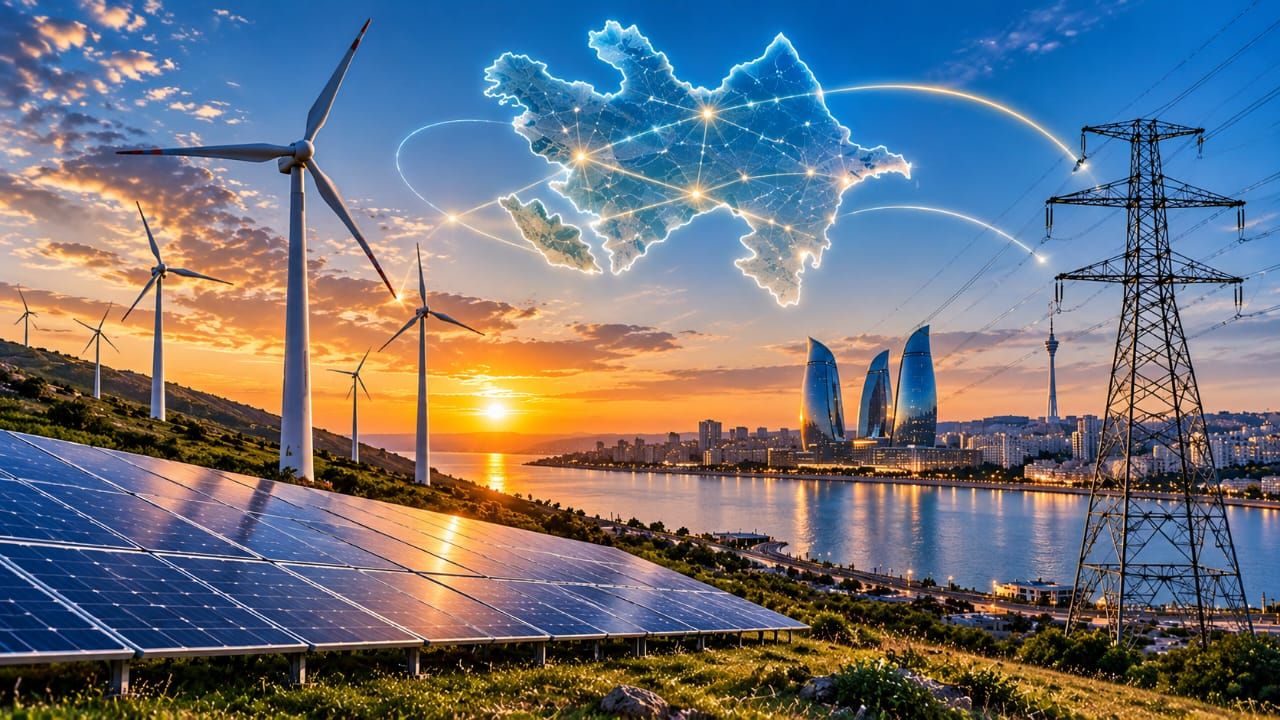
That project does at least have ground to stand on. A plot of 321 hectares has been designated as a renewable energy zone for the planned 160 megawatt solar plant. The parties also reviewed technical issues related to integrating the plant into the electricity grid. Offshore wind was next on the agenda, with a 200 megawatt pilot planned in Azerbaijan's sector of the Caspian Sea and intended to supply the domestic market. Set against the government's own estimate of 157 gigawatts of offshore wind potential in that sector, a 200 megawatt first step is deliberately modest. What else can be said here? Baku is known as the City of Winds, so why not harness the power of nature and put it to good use? At the same time, developing offshore wind energy in the Caspian Sea involves several technical сhallenges. In some areas of the Caspian Sea, the sea depth is relatively small. This affects the choice of the foundations on which wind turbines are installed, as well as the cost and technology of construction. In addition, the Caspian region is characterized by seismic activity. Therefore, engineers need to take into account the stability of the seabed and the foundations of the turbines so that the structures can operate safely in the long term.
Nevertheless, achieving these ambitions will require considerable investment and careful coordination. The expansion of renewable generation must be accompanied by modernisation of the electricity grid and the establishment of commercially viable arrangements for cross-border electricity supplies. So, the country with the Caspian on one flank and routes toward Georgia, Türkiye and Iran on the others can trade electricity in directions that most producers cannot, and green hydrogen is the logical long term extension of that position once the volumes justify the pipelines and the electrolysers.
The second meeting, with TBEA's Zheng Yan, worked from a memorandum the ministry and the company signed at COP29 in November 2024. That document covers ultra-high voltage direct and alternating current products, the manufacture of high-tech grid equipment, a data centre and participation in regional green energy connectivity. Much of the attention went to setting up production in Azerbaijan's industrial parks and free economic zones, with high voltage direct current transmission cables and other essential equipment at the top of the list. TBEA is the largest maker of transformers and transmission equipment in China and among the biggest on earth, so its decision to consider local production carries weight well beyond one factory gate. The two sides also exchanged views on the company's role in introducing innovative energy solutions to the Azerbaijani market and in carrying out hydropower plant projects.
The political framing came separately from Elchin Amirbekov, the Azerbaijani president's special representative, in an interview with China Daily during a visit to China in the second half of November. He said Azerbaijan is interested in cooperating with Chinese companies in renewable energy and is ready to draw on Chinese technological achievements and experience in matters of food security. Amirbekov noted that the main directions of the Global Development Initiative, put forward by President Xi Jinping at the 76th session of the United Nations General Assembly in 2021, line up with the priorities of Azerbaijan's development strategy through 2030, which in his view makes it considerably easier to concentrate on practical results rather than on declarations. He also pointed to the Middle Corridor as the shortest and most cost-effective route connecting western China with Western Europe, which is a strong argument.
It is worth noting that renewables currently account for slightly over twenty percent of Azerbaijan's installed generating capacity, and the government wants that share at 34 percent by 2030, with six gigawatts of wind and solar in place by that date and eight by 2032. Solar and wind plants are going up with bp, Masdar, ACWA Power, China Gezhouba Group Overseas Investment, SOCAR Green and others, and the projects already delivered show what the pipeline looks like in practice. The 230 megawatt Gobustan solar plant built by a Chinese contractor was connected in October 2023, the first large scale renewable project in the country with Chinese participation, and the 240 megawatt Khizi-Absheron wind farm commissioned in January 2026 is the largest in the South Caucasus.
China has a complete renewable energy industry chain and strong advantages in technology, equipment manufacturing, and project development. Azerbaijan, on the other hand, has abundant wind and solar resources, as well as a favorable geographical location and great potential for renewable energy development. Therefore, cooperation between the two countries can make full use of their respective strengths and create mutual benefits. At the same time, it can accelerate Azerbaijan’s energy transition and further strengthen its position in the regional energy market.
Ultimately, the outcome of Azerbaijan's engagement with Chinese energy companies will depend on how quickly the agreements translate into concrete projects. The development of renewable generation and modernisation of transmission infrastructure are interconnected processes that require long-term investment and a stable regulatory framework. For Azerbaijan, the main challenge will be to ensure that the growth of renewable energy is matched by the infrastructure and market conditions needed to make it a sustainable part of the country's broader energy system.
Here we are to serve you with news right now. It does not cost much, but worth your attention.
Choose to support open, independent, quality journalism and subscribe on a monthly basis.
By subscribing to our online newspaper, you can have full digital access to all news, analysis, and much more.
You can also follow AzerNEWS on Twitter @AzerNewsAz or Facebook @AzerNewsNewspaper
Thank you!