
Armenian revanchism finds new allies on the French Riviera

Ulviyya Poladova
Read moreAs soon as Yerevan started talking about a constitution capable of resolving tensions in the South Caucasus, the revanchists stuck their noses out again, as if on cue. The painting is already familiar enough to be read from afar. Every time the Armenian government approaches a settlement with Azerbaijan, the same political forces resort to constitutional debates and try to turn them from a plan to achieve peace into an obstacle to its achievement, and this fall they found a convenient platform for this work on the French Riviera.
Rather than allowing the Armenian government to pursue a peaceful future based on mutual recognition and respect for sovereignty, these forces continue to exploit historical grievances and nationalist sentiment in an attempt to restrict its room for diplomatic manoeuvre.
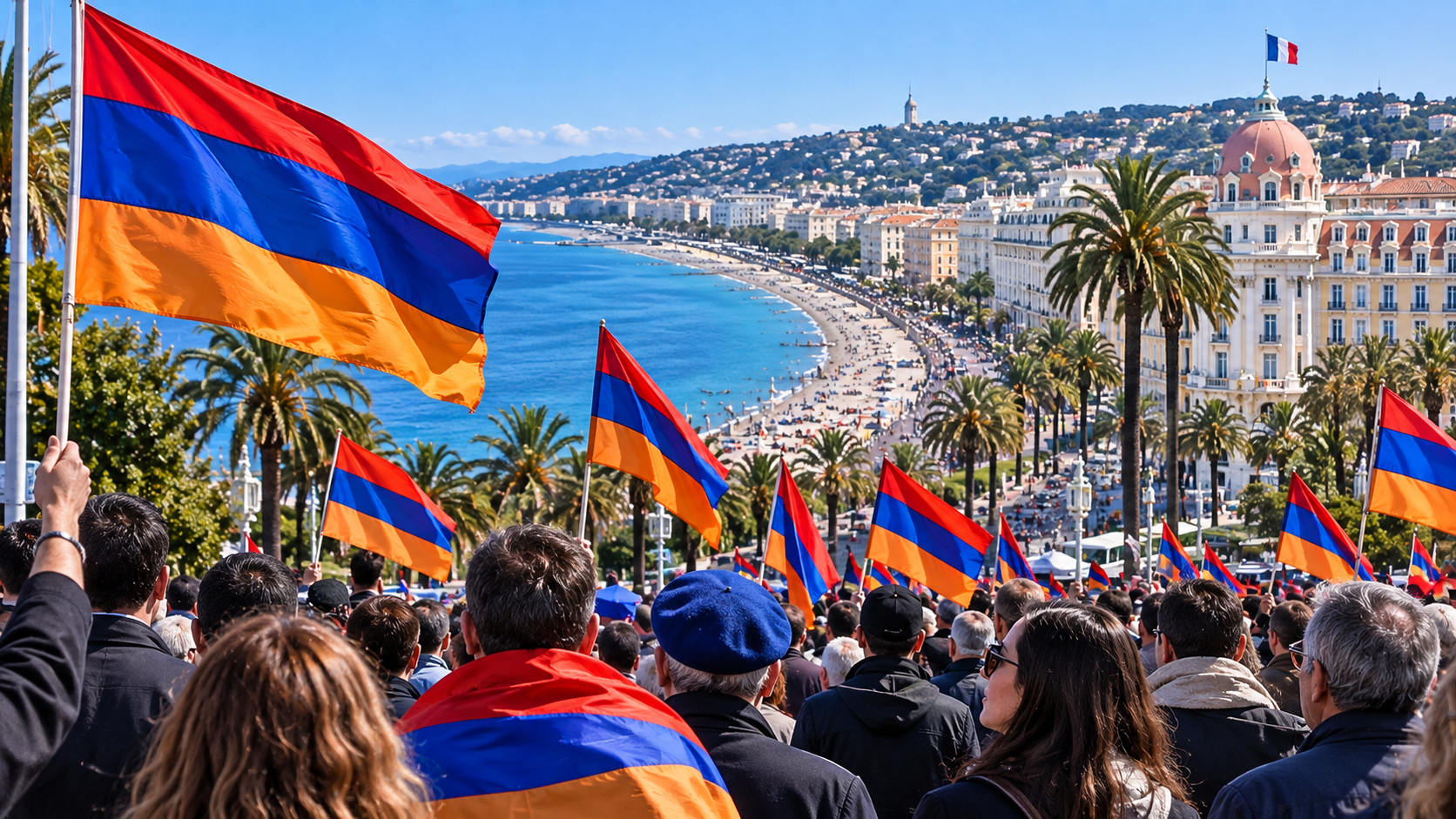
What makes this situation particularly interesting is that the campaign against the emerging peace process is no longer confined to Armenia itself. It increasingly finds support among certain political circles and diaspora organisations in France, where initiatives presented as humanitarian or cultural solidarity have also acquired a distinctly political character. For instance, the "events" in Nice, Paris and Marseille suggest that parts of the Armenian diaspora are seeking to maintain the Karabakh issue on the French political agenda, even as Azerbaijan and Armenia can make a long-term peace.
All this has been described to make it easier to understand the following occurrences.
On November 19, the municipal council of Nice unanimously adopted an appeal introduced by municipal councillor Alexandre Saratsian calling for the release of the prisoners detained in Azerbaijan. The initiative, adopted at the proposal of Nice Mayor Eric Ciotti, also provides for members of the municipal council to become symbolic patrons of the detainees, while their photographs will continue to be displayed outside the city hall. The meeting was also attended by a representative of a separatist entity in France. The killers of innocent people have never received so many "honors."
Ciotti justified the decision by referring to Nice's historical ties with the Armenian people and arguing that the city administration could not remain silent on the "matter." Yet the question that deserves closer examination is why a municipal authority in southern France has chosen to involve itself so directly in an issue connected to the sensitive post-conflict relationship between Azerbaijan and Armenia, particularly when the region is trying to establish conditions for a sustainable peace. Turning such appeals into instruments of political pressure, reinforced by symbolic patronage and public displays, risks transforming an issue into yet another pretext for politicising the conflict and reigniting confrontation.
The political significance of these activities becomes easier to understand when the wider Armenian presence in France is taken into account. The country is home to one of Europe's largest Armenian communities, with estimates of its population ranging from approximately 500,000 to 750,000. Nice and the wider French Riviera have their own established Armenian communities, while Marseille has historically served as one of the principal centres of Armenian diaspora life. This presence naturally gives Armenian organisations access to a considerable social and political network. However, the existence of a large diaspora does not automatically mean that its political priorities should become an extension of France's foreign policy or that local authorities should be drawn into disputes whose resolution requires direct diplomatic engagement between sovereign states.
Another development illustrating the growing involvement of diaspora structures is the announcement by Bedros Terzyan, president of the French Armenian Fund, that a fundraising campaign entitled Phonéthon 2026 would take place from November 19 to 22. The campaign is intended to support Armenia, particularly residents of communities located near the Azerbaijani border.
There is nothing inherently objectionable about humanitarian assistance or infrastructure development in Armenia, and Azerbaijan has no reason to oppose projects that improve living conditions for ordinary people. Indeed, the foundation has previously provided housing and agricultural land to 96 families displaced from Karabakh.
The political calendar in France suggests that these activities are part of a broader effort to institutionalise Armenian diaspora engagement. On November 28, a conference entitled "France, Armenia and the Diaspora: From Commitment to Concrete Action" is scheduled to take place at the French Senate building under the patronage of Senator Pierre Ouzoulias. It is important to clarify that this is not an official Senate event, but a conference being organised on the premises of the institution, a distinction that does not diminish the political visibility the venue provides to the organisers.
The event is being organised by the National Collective France-Armenia, known by its French acronym CNAF, which was established in Marseille in 2025 and currently brings together 95 Armenian organisations operating in France. The collective functions separately from the Coordinating Council of Armenian Organisations in France, or CCAF, one of the principal structures representing the Armenian diaspora. Its emergence has reportedly exposed differences within the diaspora itself, with CCAF co-chair Ara Toranyan describing the new organisation as an initiative associated with political forces close to Armenian Prime Minister Nikol Pashinyan.
France's involvement is hardly surprising given its longstanding relationship with Armenia. For decades, Paris has maintained close political and cultural ties with Yerevan, and this relationship has increasingly been accompanied by military-technical cooperation and public statements on developments in the South Caucasus. Azerbaijan has repeatedly expressed concern that such an approach undermines France's credibility as an impartial actor in the Armenian-Azerbaijani settlement, particularly in light of its former position as a co-chair of the OSCE Minsk Group.
The contradiction in France's approach is difficult to overlook. While Paris frequently emphasises the importance of international law, sovereignty and territorial integrity, certain French political circles appear considerably less willing to acknowledge the consequences of the occupation for Azerbaijan. Entire Azerbaijani cities and settlements were left in ruins, cultural and religious monuments suffered extensive destruction, and hundreds of thousands of Azerbaijanis were forced to live for decades without the possibility of returning to their homes. These realities deserve the same attention and political recognition that French officials so readily extend to Armenian "grievances."
The South Caucasus has already paid an enormous price for political ambitions built on territorial claims and historical antagonism. Azerbaijan's position has consistently been that lasting peace must rest on mutual recognition of sovereignty and territorial integrity, the rejection of territorial claims and the establishment of normal relations between neighbouring states. Armenia now has an opportunity to move beyond the legacy of confrontation, but that opportunity cannot be realised if domestic revanchists and their supporters abroad continue to undermine every step towards reconciliation.
Here we are to serve you with news right now. It does not cost much, but worth your attention.
Choose to support open, independent, quality journalism and subscribe on a monthly basis.
By subscribing to our online newspaper, you can have full digital access to all news, analysis, and much more.
You can also follow AzerNEWS on Twitter @AzerNewsAz or Facebook @AzerNewsNewspaper
Thank you!