
SOCAR's Italian expansion and TAP's next phase put Azerbaijan at heart of Europe's energy security

Ulviyya Poladova
Read moreAntonio Tajani, Italy's deputy prime minister and foreign minister, spent Monday in Baku, where President Ilham Aliyev received him and where he opened an Azerbaijani and Italian business forum attended by more than two hundred Italian companies. Energy remained one of the central issues on the agenda, reflecting the importance of Azerbaijan as a major supplier of hydrocarbons to Italy and the country's growing presence in the Italian energy market.
President Aliyev underlined that Italy is Azerbaijan's main trading partner in the energy sector. He also drew attention to the fact that Azerbaijan has entered the Italian energy market not only as a supplier of resources but also as an investor, acquiring oil refining facilities and fuel stations in the country. This development reflects a significant shift in the nature of bilateral relations, with Azerbaijani companies increasingly participating in the European energy value chain.
Tajani was equally direct at the forum. Italy fully supports expanding the capacity of the Trans Adriatic Pipeline, he said, describing Azerbaijan as a reliable and irreplaceable energy partner. In the first six months of 2026 the country supplied 16 percent of Italy's gas imports and 13 percent of its oil imports, figures that make a mid-sized Caspian producer one of Italy's largest suppliers.
"TAP has played a key role in strengthening our energy security, especially since 2022. We fully support the expansion of its capacity to increase gas supplies to Italy and Europe," Tajani said.
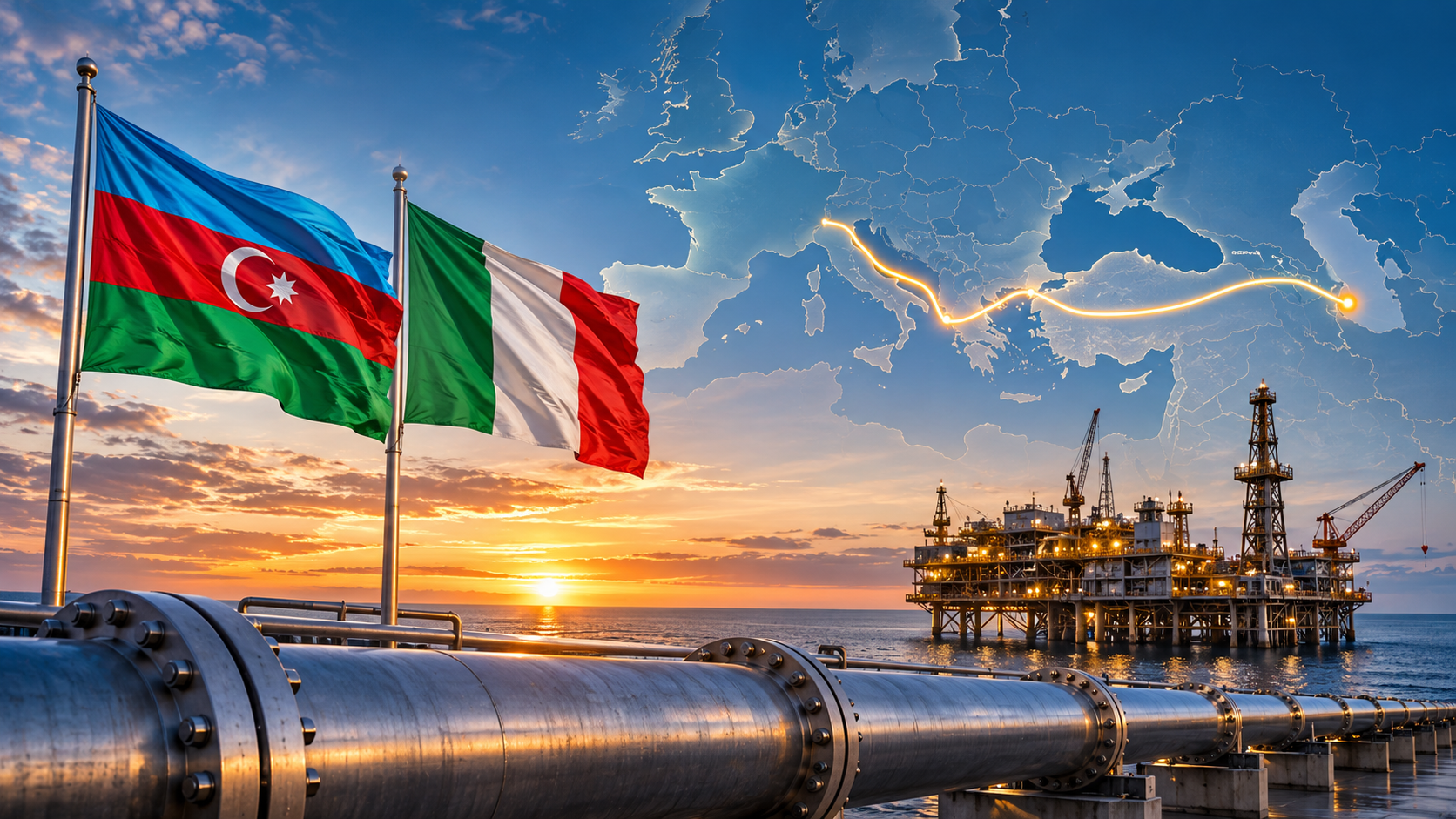
The pipeline he was talking about runs 877 kilometres from the Greek and Turkish border through Greece and Albania, under the Adriatic, and comes ashore in southern Italy. It carries gas from the Shah Deniz field and forms the European leg of the Southern Gas Corridor. Commercial operations began in late 2020 with a capacity of 10 billion cubic metres a year, and the system was designed from the start to double that figure. TAP's shareholders include bp, SOCAR, Snam, Fluxys, Enagas and Axpo, which means an Italian grid operator and an Azerbaijani state company sit in the same boardroom.
The economic dimension of this partnership is becoming increasingly observable. Kamal Abbasov, Azerbaijan's deputy energy minister, told the forum that supplies to Italy through TAP have passed 51 billion cubic metres since 2020. He also widened the picture. SOCAR's work with Italian companies covers natural gas, crude oil of various origins, refined products, liquefied natural gas and petrochemicals, which is a portfolio rather than a single export line.
The two companies have also started operating together outside their home region. In September 2026 SOCAR bought a 10 percent stake in the Baleine oil and gas project in Cote d'Ivoire alongside Eni, which itself holds 5 percent of the Baku-Tbilisi-Ceyhan pipeline. The more consequential step came in May 2026, when SOCAR closed the purchase of 99.82 percent of Italiana Petroli. That company runs two refineries with combined capacity of roughly 10 million tonnes a year, a nationwide storage and logistics network and more than 4,600 filling stations. Italian press put the price at around 3 billion euros.
The strategic importance of this partnership becomes even clearer when viewed against the current situation in Europe. The continent is entering the 2026-2027 winter season with unusually low gas storage levels, while geopolitical tensions in the Middle East have placed additional pressure on international energy supplies. Disruptions to LNG shipments through the Strait of Hormuz have tightened the global market, particularly following the interruption of Qatari exports. Storage levels are well below seasonal norms, and the cold start to November has already forced utilities to draw down what is left. According to Bloomberg, benchmark European gas futures jumped 8.6 percent to 96.075 euros per megawatt hour on expectations of a sharp cold snap and further disruption.
A market like that does not negotiate patiently. Half of Azerbaijan's gas exports now go to Europe, and EU leaders describe the country as a reliable partner in gas supply. Italy, Greece, Bulgaria, Hungary, Romania, Serbia, North Macedonia, Slovakia, Slovenia and Croatia all buy Azerbaijani gas. The 2022 agreement with Brussels set a target of 20 billion cubic metres a year by 2027, a figure that only makes sense if TAP's second phase is built on schedule.
President Ilham Aliyev has repeatedly emphasised the importance of expanding gas transportation infrastructure. Speaking at a roundtable entitled "Building a Competitive Europe – Innovation, Connectivity and Affordable Energy" during the ninth European Political Community Summit in Dublin on November 12, he highlighted the need to increase the capacity of the pipeline system connecting Azerbaijan with European markets. He also pointed to the country's plans to increase gas production through the development of new fields.
For Europe, the significance of Azerbaijani gas extends beyond the volumes currently delivered. In an increasingly competitive global market, where Asian and European buyers compete for available LNG cargoes, pipeline supplies from the Caspian region provide an additional source of diversification. They also reduce dependence on a limited number of maritime routes that can be exposed to geopolitical disruptions.
At the same time, Azerbaijan and Italy are clearly seeking to build a partnership that goes beyond traditional hydrocarbons. The discussions during Tajani's visit and the Azerbaijan-Italy Business Forum have also focused on industrial cooperation, infrastructure, renewable energy, advanced technologies and critical raw materials. More than 240 representatives of companies and business associations are participating in the forum, demonstrating the scale of commercial interest in expanding bilateral relations.
Azerbaijan is seeking to turn its resource potential and existing infrastructure into a stronger long-term economic position. The expansion of TAP, the development of new gas fields and the growing involvement of SOCAR in Italy's energy industry could give this partnership a new dimension. Thus, Tajani's visit to Baku has therefore highlighted more than the strength of existing bilateral ties. As Europe faces another period of uncertainty in its gas market, Azerbaijan's importance as an energy partner to remain a significant part of the deliberation.
Here we are to serve you with news right now. It does not cost much, but worth your attention.
Choose to support open, independent, quality journalism and subscribe on a monthly basis.
By subscribing to our online newspaper, you can have full digital access to all news, analysis, and much more.
You can also follow AzerNEWS on Twitter @AzerNewsAz or Facebook @AzerNewsNewspaper
Thank you!