
How Europe's critical minerals race creates new opportunity for Azerbaijan and Italy?

Qabil Ashirov
Read moreItaly's interest in developing joint critical raw materials projects with Azerbaijan, including ventures in third countries, points to a potentially important change in the economic relationship between the two countries. What has traditionally been built around oil, natural gas and energy infrastructure could expand into mining, metallurgy, industrial technology and the supply chains that will determine Europe's future competitiveness.
The proposal put forward by Italian Deputy Prime Minister and Foreign Minister Antonio Tajani in an interview with Trend is significant not simply because of the minerals involved, but because of the geographical and industrial ambitions behind it. Rome is looking beyond Azerbaijan's domestic resource base towards opportunities across Central Asia, where mineral deposits could be developed with Italian technological expertise and Azerbaijani transport infrastructure providing a connection to European markets.
First, this is more than an opportunity for Baku, especially for moving further up the industrial value chain. Azerbaijan could become a platform connecting mineral extraction, processing, investment and distribution across a much wider geographical area rather than remaining primarily a supplier of hydrocarbons and a transit country for regional trade.
As regards Italy, there are compelling economic reasons for the country to pursue this direction. Europe's industrial model is undergoing a transformation as governments and companies invest in electric mobility, renewable energy, digital infrastructure and defence production. These sectors require increasingly reliable access to copper, nickel, graphite, lithium and rare earth elements. Competition for such resources is no longer exclusively a commercial matter: it has become an issue of industrial security and geopolitical influence.
The European Union's Critical Raw Materials Act reflects this shift. Its 2030 objectives include meeting 10 per cent of annual consumption through domestic extraction, 40 per cent through processing within the EU and 25 per cent through recycling. It also seeks to ensure that no more than 65 per cent of the Union's annual consumption of any strategic raw material at a relevant processing stage comes from a single third country. The targets underline the extent to which Brussels wants to diversify supply chains and reduce exposure to external disruptions.
Italy, with its substantial manufacturing base, has a direct commercial interest in this strategy. Its automotive, machinery, metallurgy, electronics and defence industries need predictable supplies of industrial inputs. Establishing partnerships with resource-producing countries can therefore help Italian companies secure materials while creating export opportunities for their own engineering, processing and industrial technology businesses.
Azerbaijan offers Rome a particularly interesting partner because its geographical advantages extend beyond its own mineral resources. Its position on the western shore of the Caspian Sea provides access to Central Asian markets, while its established transport links and growing logistics capacity offer an alternative connection between resource-producing economies and European industrial centres.
This is where Tajani's reference to joint projects in third countries becomes particularly important. The proposal could transform the relationship from a conventional bilateral arrangement into a regional industrial partnership. Central Asian countries could provide mineral resources, Italian companies could contribute engineering and processing technologies, and Azerbaijan could facilitate transportation, energy supply and access to international markets.
Such an arrangement would also give the Middle Corridor a more sophisticated economic role. The route is increasingly discussed as an alternative Eurasian trade connection linking China and Central Asia with Europe through the Caspian Sea and the South Caucasus. However, its long-term commercial value will depend on more than the volume of containers and general cargo transported across the region. The development of industrial supply chains, including the movement of raw materials and processed metals, could generate additional demand for railways, ports, storage facilities and logistics services.
Moreover, the financial foundations for this ambition are already substantial, as bilateral trade between Azerbaijan and Italy approached €8bn in 2025, making Italy Azerbaijan's leading export destination. Italian exports to Azerbaijan amounted to approximately €432mn that year and increased by more than 14 per cent in 2026, according to Tajani. These figures demonstrate that the relationship is not confined to diplomatic engagement or energy cooperation. There is an established commercial market in which Italian companies already have a significant presence.
Investment is another indication of how the partnership is evolving. For instance, SOCAR's acquisition of a 99.82 per cent stake in Italy's Italiana Petroli is particularly noteworthy. The transaction represents more than an expansion of Azerbaijan's overseas energy portfolio. It gives an Azerbaijani state-owned company a substantial position in Italy's downstream petroleum market, including fuel distribution and related industrial activities. It also demonstrates that economic cooperation is increasingly moving in both directions, with Azerbaijani capital becoming an important component of the relationship.
Besides, it is worth noting that the broader investment figures reinforce this trend. Let's take a look at Azerbaijani direct investment in Italy, which has reached $3.2456bn in the first half of 2026, a dramatic increase compared with the corresponding earlier period. And of course, this growing financial presence provides a stronger basis for discussing projects beyond traditional energy trade, particularly in industrial production, technology and strategic infrastructure.
However, the most important question for Azerbaijan is how much economic value the country can retain from the proposed cooperation. Exporting unprocessed minerals or providing transit services would offer commercial benefits, but developing processing and manufacturing capabilities would create a considerably wider economic impact.
Mineral processing requires specialised technology, reliable electricity, industrial infrastructure and qualified personnel. Italian expertise in engineering, metallurgy, automation and industrial equipment could help address some of these requirements. Cooperation could also extend to recycling and resource efficiency, areas in which European environmental standards are becoming increasingly important.
Azerbaijan's Alat Free Economic Zone could provide an additional incentive for investors considering regional manufacturing and processing operations. Its customs and tax arrangements, together with the country's transport connections, could help companies establish production facilities serving markets beyond Azerbaijan. The potential combination of industrial investment and access to Central Asian resources would make such projects more attractive than a narrow arrangement based solely on importing and exporting raw materials.
There are, nevertheless, substantial commercial obstacles. Mining projects involve considerable upfront expenditure, geological uncertainty and investment horizons that can extend over many years. Central Asian mineral deposits are not automatically commercially viable, and their development requires detailed exploration, transparent licensing arrangements and long-term financing. Processing facilities, meanwhile, need competitive energy prices, dependable transport links and guaranteed demand from industrial buyers.
Environmental requirements will also matter. European manufacturers increasingly need to demonstrate the origin and sustainability of the materials entering their supply chains. Any partnership seeking access to European markets will therefore have to meet increasingly demanding standards for environmental protection, traceability and responsible production.
These considerations make the involvement of established Italian industrial companies and financial institutions particularly important. Political agreements can establish a framework for cooperation, but commercial investment will depend on clearly identified deposits, bankable feasibility studies, predictable regulations and contracts that distribute risks and returns between partners.
Ultimately, Italy's initiative is significant because it brings together three complementary economic interests. Central Asia has mineral resources that European industries increasingly need; Italy possesses industrial technology, engineering capabilities and access to European manufacturing networks; Azerbaijan offers the geographical position, energy infrastructure and transport connections required to bring these elements together.
The partnership's potential should therefore be measured not simply by the value of future mineral exports or the volume of bilateral trade, but by the investments it generates in processing, manufacturing and regional infrastructure.
Azerbaijan has already established itself as an important energy supplier to Italy and the wider European market. The next challenge is to translate that position into a broader industrial role. If the proposed critical raw materials projects progress from diplomatic discussions to commercially viable investments, the relationship could develop into something considerably more ambitious than an extension of the existing energy partnership: a new economic connection between European industry and the resource potential of Central Asia.
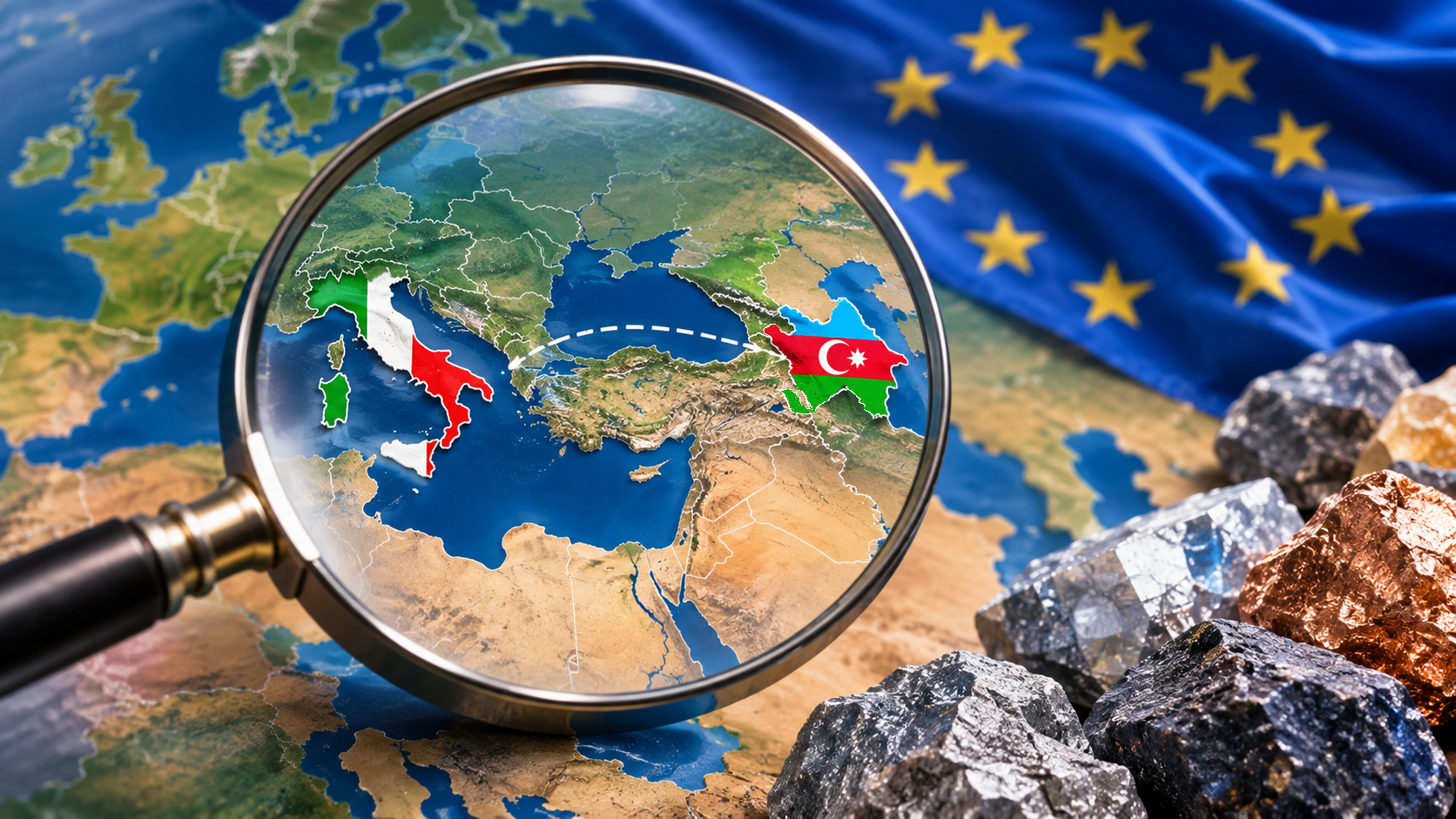
*AI-generated picture
Here we are to serve you with news right now. It does not cost much, but worth your attention.
Choose to support open, independent, quality journalism and subscribe on a monthly basis.
By subscribing to our online newspaper, you can have full digital access to all news, analysis, and much more.
You can also follow AzerNEWS on Twitter @AzerNewsAz or Facebook @AzerNewsNewspaper
Thank you!