
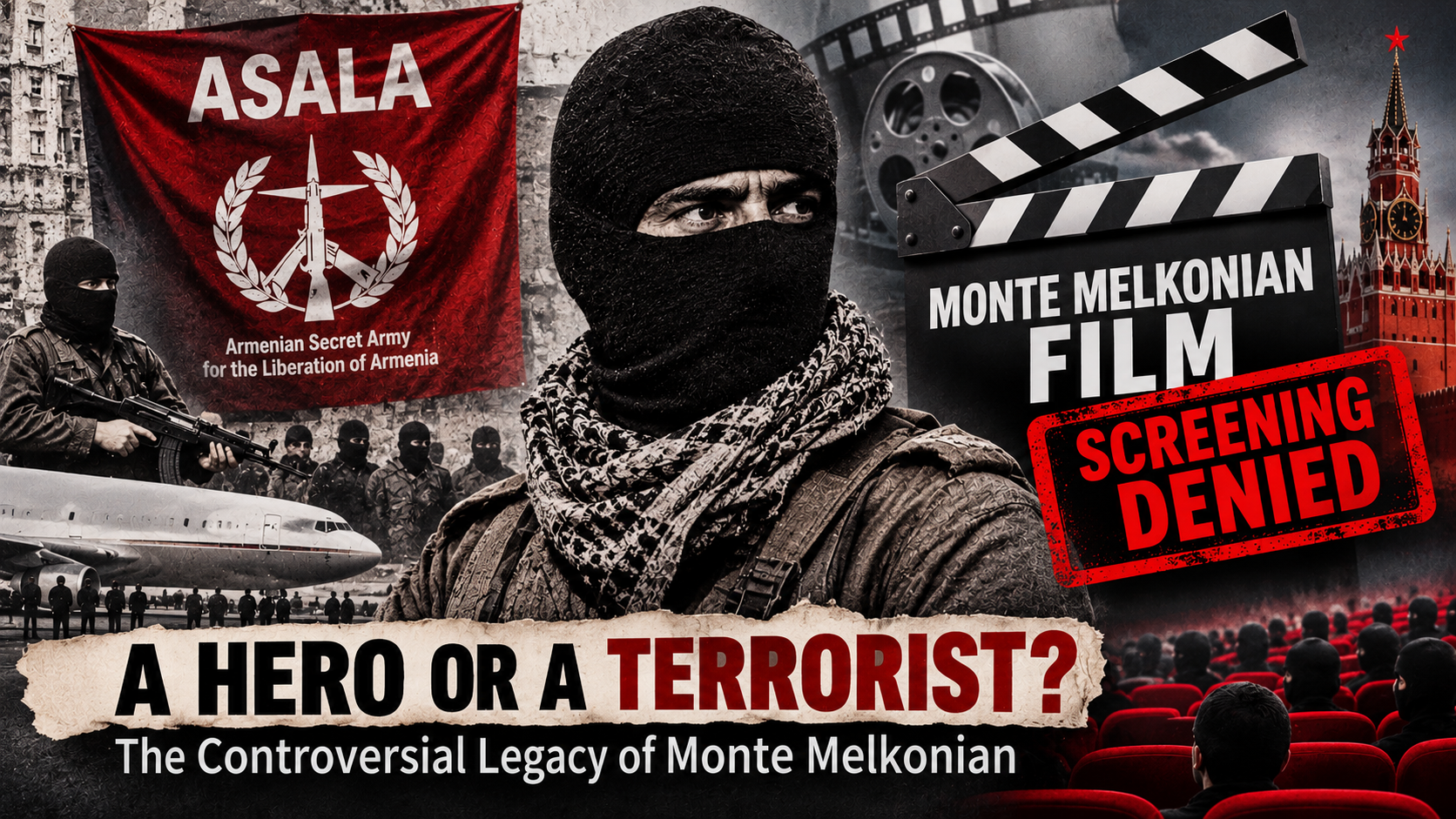
Film about Monte Melkonian sparks controversy over his ASALA terrorist past
Qabil Ashirov
Read moreThe controversy surrounding a film about Monte Melkonian raises a question that extends far beyond cinema: how does a country reconcile its efforts to present a terrorist as a national hero with the historical record of his involvement in an organisation associated with international terrorism? Reports that the film's screening was prevented in Russia have brought renewed attention to a figure whose legacy remains deeply contentious, particularly in Azerbaijan, Turkiye and parts of Europe.
Melkonian occupies an unusual position in modern Armenian political mythology. Celebrated in Armenia as a military commander who fought in the former Karabakh conflict, he is remembered by the Caucasians as a terrorist who arrived in the region and took part in armed operations against Azerbaijan. However, his political and military biography began long before the collapse of the Soviet Union and the outbreak of the former Karabakh conflict. His association with the Armenian Secret Army for the Liberation of Armenia (ASALA) connects his legacy to a much broader history of political violence.
Founded in 1975 in Beirut, ASALA emerged as an underground militant organisation seeking to force Turkiye to recognise “the Armenian genocide” and pursue territorial demands. Under its founder and principal leader, Hagop Hagopian, the organisation conducted a campaign of attacks against Turkish diplomats and diplomatic facilities, particularly during the late 1970s and early 1980s. Its activities, however, eventually extended beyond Turkish targets, exposing the international dimension of its operations and undermining claims that its violence was confined to a bilateral historical dispute.
Melkonian joined ASALA in 1980 and became one of its prominent members. Following internal disagreements in 1983, Melkonian separated from Hagopian's faction and established the ASALA-Revolutionary Movement. So, here, some nuances need to be distinguished, as the history of the organisation was considerably more complicated than the simplified narratives frequently presented in political discussions.
Israel's 1982 invasion of Lebanon significantly changed the security environment in which ASALA operated. Although the Palestine Liberation Organisation was the principal target of Israel's military campaign, the intervention also disrupted the positions and operational networks of other militant organisations, including ASALA. The subsequent weakening of its presence in Lebanon added to the pressures that contributed to the organisation's fragmentation.
One of the most consequential episodes in ASALA's history was the July 15, 1983, attack at Paris-Orly Airport. The bombing killed eight people and injured more than 50. The incident demonstrated that the organisation's activities could endanger civilians far beyond the geographical boundaries of its original confrontation with Turkiye.
France itself became an important part of this history. Melkonian was arrested in Paris in November 1985 and sentenced in December 1986 to six years in prison. He was subsequently released and deported from France in February 1989. His case illustrates an uncomfortable historical contradiction.
The collapse of the Soviet Union opened another chapter in Melkonian's biography. He eventually travelled to Karabakh, where he became involved in military aggression against Azerbaijani forces. He was killed in June 1993 during fighting near the village of Merzili in the Agdam region.
Melkonian's death marked the end of the military career of one of the most prominent Armenian militants involved in the Karabakh conflict. It also came during the final years of ASALA's existence as an organised militant movement. Despite years of counterterrorism efforts and security pressure from countries including Israel, Turkiye and France, ASALA had never been completely eliminated by any of them. Its organisational structure had already suffered severe fragmentation, particularly following the divisions of the 1980s. Azerbaijan, however, dealt a decisive blow to the armed activities of Melkonian and his forces in Karabakh. The distinction is important: while Azerbaijan did not single-handedly dismantle the original ASALA, its military resistance brought Melkonian's campaign against Azerbaijan to an end.
This process raises a broader question about the relationship between national memory and political responsibility. Countries routinely commemorate military figures whose histories remain controversial. However, celebrating an individual while excluding inconvenient chapters of his biography creates a selective historical narrative. Melkonian's involvement with ASALA cannot simply disappear because his subsequent activities took place in Karabakh.
The wider history of Armenian militant nationalism also contains episodes that deserve serious examination. The January 1977 Moscow bombings, which killed seven people and injured dozens, resulted in the conviction and execution of three individuals by Soviet authorities. The case remains controversial because of questions surrounding the investigation and the closed nature of the trial. Nevertheless, it represents an important episode in the history of political violence in the late Soviet period. Historical analysis should distinguish documented judicial findings from broader political allegations, particularly when discussing responsibility for other attacks in the Caucasus.
The killing of Russian official Vitaly Polyanichko in North Ossetia in August 1993 provides another example of the region's violent political environment. Polyanichko, Major General Anatoly Koretsky and Alfa special forces officer Viktor Kravchuk were killed in an armed attack. Although the incident occurred against the background of the Karabakh conflict and regional instability, responsibility should not be attributed to a particular organisation or ethnic group without reliable evidence.
For Azerbaijan, however, Melkonian's legacy is inseparable from the military confrontation of the early 1990s. Melkonian was an Armenian militant and a former ASALA operative who became one of the most prominent foreign commanders fighting against Azerbaijan during the Karabakh war. His participation in armed operations against Azerbaijani forces turned him into a symbol of the military confrontation, but it also cemented his controversial legacy as a terrorist with a history that extended far beyond the battlefield in Karabakh. His subsequent glorification in Armenia reinforced the perception that the country was elevating a militant with an international record of armed activity into a national symbol.
Ultimately, the question is not whether Armenia has the right to commemorate its historical figures. Every country constructs its own national narratives. The question is whether those narratives can withstand examination against the available historical evidence.
Monte Melkonian's biography contains several distinct chapters: international terrorism, imprisonment in France, organisational divisions within ASALA and participation in the Karabakh war. Treating only the final chapter as relevant produces an incomplete historical picture.
A country seeking international credibility cannot expect the rest of the world to accept a selective interpretation of its past. Historical figures may become national symbols, but commemoration does not erase documented actions, judicial records or the experiences of those who suffered from political violence. In Melkonian's case, the debate is therefore about much more than a film. It is about whether historical memory should serve political convenience or withstand the scrutiny of history.
Here we are to serve you with news right now. It does not cost much, but worth your attention.
Choose to support open, independent, quality journalism and subscribe on a monthly basis.
By subscribing to our online newspaper, you can have full digital access to all news, analysis, and much more.
You can also follow AzerNEWS on Twitter @AzerNewsAz or Facebook @AzerNewsNewspaper
Thank you!