
Nakhchivan gets ready for a corridor that could change its fortunes

Akbar Novruz
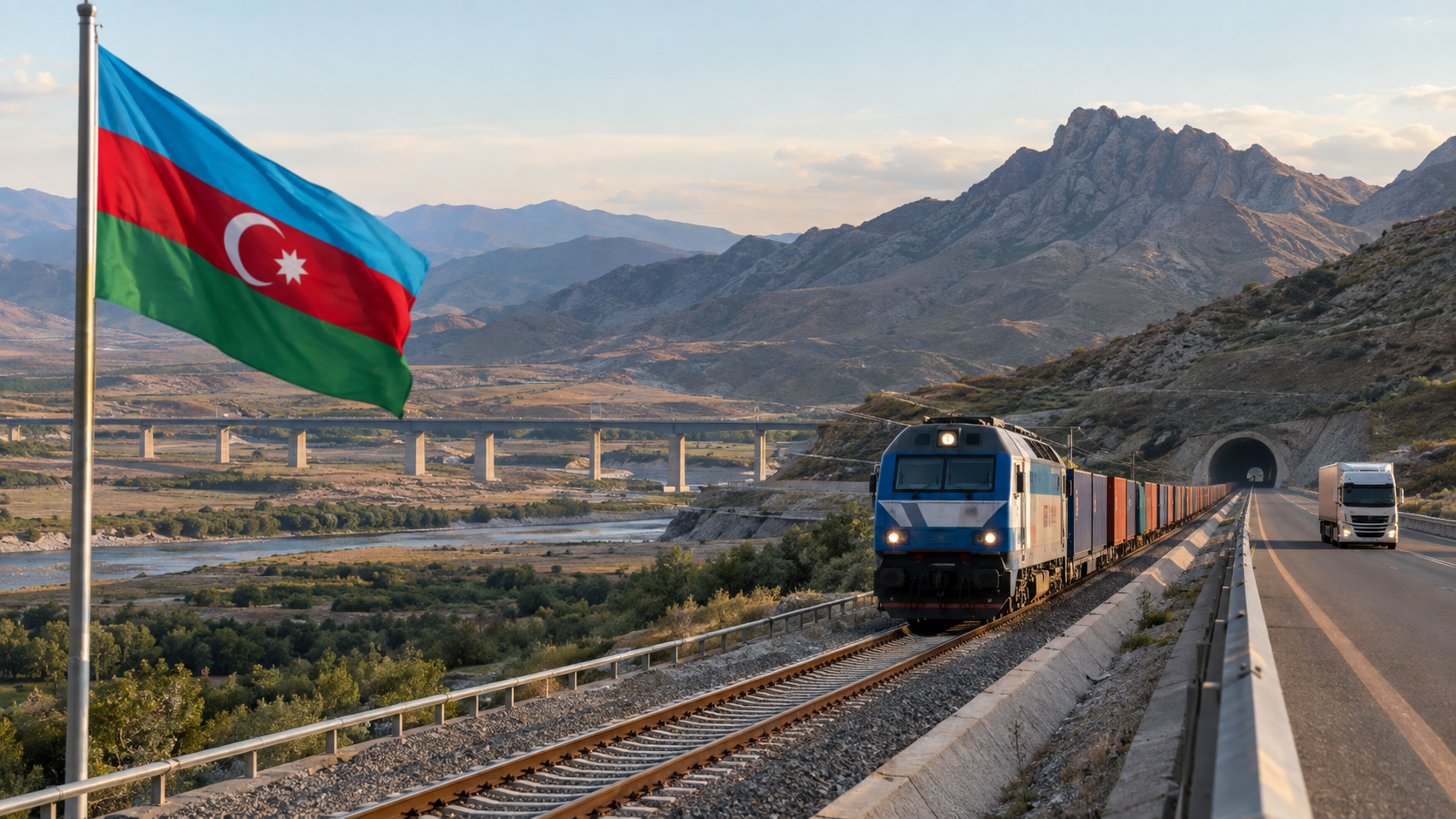
Read moreNakhchivan has long been a geographical enigma of sorts: an enclave of Azerbaijan inhabited by about 460,000 people, cut off from the rest of Azerbaijan by territory controlled by Armenia and accessible only by land through Iran or Türkiye. Until recently, that geography has made the place a liability rather than an asset for Azerbaijan, which has been treating the area as such. However, a new amendment to the socio-economic development program of Nakhchivan for the years 2023-2027 seems to indicate a change in that mentality. The document is based on the premise that a much-needed piece of infrastructure is going to come online soon - a Zangezur corridor [TRIPP] connecting Nakhchivan with Azerbaijan through the southern Armenian province of Syunik.
The revised plan is light on numericals but heavy on intent, which itself reveals much. These include "targeted logistical support systems" for exporters, undefined tax and freight discounts that will "stimulate the comprehensive usage" of the corridor, and an enhanced entrepreneurial program when the route is open for business. Governments generally don't revise five-year economic plans around infrastructure that exists only in theory. This decree should be understood as the Azerbaijani government gearing up to act quickly once the politics of the corridor – mainly the conflicting views on transit control rights held by Yerevan and Moscow through Syunik are sorted out.
Numbers behind the ambition
Nakhchivan's economy has traditionally operated based on budget transfers rather than exports. In 2023, the overall economic output in the autonomous republic amounted to 1.55bn manats ($910m), where the share of industry amounted to 593.9 mln manats ($349 mln), while the agriculture sector produced 358.4 mln manats ($210 mln). However, there was a dramatic turn of events: between 2023 and 2025, Nakhchivan's GDP increased by 7.6%, industrial production – by 4.6%, and, interestingly, transport and warehousing increased their operations by 25.7%, having already outperformed all other sectors in growth before the corridor was even completed. Investments in fixed assets have increased 2.5 times in this timeframe, while construction and installation works have more than doubled. The development of entrepreneurial lending took the same path: from 2023, 342 projects were supported by the region's Entrepreneurship Development Fund, amounting to 27.2 mln manats ($15.2 mln) of concessional loans, 77% of which were registered in 2025 and the first half of 2026.
As far as the actual infrastructure goes, however, the numbers are, predictably for an initiative of three countries, disputed. Azerbaijan's very own approach roads have already neared completion: the 123.6km-long Horadiz–Jabrayil–Zangilan–Aghband road, comprising three tunnels amounting to 12km in total length, was claimed to be 95% finished by September 2025, with the rest of the works expected to be completed during the second half of 2026. The rail network in Azerbaijan consists of a 110km-long Horadiz–Aghband track capable of transporting up to 15 mln. tonnes of cargo and 5.5 mln. passengers per year once operational. Türkiye has started the construction of a 224km Kars–Iğdır–Aralık–Dilucu railway line, which is to be a four-year project, whereas about 180km of tracks will need repairs or construction in Nakhchivan. The true bottleneck – the stretch going through sovereign Armenian territory – is the only part of the initiative on which estimates range wildly from 26km to 43.5km depending on the particular government official, and on which construction has yet to begin even in late 2026, according to Türkiye's own transport minister.
It is a lesson that one suspects is learned through experience of other corridors, which did not measure up to expectations in terms of throughput because of the lack of locally produced goods to feed into them. A trans-Caspian transport corridor is only as good as the goods that transit through it, and any government that would like its corridor to be taken seriously would want to load it up with guaranteed cargo from within its borders – in this case, the produce from Nakhchivan – before relying on Eurasian cargo controlled by actors in Beijing, Ankara, or Brussels. Geography in that sense completes the argument for Baku. Nakhchivan already shares an 11-kilometre-long border with Türkiye, and investments by Türkiye into the exclave – whether in the form of joint universities or energy connections between the countries – have increased consistently over the past decade. So the region is structurally positioned to evolve into a Preferential Trade Area (PTA) or a specialized industrial border zone acting as a bridge between the Turkish and Azerbaijani economies.
If the Zangezur Corridor is built successfully, products from Nakhchivan could be as easily transported to the rest of Azerbaijan as to the east of Türkiye, effectively making producers in Nakhchivan available to two market routes instead of one. While nothing in the decree commits Azerbaijan to such a move, it is easy to foresee a time when Baku could institutionalize such a policy as a preferential trade zone along the Nakhchivan-Türkiye border, similar to free zones used in China’s Belt and Road project in order to attract manufacturing investment to a transit choke point.
Geopolitical dividend
Now that Azerbaijan's budget itself has been diverting hydrocarbon profits towards those regions with little output of anything else, including Nakhchivan, the wider narrative of macroeconomics is on the go past this particular exclave. This strategy of moving away from simple budget subsidies to building out access through better logistical services, cheaper freight transportation, more efficient border control, and lower taxes is in many ways a more sustainable one than simply topping up an already existing budget entry each year. However, for it to work, there needs to be something to be done with all those facilities built: if there is no productive potential, then there are no incentives for it; this can be seen by how many special economic zones set up in post-Soviet countries turned into empty shells precisely because there was nothing to do there. The agricultural sector of Nakhchivan, while present, does not have much potential, and that is why the success of this order depends not so much on what incentives it contains but on whether Baku makes investments into real productive capacities.
The most intangible yet probably the most significant impact of this project is one that is strategic, rather than economic in nature. The fact that an exclave, which has an operational overland link to the rest of its own country, cannot be isolated, pressured or bargained with is not lost on Baku, considering its experiences of being under blockade and its dependency on Iran and Türkiye for sustaining itself. Creating several ways of delivering goods into the area as well as exporting goods from there, in this context, is not only an economic development strategy but also an insurance against any future turbulence in the region. It may still take some time until the corridor becomes operational on the schedule as expected by Baku, as this question is at the moment in the hands of Yerevan and Moscow, as much as in Azerbaijan.
Here we are to serve you with news right now. It does not cost much, but worth your attention.
Choose to support open, independent, quality journalism and subscribe on a monthly basis.
By subscribing to our online newspaper, you can have full digital access to all news, analysis, and much more.
You can also follow AzerNEWS on Twitter @AzerNewsAz or Facebook @AzerNewsNewspaper
Thank you!