
Azerbaijan wants more than transit as Middle Corridor expands [COMMENTARY]
![Azerbaijan wants more than transit as Middle Corridor expands [COMMENTARY]](https://www.azernews.az/media/2026/09/09/24578246724_1.jpg)

Ulviyya Poladova
Read moreThe V International Black Sea-Caspian Transport Forum, titled "Corridors. Infrastructure. Investments," was held in Baku, bringing together experts and industry representatives to discuss the development of transport and logistics links across the region.
The forum featured several panel discussions focusing on major issues shaping regional connectivity, including "The Black Sea-Caspian Region on the New Map of Global Logistics: The Role of Azerbaijan, Corridors and Freight Flows," "The Middle Corridor: Resilience and Competitiveness," "The Architecture and Services of the Multimodal Route: Ports and Terminals, Digitalization and Insurance," and "Investment in the Region’s Transport and Logistics Infrastructure: Priorities, Instruments and Sources of Capital."
During the forum, experts shared their views on the development of regional transport routes and Azerbaijan’s growing role in the logistics network.
According to Orkhan Yolchuyev, Director and Co-Founder of the Baku-based CASPIA Center, Azerbaijan has emerged as a key hub in the evolving Black Sea-Caspian transport architecture. He noted that several major transport corridors and routes intersect in the region, including the North-South Corridor and Black Sea routes, placing Azerbaijan at the center of the emerging logistics network.
Azerbaijan has already built important advantages through its railway and port infrastructure, as well as its wider transport and logistics capabilities.
It was also highlighted during the forum that Azerbaijan is connected to more than 33 countries through its transport network, with major routes linking the country to Georgia, Türkiye, Russia and European markets.
The development of railway infrastructure and the expansion of the Baku-Tbilisi-Kars railway are aimed at increasing the capacity of regional transport corridors. The Baku-Tbilisi-Kars railway currently has a capacity of around 30,000 tons annually and the line has already been expanded.
The maritime sector is also expected to play an increasingly important role. The Port of Baku currently has significant cargo-handling capacity, which is expected to grow further as infrastructure development continues. According to information presented at the forum, the port currently has an annual handling capacity of around 150,000 tons, with this figure expected to increase to approximately 260,000 tons next year.
At the same time, experts stressed that infrastructure alone will not be enough to ensure the long-term development of regional routes.
Coordination between the countries along the Middle Corridor has become essential for the route’s development, Aizhan Beiseyeva said. Head of CPCS Central Asia noted that the Trans-Caspian International Transport Route, also known as the Middle Corridor, has reached a stage where better coordination between the countries involved is necessary.
"In my view, we have already reached the point where both practitioners and experts agree that without coordination, the Middle Corridor cannot develop successfully," she added.
The Middle Corridor, or Trans-Caspian International Transport Route, connects Central Asia, the Caspian Sea, the South Caucasus, Türkiye and Europe. In recent years, it has become one of the fastest-growing routes for trade between East and West. For Azerbaijan, the route is particularly important, as one of its central sections runs through Kazakhstan, the Caspian Sea, Azerbaijan and Georgia.
Interest in the Middle Corridor increased sharply after 2022, when many countries and companies began looking more actively for alternative and efficient routes between Asia and Europe. Between 2019 and 2021, around 0.6-0.8 million tons of cargo was transported along the route annually. By 2024, volumes had exceeded 4.5 million tons, highlighting the rapid growth of the Trans-Caspian route.
Azerbaijan, as a country that is at the center of this transport chain, has direct consequences for this growth.Cargo flows are increasingly passing through the country, where maritime, railway and logistics routes come together. Azerbaijan had already been preparing for this shift by investing in ports, railways, logistics facilities and international cooperation. According to forecasts by the OECD and EBRD, if key sections of the route are developed consistently, freight volumes could reach 10-11 million tons by 2030.
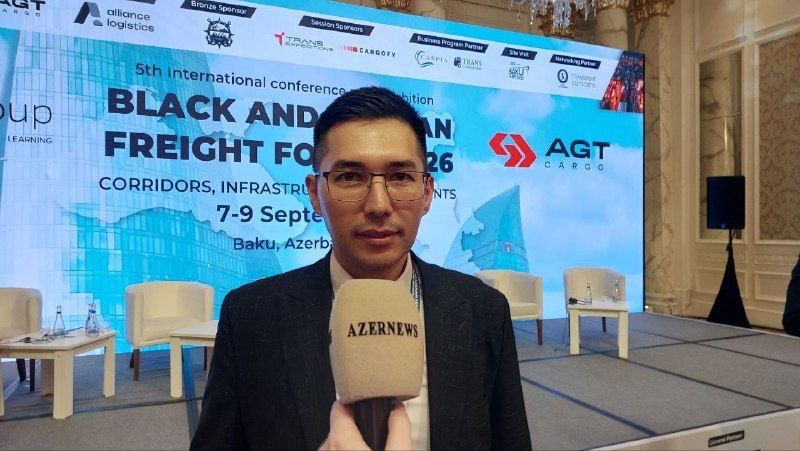
Dastan Ospanov, Commercial Director at TransConsulting, in a commentary for AzerNEWS said that Azerbaijan is playing a central role in shaping an integrated logistics chain connecting Central Asia, the South Caucasus and Europe.
"Azerbaijan is the heart of the Middle Corridor and sets the pace for the development of this route," Ospanov noted.
He emphasized that Azerbaijan needs to keep up with the rapid development of infrastructure in Kazakhstan and Turkmenistan to ensure the Middle Corridor continues to expand effectively.
Ospanov highlighted Azerbaijan’s strategic decisions in developing the route, including the Baku-Tbilisi-Kars railway, which was financed from Azerbaijan’s own funds.
He also noted Azerbaijan’s significant role in maritime transportation along the Middle Corridor, including its control and ownership of vessels operating between Kazakhstan and Azerbaijan.
"At the same time, Kazakhstan should not rely entirely on the Azerbaijani side. Its government and businesses should also contribute their own efforts to the development of the project," Ospanov said.
He emphasized that the Middle Corridor should not be viewed merely as a transit route connecting China and Europe, but also as an opportunity to expand export-import relations among the Organization of Turkic States (OTS). According to Ospanov, the corridor will be truly successful when goods from Azerbaijan and Türkiye become readily available on the shelves of Kazakhstan, while Kazakh products can likewise reach Azerbaijani markets.
Turning to Azerbaijan’s position as a logistics hub, Ospanov said the country already has all four major modes of transport: air, rail, maritime and road. He highlighted the establishment of the Alat Free Economic Zone and its attractive tax incentives for businesses as an important factor strengthening Azerbaijan’s position as a regional logistics center.
Ospanov expressed confidence that Baku will become a key hub within the Middle Corridor supply chains in the near future.
He also pointed to the further development of the North-South corridor and the planned development of the TRIPP route, saying that these projects would create additional opportunities for Baku and contribute to the emergence of a major multimodal logistics hub.
Here we are to serve you with news right now. It does not cost much, but worth your attention.
Choose to support open, independent, quality journalism and subscribe on a monthly basis.
By subscribing to our online newspaper, you can have full digital access to all news, analysis, and much more.
You can also follow AzerNEWS on Twitter @AzerNewsAz or Facebook @AzerNewsNewspaper
Thank you!