
Azerbaijan’s export structure is changing faster than ever

Qabil Ashirov
Read moreFor more than three decades, one of Azerbaijan's most important economic objectives has been reducing its dependence on hydrocarbons. Like many resource-rich nations, Azerbaijan has long exhibited the classic symptoms of the so-called "Dutch disease"—an economic phenomenon in which booming natural resource exports strengthen one sector while weakening the competitiveness of the rest of the economy. Diversifying both GDP and exports has therefore remained at the heart of the country's long-term economic strategy.
The scale of that dependence was difficult to ignore. For years, hydrocarbons accounted for roughly half of Azerbaijan's GDP and close to 90 percent of total exports. Such concentration made the country highly vulnerable to fluctuations in global commodity prices. Every sharp decline in oil prices translated into pressure on public finances, foreign exchange earnings, and economic growth. Building a more balanced export structure was therefore not merely an economic ambition but a strategic necessity.
To be fair, Azerbaijan has made substantial progress in developing its non-oil economy over the past three decades. The numbers tell an impressive story. In 1994, the country's total exports—including oil and gas—amounted to only around $300 million. By 2024, however, Azerbaijan's non-oil exports alone had reached approximately $3.3 billion. In other words, exports outside the energy sector expanded more than tenfold over thirty years. Few would dispute that this represents a significant achievement.
Yet the broader picture remained more complicated. While non-oil exports were growing steadily, hydrocarbon exports expanded even faster for much of that period. Massive investments in the Azeri-Chirag-Gunashli oil fields, followed later by the Southern Gas Corridor and the Shah Deniz gas project, generated export revenues on a scale that the non-oil sector simply could not match. As a result, despite impressive absolute growth, the relative weight of non-oil exports often remained disappointingly small. There were even years when crude oil alone accounted for well over 90 percent of Azerbaijan's export earnings.
The first meaningful shift became visible after 2020. Rather than relying overwhelmingly on crude oil, Azerbaijan's export basket gradually became more diversified within the energy sector itself. Natural gas exports increased rapidly as deliveries to European markets expanded following the completion of major pipeline infrastructure. Consequently, the export structure evolved into a more balanced composition: roughly 45-50 percent crude oil, around 40-45 percent natural gas, and approximately 10 percent non-oil products. Although hydrocarbons still dominated, Azerbaijan was no longer dependent on a single commodity.
The figures released for the first half of 2026, however, suggest that an even more significant transformation may now be underway.
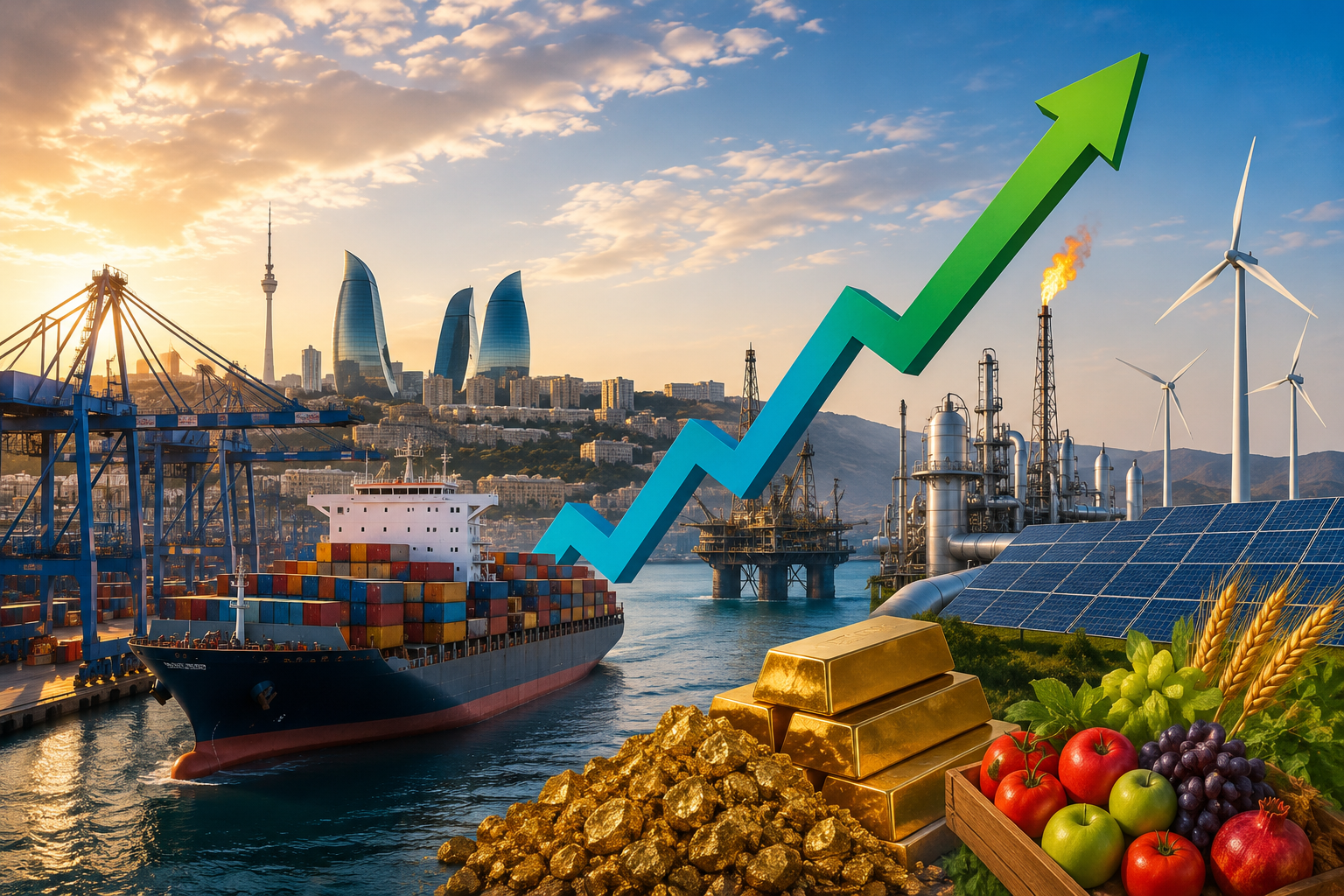
According to official trade statistics, oil and petroleum products accounted for only around 40-41 percent of total exports during the first six months of the year, while natural gas represented roughly 25 percent. Most remarkably, Azerbaijan's non-oil exports exceeded $5.5 billion during the same period—the first time in the country's history. Even more striking is the pace of growth. During the corresponding period of 2025, non-oil exports stood at approximately $1.8 billion. Within just one year, they have effectively tripled.
Naturally, such an extraordinary increase deserves closer examination before being interpreted as a permanent structural breakthrough.
The overwhelming driver behind this surge has been gold exports. According to official statistics, gold exports reached approximately $3.7 billion during the first half of 2026, accounting for roughly 22.5 percent of Azerbaijan's total non-hydrocarbon exports. Although customs data does not explicitly identify the destination of these shipments, the available trade statistics provide a compelling clue. The United Kingdom emerged as Azerbaijan's largest non-oil export market, importing approximately $3.45 billion worth of non-oil products during the first six months of the year.
Historically, Azerbaijan's principal non-oil export destinations have been neighboring markets such as Russia, Türkiye, Georgia, and, for precious metals, Switzerland. Britain's sudden emergence as the dominant destination strongly suggests that the overwhelming majority of these gold exports were shipped there, most likely to London, one of the world's leading centers for precious metals trading and refining.
Whether this represents a temporary statistical anomaly or the beginning of a lasting trade relationship remains an open question. Gold exports are inherently volatile and can fluctuate significantly depending on global prices, mining output, and international market conditions.
Nevertheless, dismissing these figures as a statistical curiosity would also be a mistake. Even if gold accounts for much of this year's spectacular increase, the broader trajectory remains encouraging. Azerbaijan has gradually expanded manufacturing, agriculture, food processing, chemicals, logistics, and other export-oriented industries over many years. The country's transport infrastructure, strategic location along the Middle Corridor, and growing integration into regional supply chains continue to strengthen the competitiveness of its non-energy economy.
Looking further ahead, another potentially transformative opportunity is beginning to emerge. Azerbaijan's ambitious renewable energy agenda, supported by major investments in solar and wind generation, aims not only to satisfy domestic demand but eventually to export green electricity to European markets through projects such as the Black Sea submarine cable. If these initiatives progress as planned, electricity could gradually become another significant export category alongside oil, gas, and precious metals.
No country escapes decades of resource dependence overnight. Yet the latest export statistics demonstrate that diversification is no longer merely a policy objective discussed in government strategies—it is becoming increasingly visible in the country's trade data. Whether driven by gold today or green electricity tomorrow, every percentage point gained by non-oil exports strengthens Azerbaijan's economic resilience and reduces its vulnerability to external commodity shocks.
Here we are to serve you with news right now. It does not cost much, but worth your attention.
Choose to support open, independent, quality journalism and subscribe on a monthly basis.
By subscribing to our online newspaper, you can have full digital access to all news, analysis, and much more.
You can also follow AzerNEWS on Twitter @AzerNewsAz or Facebook @AzerNewsNewspaper
Thank you!